Latest

UP Super TET 2026 Notification OUT

UP Super TET 2026 Notification

For thousands of B.Ed and D.El.Ed graduates across Uttar Pradesh, “Super TET” isn’t just an exam name it’s the exam that decides whether years of study finally turn into a government teaching job. And right now, with UPTET 2026 done and dusted, the entire teaching-aspirant community has shifted its focus to one question: when does the Super TET 2026 notification actually drop?

Let’s break down what’s confirmed, what’s expected, and what you should be doing while you wait.

First, What Exactly Is Super TET?

If you’re new to this exam ecosystem, here’s the simplest way to understand it: UPTET is the gate, Super TET is the job.

UPTET (Uttar Pradesh Teacher Eligibility Test) only certifies that you’re eligible to be considered for a teaching post it doesn’t get you hired. Super TET, conducted by the Uttar Pradesh Basic Education Board (UPBEB), is the actual recruitment-cum-selection exam for Assistant Teacher posts in primary and upper-primary government schools, and for Principal/Headmaster positions as well. You cannot even sit for Super TET unless you’ve already cleared UPTET or CTET. Think of it as the final competitive round where your merit rank not just a pass/fail tag decides whether you get appointed.

Has the Super TET 2026 Notification Been Released?

As of now, the official Super TET 2026 notification has not yet been released. What has happened is groundwork and it’s significant groundwork, not just rumors.

UPTET 2026 was conducted on July 2, 3, and 4, 2026, ending a nearly five-year gap since the last cycle in 2021. Since UPTET clearance is a mandatory prerequisite for Super TET, most exam trackers and coaching institutes expect the Super TET 2026 notification to follow once the UPTET result is officially declared likely in the weeks or months immediately after. The UP government has already signaled that a fresh round of Assistant Teacher recruitment is on the horizon, and the syllabus and exam structure appear to be more or less finalized, which is usually the last step before a notification goes public.

In short: nothing official yet, but every visible signal points toward this notification landing sometime after the UPTET result cycle wraps up.

Where Will the Notification Be Published?

Bookmark this now, not later: updeled.gov.in is the official portal maintained by the UP Basic Education department, and it’s where the Super TET notification, application link, admit card, and result will all eventually appear. Treat any other website, YouTube video, or forwarded message as secondary useful for quick updates, but never a substitute for checking the source directly.

Who’s Eligible to Apply?

This is where a lot of candidates trip up Super TET eligibility isn’t just about a degree; it’s a layered checklist.

  • For Primary level (Classes 1–5): Senior Secondary (Class 12) + a two-year Diploma in Elementary Education (D.El.Ed) + UPTET Paper I qualified
  • For Upper Primary level (Classes 6–8): Graduation + B.Ed degree + UPTET Paper II qualified
  • Age limit: Typically 21 to 40 years for general category candidates
  • Age relaxation: Around 5 years for SC/ST/OBC candidates, and up to 15 years for candidates with disabilities
  • Domicile: UP domicile is generally required for appointment to UP government schools, even though the exam itself may be open more broadly

One detail candidates often overlook: there’s usually no cap on the number of attempts you can keep appearing for Super TET as long as you’re within the maximum age limit. That’s genuinely good news if this isn’t your first attempt.

What Does the Exam Actually Look Like?

Super TET is conducted offline in objective (MCQ) format, and while the exact paper structure for 2026 will be confirmed only in the official notification, previous cycles followed a fairly consistent pattern: a single 150-mark paper covering areas like Child Development & Pedagogy, Hindi, Mathematics, Environmental Studies, and General Awareness for Assistant Teacher posts, with a separate structure for Principal/Headmaster candidates that also factors in teaching experience.

Qualifying marks in recent cycles have hovered around 40% (60/150) for General category and 33% (49.5/150) for SC/ST/OBC-NCL/PwD candidates. But here’s the catch that trips up a lot of first-timers: since Super TET is a recruitment exam and not just an eligibility test, clearing the minimum qualifying mark doesn’t guarantee a job. The real competition happens at the merit-list stage, where cut-offs in past cycles have climbed well above 90–130 marks out of 150, depending on category and how many vacancies are notified. Passing the exam and making the merit list are two very different targets prepare for the second one, not just the first.

How Many Vacancies Are Expected?

Vacancy numbers are still speculative until the official notification lands, and you’ll see wildly different figures floating around some trackers mention numbers in the tens of thousands, and social media chatter has thrown around even higher figures tied to a broader teacher recruitment push. Rather than anchoring your expectations to any single number right now, treat vacancy count as one of the details that will only be trustworthy once it’s printed in the actual notification PDF.

What’s the Pay Like, Once You’re In?

This is often the part candidates skip past in the excitement of exam prep, but it matters for long-term planning. Assistant Teacher posts under Super TET are generally placed at 7th Pay Commission Level 6, with a pay scale in the range of roughly ₹35,400 to ₹1,12,400, plus applicable Dearness Allowance, House Rent Allowance, and Transport Allowance. In practical terms, that typically translates to an in-hand starting salary in the ₹40,000–₹45,000 range in major UP cities, with realistic growth toward ₹60,000+ over 5–10 years through annual increments. It’s a stable, pensionable government post which is exactly why competition for every seat is so intense.

What Should You Be Doing While You Wait?

Waiting for a notification doesn’t mean waiting to prepare. Here’s a practical checklist:

  1. Keep your UPTET result and documents organized scorecard, degree certificates, category certificate, and domicile proof should all be ready to upload the moment the application window opens.
  2. Start the syllabus early, especially Child Development & Pedagogy and Environmental Studies, since these sections tend to separate qualifiers from merit-listers.
  3. Take timed mock tests regularly rather than only reading theory Super TET rewards speed and accuracy under pressure, not just knowledge.
  4. Track the official portal weekly, not daily obsessively updeled.gov.in updates aren’t hourly events, so save your energy for prep instead of refreshing a tab all day.
  5. Follow one or two reliable sources for updates instead of ten conflicting ones it reduces the noise and the anxiety that comes with rumor-chasing.

The Bottom Line

The Super TET 2026 notification hasn’t arrived yet, but every sign the UPTET exam having just concluded, the syllabus groundwork already visible, and the government’s stated intent to fill Assistant Teacher vacancies points to it being a matter of when, not if. For now, the smartest move isn’t refreshing the portal every hour; it’s using this exact window to get your documents, your syllabus coverage, and your mock-test consistency in order, so that when the notification does land, you’re applying with confidence instead of scrambling.

Frequently Asked Questions

Q: Can I apply for Super TET without clearing UPTET?

No. Only candidates who have already qualified UPTET or CTET are eligible to appear for Super TET.

Q: Is Super TET conducted online or offline?

Super TET is conducted offline in objective, MCQ-based mode.

Q: Does clearing the Super TET qualifying marks guarantee a job?

No. Super TET is a recruitment exam, so final selection depends on your rank in the merit list, which is usually well above the minimum qualifying score.

Q: Is there a limit on the number of attempts for Super TET?

Generally, there’s no cap on attempts as long as you remain within the maximum age limit for your category.

UP Special TET 2026 Online Form Apply

UP Special TET 2026

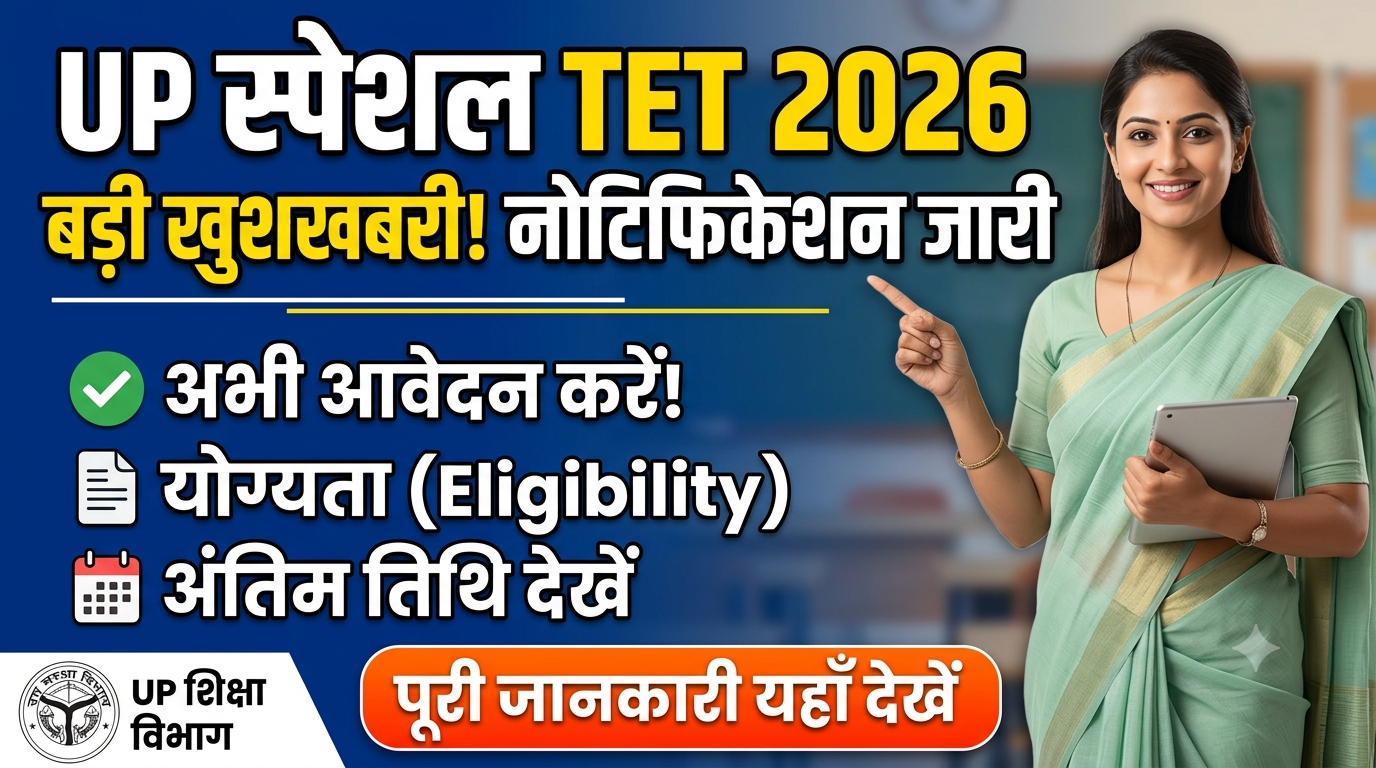
The Uttar Pradesh Education Service Selection Commission (UPESSC) has officially announced the recruitment for Uttar Pradesh Teacher Eligibility Test Special TET 2026. This is an excellent opportunity for aspiring teachers who want to build a career in the education sector of Uttar Pradesh. Candidates interested in applying for this examination should understand all the important details before submitting their applications.

The UP Special TET is a competitive examination designed to identify qualified and skilled teachers for positions in Uttar Pradesh schools. This examination assesses the teaching competency and subject knowledge of candidates. The recruitment process is transparent and follows all government regulations set by UPESSC.

Critical Dates for UP Special TET 2026

It is essential to keep track of important dates to ensure you don’t miss any deadline. Here are the key dates you need to remember:

  • Online Application Start Date: 05 September 2026
  • Online Application Last Date: 04 October 2026
  • Fee Payment Deadline: 04 October 2026
  • Form Correction Window: 08 October 2026
  • Examination Date: 03 November 2026
  • Admit Card Release: Will be issued before the examination date
  • Result Announcement: Will be updated on the official website

Candidates are advised to verify these dates with the official UPESSC website to ensure accuracy, as dates may be subject to change at the discretion of the commission.

Application Fee Structure

The application fee varies based on your category. the fee structure helps you prepare financially for the application process. Here’s the detailed breakdown:

  • For General, EWS, and OBC candidates, the application fee is ₹1000
  • SC and ST candidates need to pay ₹500 as application fee
  • Persons with Disabilities (PH) candidates are required to pay ₹300

The payment mode is entirely online and you can choose from multiple payment options including debit card, credit card, internet banking, IMPS, cash card, or mobile wallet for your convenience.

Age Eligibility Requirements

  • The age eligibility criteria for UP Special TET 2026 is as follows:
  • Minimum Age Requirement: Not Applicable (N/A)
  • Maximum Age Limit: 60 Years

UPESSC provides age relaxation for eligible candidates as per their official regulations. Age relaxation is granted to reserved category candidates and other eligible persons in accordance with government rules. It is recommended that candidates check the official notification for detailed age relaxation provisions applicable to their category.

Educational Qualifications and Eligibility Criteria

To appear for the UP Special TET, candidates must meet specific educational requirements based on the teacher level they are applying for. The eligibility criteria are strictly defined by UPESSC and must be fulfilled before submitting your application.

Position LevelEducational Requirements
Primary Teacher for Classes 1-5Bachelor’s degree from an NCTE-recognized institution with a minimum of 50% marks along with valid teacher training qualification such as BTC, B.El.Ed, or equivalent. Final-year candidates enrolled in these courses are also eligible to apply.
Upper Primary Teacher for Classes 6-8Bachelor’s degree with at least 50% marks (45% in certain cases as per rules) from an NCTE-recognized institution combined with valid teacher training qualification like B.Ed, BTC, B.El.Ed, or equivalent. Final-year candidates are eligible. Additionally, candidates with specialized education qualifications from RCI-recognized institutes and those with 50% marks in intermediate plus a 4-year integrated teaching program can apply.

How to Apply for UP Special TET Online Form 2026

The application process for UP Special TET is completely online. Here’s a step-by-step guide to help you apply successfully:

  • Visit the Official Portal: Go to the official UPESSC website (www.upessc.up.gov.in) to access the application form.
  • Register Yourself: Create a new account by providing your basic information and email address. Ensure you use a valid email address as this will be your communication channel.
  • Fill Application Details: Carefully enter all required information in the application form including personal details, educational qualifications, and category information. Double-check every field to avoid errors.
  • Upload Required Documents: Scan and upload all necessary documents in the specified format. Ensure the documents are clear and legible.
  • Pay Application Fee: Complete the online payment of your application fee using your preferred payment method.
  • Submit Form: Review all information one final time before clicking the submit button.
  • Print Confirmation: Save and print the confirmation receipt for future reference.

Important Note: Candidates are strongly advised to carefully read the official notification before filling their form. Ensure you meet all eligibility criteria regarding last date, age limit, and educational qualification before submitting your application.

Mode of Selection

The selection process for UP Special TET 2026 is based on written examination. Candidates will be required to appear for a written test that evaluates their knowledge and teaching aptitude. The examination pattern and syllabus are defined by UPESSC and are available on their official website.

Points to Remember Before Applying

Verify your educational qualifications match the eligibility criteria specified for your chosen position level.

Ensure your age falls within the stipulated limits or that you are eligible for age relaxation.

Keep all required documents ready in the specified digital format before starting the application.

Use a valid and active email address and mobile number for registration.

Complete your application well before the deadline to avoid technical issues.

Pay the correct application fee based on your category.

Save the application confirmation receipt for your records.

Review all entered information carefully to prevent errors that might cause rejection.

UPESSC and the Recruitment Process

The Uttar Pradesh Education Service Selection Commission is a constitutional body responsible for recruitment and selection of qualified individuals for educational positions in Uttar Pradesh. UPESSC conducts various examinations throughout the year to ensure that only qualified candidates are selected for teaching positions. The commission follows transparent procedures and adheres to government guidelines in all recruitment processes.

Why This Recruitment Matters

The UP Special TET 2026 is significant for candidates seeking a stable and respectable career in education. Teaching positions in government schools come with benefits including job security, pension schemes, and career advancement opportunities. This recruitment represents a golden opportunity for qualified candidates to contribute to the education system while securing their professional future.

Updates and Amendments

The dates, eligibility criteria, and other details mentioned in this article are based on information available as of the notification date. UPESSC may announce amendments or updates to any aspect of this recruitment. Candidates must regularly check the official UPESSC website for any changes or important announcements related to the examination.

Official Links and Resources

ResourceLink
Online Application LinkClick Here ( Activates on 05 September 2026 )
Official NotificationClick Here
Super TET Syllabus and Exam PatternClick Here
Senior Level Syllabus and Exam PatternClick Here
Junior Level Syllabus and Exam PatternClick Here
UPESSC Official WebsiteClick Here

Frequently Asked Questions About UP Special TET 2026

When does the online application process begin?

The online application window opens on 05 September 2026. Candidates can start filling their forms from this date onwards.

What is the final submission deadline?

The last date to submit the online application is 04 October 2026. Applications received after this date will not be accepted.

What are the age requirements?

There is no minimum age requirement. The maximum age limit is 60 years. Age relaxation is provided to eligible candidates as per government norms.

Can final-year candidates apply?

Yes, candidates in their final year of bachelor’s degree and teacher training courses are eligible to apply. They must complete their qualification before the examination date.

What payment methods are accepted?

Online payment is accepted through multiple modes including debit cards, credit cards, internet banking, IMPS, cash cards, and mobile wallets.

How can I download the admit card?

The admit card will be made available on the official UPESSC website before the examination date. Instructions for downloading will be provided on the portal.

Where will the result be announilable?

Yes, age relaxation is provided to reserved category candidates and other eligible persons as per government rules. Details are available in the official notification.

What happens if I miss the deadline?

Late applications are not accepted. It is your responsibility to apply before the specified deadline. No extensions are typically granted.

Where do I find the complete syllabus?

The detailed syllabus for all levels is available on the UPESSC official website in the designated section. Candidates should download and study the prescribed syllabus thoroughly.

UP Super TET Vacancy 2026: 60,000+ Assistant Teacher Posts Expected

UP Super TET Vacancy 2026

Uttar Pradesh is preparing for what could be its largest primary and upper-primary teacher recruitment drive in years. Reports citing the state government’s own internal assessment point to more than 60,000 Assistant Teacher vacancies likely to be filled through the upcoming Super TET cycle, making this one of the most closely watched recruitment announcements for teaching aspirants across the state right now.

If you’ve qualified UPTET or CTET and have been waiting for a large scale recruitment window to open up, this is shaping up to be it. Here’s a complete, honest breakdown of where things currently stand.

Current Status: Notification Awaited, Numbers Taking Shape

As of now, the official Super TET 2026 notification has not been released by the Uttar Pradesh Basic Education Board (UPBEB) or the Uttar Pradesh Education Service Selection Commission (UPESSC). What has emerged, however, is a fairly consistent set of signals from government planning reports and recruitment tracking sources: the state has identified a vacancy pool exceeding 60,000 posts, with some reports specifically citing figures around 69,000 vacancies based on internal assessments.

This recruitment is also being described as directly linked to a broader hiring roadmap the commission is currently executing one that includes Assistant Teacher recruitment for council primary schools alongside separate drives for TGT, PGT, Principal, and Special TET posts. Within that roadmap, a batch of 11,508 council primary school Assistant Teacher posts is already under preparation, which may form part of or run parallel to the larger Super TET cycle.

The honest caveat here, and it’s an important one: 60,000+ is a projected figure, not a confirmed number. Government identified vacancy pools often get revised sometimes upward, sometimes downward once the official notification finalizes district wise and category wise allocations. Treat this number as a strong directional signal of scale rather than a locked-in figure until UPBEB publishes the notification PDF.

What Is Super TET, and Why Does It Matter So Much?

Super TET is the recruitment examination conducted by UPBEB for Assistant Teacher posts in Uttar Pradesh’s government primary schools (Classes 1–5) and upper primary schools (Classes 6–8). Unlike UPTET, which is only an eligibility certificate, Super TET is the actual recruitment exam that leads to a real teaching appointment which is why the stakes, and the competition, run considerably higher.

A crucial eligibility filter applies here: only candidates who have already qualified UPTET or CTET are permitted to sit for Super TET. If you haven’t cleared either of those yet, that has to be your first step before Super TET becomes relevant to you at all.

Expected Eligibility Criteria

Based on the framework used in previous Super TET cycles, the eligibility structure is expected to look like this:

For Primary Teacher posts (Classes 1–5): Class 12th with at least 50% marks, plus a 2-year Diploma in Elementary Education (D.El.Ed) or equivalent, along with a qualifying UPTET Paper I or CTET Paper I score.

For Upper Primary Teacher posts (Classes 6–8): A graduation degree along with a B.Ed qualification, plus a qualifying UPTET Paper II or CTET Paper II score.

Age limits and relaxations are expected to follow standard Uttar Pradesh government norms, with reserved category candidates receiving relaxation as per existing state policy. Final eligibility details, including any amendments, will only be confirmed once the official notification is out the commission’s broader recruitment roadmap has referenced pending eligibility amendments for related teacher recruitment categories, so it’s worth double-checking this specific point once the notification drops rather than assuming last cycle’s rules carry over unchanged.

Exam Pattern: What to Expect

While the final pattern will be confirmed with the official notification, based on the previous Super TET cycle and current syllabus planning, the exam structure is expected to include:

A written examination of 150 multiple-choice questions carrying 150 marks, to be completed in 2.5 hours, covering Hindi, English, Mathematics, Science, Social Studies, General Knowledge, Reasoning, Pedagogy, Information Technology, and Life Skills. Some recent reports have also referenced an alternate structure of 120 questions at 3 marks each a discrepancy that hasn’t been resolved yet across sources, which is exactly the kind of detail only the official notification can settle definitively.

The exam is conducted in offline, pen-and-paper (OMR-based) mode across centres statewide.

Selection Process

Super TET recruitment typically follows a multi-stage process rather than relying on the written exam alone:

The process begins with the written examination, which all applicants must clear to move forward. Candidates who qualify are then called for counseling, where marks from the written exam are considered alongside academic performance metrics. This is followed by document verification, where educational certificates, category certificates, and identity documents are physically checked. Candidates who clear all stages and meet the applicable cutoff receive their final appointment letter.

Notably, some sources reference an interview stage as part of this evaluation, so it’s worth watching the official notification closely to confirm whether counseling alone or counseling plus interview applies to this specific cycle.

Why This Recruitment Cycle Is Generating So Much Attention

A few things make the scale of this drive particularly significant. Uttar Pradesh’s primary and upper-primary schools have accumulated a substantial vacancy backlog over recent years, and a hiring gap at this scale 60,000-plus posts represents one of the largest single opportunities for UPTET/CTET-qualified candidates in recent memory.

It’s also part of a much larger recruitment push happening in parallel. UPESSC has laid out a roadmap covering seven major recruitment exams spanning Assistant Professor, PGT, TGT, Principal, Special TET, and Assistant Teacher posts with a stated target of completing this entire recruitment cycle by December 2026. Super TET sits within that broader push, which suggests the commission is treating this period as a concentrated, high-priority hiring window rather than a routine annual cycle.

For candidates, a larger vacancy pool generally though not guaranteed tends to ease per-seat competition compared to smaller, tightly capped recruitment drives. That said, a vacancy count this large will also likely draw a correspondingly large applicant pool, so strong preparation still matters as much as ever.

How to Prepare While the Notification Is Pending

The period before an official notification drops is exactly when serious candidates build their advantage. A few practical steps worth taking now:

Make sure your UPTET or CTET qualification is current and valid, since this is the non-negotiable entry requirement for Super TET. Begin working through the subject-wise syllabus Hindi, English, Mathematics, Science, Social Studies, GK, Reasoning, Pedagogy, IT, and Life Skills since this breadth means you can’t rely on strength in just one or two areas. Practice previous years’ Super TET papers to understand the question style and difficulty level the board typically favors. Keep your educational and category documents organized and ready, since application windows for large-scale recruitments tend to see heavy last-minute traffic. Most importantly, track the official UPBEB and UPESSC websites directly rather than depending on unverified vacancy figures circulating on social media, since numbers this large tend to get exaggerated or misreported as they spread.

The Bottom Line

The UP Super TET 2026 recruitment, with a projected 60,000+ vacancies, represents a genuinely major opportunity for UPTET and CTET-qualified candidates across Uttar Pradesh. The official notification, exact vacancy breakdown, and confirmed exam pattern are still pending, but the scale and direction of this recruitment drive are clear enough that waiting for the notification to start preparing would mean giving up valuable time. Get your eligibility documents in order, start working through the syllabus now, and keep the official UPBEB portal bookmarked so you’re among the first to know the moment the notification goes live

CTET Qualifying Marks 2026 Category-Wise Passing Marks, Cut-Off

ctet qualifying marks

If you’re preparing for the Central Teacher Eligibility Test (CTET) 2026, one of the very first numbers you need to know isn’t a syllabus topic it’s the qualifying mark. Unlike a competitive exam with a shifting rank-based cut-off, CTET has a fixed, category-wise passing threshold set by the CBSE as per NCTE guidelines. Hit that number, and you’re CTET qualified for life no re-appearing required.

This article breaks down the CTET Qualifying Marks 2026 in complete detail category-wise marks, how they apply to Paper 1 and Paper 2, what “qualifying” actually means, and how it’s different from a merit-based selection score.

DetailInformation
Exam NameCentral Teacher Eligibility Test (CTET)
Conducting BodyCentral Board of Secondary Education (CBSE)
Governing GuidelinesNational Council for Teacher Education (NCTE)
Exam TypeQualifying exam (not rank-based)
Total Marks150
Total Questions150 (MCQs, 1 mark each)
Negative MarkingNone
PapersPaper 1 (Classes 1–5) & Paper 2 (Classes 6–8)
Certificate ValidityLifetime
Result ModeScore + Qualifying Status (Pass/Fail)

CTET Qualifying Marks 2026: Category-Wise Table

CategoryMinimum Qualifying Marks (out of 150)Percentage Required
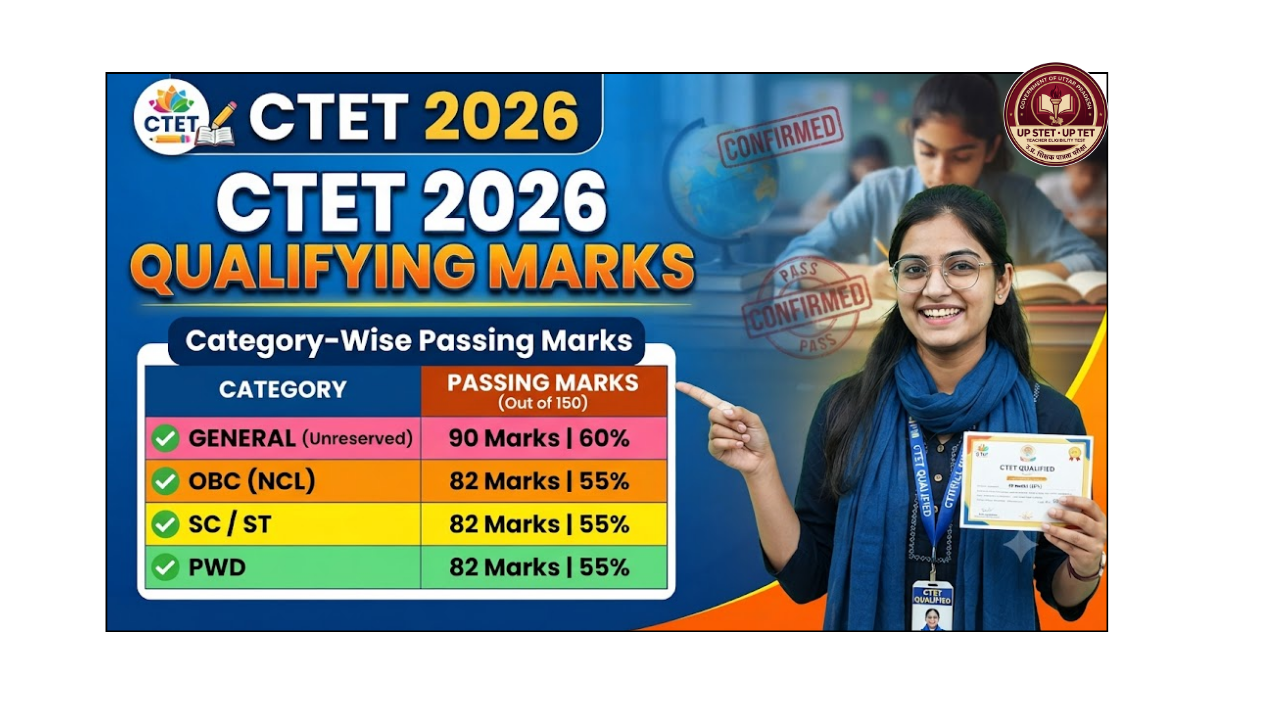
General / Unreserved (UR)9060%
OBC (Non-Creamy Layer)8255%
SC (Scheduled Caste)8255%
ST (Scheduled Tribe)8255%
PwD (Persons with Disability)8255%

Key takeaway: General category candidates need a straight 60%, while OBC/SC/ST/PwD candidates get a 5% relaxation, bringing their requirement down to 55%.

Do Qualifying Marks Differ Between Paper 1 and Paper 2?

No. The qualifying marks are identical for both papers:

PaperApplicable ToQualifying Marks (General)Qualifying Marks (OBC/SC/ST/PwD)
Paper 1Classes I–V (Primary Stage)90/150 (60%)82/150 (55%)
Paper 2Classes VI–VIII (Elementary Stage)90/150 (60%)82/150 (55%)

If you want to be eligible to teach both primary and upper-primary levels, you must appear for and qualify both papers separately clearing one does not automatically qualify you for the other.

How CTET Marks Are Calculated

  • The exam has 150 objective-type (MCQ) questions, each worth 1 mark.
  • There is no negative marking so attempting every question is always in your interest.
  • Your final score is a simple sum of correct answers across all sections of the paper (Child Development & Pedagogy, Language I, Language II, Mathematics/Environmental Studies or Social Studies, and the relevant content sections).
  • Marks are calculated and reported as whole numbers.

What Does “Qualifying” Actually Mean in CTET?

This is where many first-time candidates get confused, so here’s the clear distinction:

ConceptWhat It Means
Qualifying MarksThe fixed minimum score (90 for General, 82 for reserved categories) needed to be declared “CTET Pass”
Merit/Selection ScoreNot applicable to CTET itself CTET is not competitive, so there’s no ranking among candidates
CTET CertificateIssued to all candidates who meet the qualifying marks, valid for a lifetime
Recruitment EligibilityPassing CTET makes you eligible to apply for teaching posts in central schools (KVS, NVS, etc.) and many state-run schools it does not guarantee a job or interview call

In short: CTET tells you whether you’re qualified to teach it does not rank you against other candidates. Actual recruitment for teaching posts happens through separate exams or interviews, where your CTET certificate is one of the eligibility requirements, and in many recruitment processes, CTET/TET marks may also be given some weightage.

CTET Qualifying Marks: Historical Consistency

The 60% (General) / 55% (Reserved) qualifying bar has remained the standard NCTE-mandated benchmark across CTET cycles for years, including the most recent February 2026 session. This consistency makes it easy for aspirants to set a clear target while preparing there’s no unpredictable, exam-day-dependent cut-off to worry about, unlike competitive recruitment exams.

CTET Result & Qualifying Status: How to Check

  1. Visit the official website ctet.nic.in
  2. Click on the CTET Result link (usually available at the bottom of the homepage once declared)
  3. Enter your roll number (and other required details like date of birth)
  4. Click Submit
  5. Your result will display your subject-wise/section-wise scores, total marks obtained, and qualifying status (Pass/Fail)
  6. Download and print your result for your records
  7. Once qualified, your CTET certificate can also be accessed via DigiLocker

Key Facts About the CTET Certificate

  • The CTET certificate carries lifetime validity from the date of result declaration it no longer expires after a fixed number of years.
  • There is no limit on the number of times a candidate can reattempt CTET, even after qualifying many candidates reappear simply to improve their score for better recruitment prospects.
  • A qualified CTET certificate makes you eligible to apply for teaching posts in Kendriya Vidyalaya Sangathan (KVS), Navodaya Vidyalaya Samiti (NVS), and various central and state government schools, subject to each recruiter’s specific eligibility norms.

CTET Qualifying Marks vs. State TET Qualifying Marks

ExamGeneral CategoryReserved Category (OBC/SC/ST/PwD)
CTET90/150 (60%)82/150 (55%)
UPTET (Uttar Pradesh)90/150 (60%)82/150 (55%)
Most other State TETsTypically 60%Typically 55% (varies slightly by state)

Most State TETs mirror the CTET qualifying pattern closely, since they all follow the broader NCTE framework, though minor state-specific variations can exist always check the respective state board’s official notification for confirmation.

Preparation Tips to Comfortably Clear the Qualifying Marks

  • Don’t just aim for the minimum: Many recruitment processes give weightage to your actual TET score, so aiming well above 90/82 improves your future recruitment chances, not just your qualifying status.
  • Focus on Child Development & Pedagogy: This section is often the most scoring if concepts are understood rather than memorized.
  • Practice previous years’ papers: This helps you gauge the real difficulty level and question pattern used by CBSE.
  • Attempt every question: Since there’s no negative marking, an educated guess is always better than leaving a question blank.
  • Balance both languages sections: Language I and Language II together carry significant weightage don’t neglect grammar and comprehension practice.

Frequently Asked Questions

Q1. What are the CTET qualifying marks for the General category?

General category candidates must score at least 90 out of 150 marks (60%) to qualify CTET.

Q2. What are the CTET qualis different for Paper 1 and Paper 2?

No, the qualifying marks are the same for both Paper 1 and Paper 2 60% for General and 55% for reserved categories.

Q4. Is there negative marking in CTET?

No, there is no negative marking in CTET. Marks are awarded only for correct answers.

Q5. Does qualifying CTET guarantee a teaching job?

No. Qualifying CTET only makes you eligible to apply for teaching positions it does not guarantee recruitment or an interview call. Selection depends on the specific recruitment process of the school or board you apply to.

Q6. How long is the CTET certificate valid?

The CTET certificate is valid for a lifetime from the date the result is declared.

Q7. Can I reappear for CTET after qualifying it once?

Yes, there is no restriction on the number of attempts, and many candidates reappear to improve their score even after qualifying.

Q8. Where can I download my CTET certificate?

Once qualified, your certificate can be downloaded from the official CTET website (ctet.nic.in) as well as through DigiLocker.

UP Super TET Syllabus 2026: Complete Subject-Wise Syllabus, New Exam Pattern

upstet syllabus 2026

The Super Teacher Eligibility Test (Super TET) is one of the most significant recruitment examinations in India’s education sector. The Super Teacher Eligibility Test (Super TET) is a competitive recruitment examination conducted by the Uttar Pradesh government to select eligible candidates for Primary (Classes 1–5) and Upper Primary (Classes 6–8) teaching positions in government schools.

Unlike eligibility tests, Super TET is conducted as part of the teacher recruitment process to prepare the final merit list. If you’re aspiring to become an Assistant Teacher (Sahayak Adhyapak) in Uttar Pradesh’s government schools, understanding the 2026 exam pattern is crucial for your success.

What is Super TET 2026?

Super TET is the actual recruitment examination for Assistant Teacher positions in UP government schools. It’s important to understand the distinction: while CTET and UPTET are eligibility tests, Super TET determines your final selection based on merit.

Key Point for Eligibility

Candidates who have qualified CTET or UPTET and meet the prescribed educational qualifications are eligible to appear for the examination.

Super TET 2026: Basic Exam Structure

The 2026 exam follows a streamlined and candidate-friendly format that has remained consistent for recent cycles:

Examination Highlights

AspectDetails
Exam NameSuper Teacher Eligibility Test (Super TET)
Total Questions120
Total Marks360
Question TypeMultiple Choice Questions (MCQs)
Exam Duration120 minutes (2 hours)
ModeOffline (Pen & Paper)
LanguagesHindi and English
Marking per Correct Answer3 marks
Negative Marking1 mark deduction for incorrect answer
Conducting AuthorityUttar Pradesh Education Service Selection Commission (UPESSC)

Important Note on Marking

Each correct answer awards 3 marks, while each incorrect answer results in a 1-mark deduction. Unattempted questions do not affect your score, so strategic attempting is recommended.

Detailed Subject-Wise Breakdown

Subject Weightage and Distribution

The 2026 Super TET exam distributes its 120 questions across 10 major subjects with varying weightage:

SubjectNo. of QuestionsWeightage (%)Total Marks
Languages (Hindi, Sanskrit & English)3025.0%90
General Knowledge & Current Affairs2520.8%75
Mathematics1613.3%48
Science086.7%24
Environmental & Social Studies086.7%24
Teaching Skills086.7%24
Child Psychology086.7%24
Life Skills, Management & Aptitude086.7%24
Logical Reasoning054.2%15
Information Technology (IT)043.3%12
TOTAL120100%360

Subject Analysis

1. Languages (30 Questions – 25% Weightage) Languages carry the highest weightage in Super TET 2026. The exam covers three languages: Hindi, Sanskrit, and English. This section tests candidates’ proficiency in grammar, comprehension, vocabulary, and pedagogical approaches to language teaching.

2. General Knowledge & Current Affairs (25 Questions – 20.8% Weightage) The second-highest weightage subject covers national and international events, important personalities, government schemes, awards, and Indian culture. Daily current affairs revision is essential for this section.

3. Mathematics (16 Questions – 13.3% Weightage) Mathematics contributes significantly to the overall score. Questions focus on basic mathematical concepts, teaching methodologies, and problem-solving skills relevant to classroom instruction.

4. Science (08 Questions – 6.7% Weightage) This section covers fundamental scientific principles, experimental methods, and science teaching pedagogy.

5. Environmental & Social Studies (08 Questions – 6.7% Weightage) Questions include environmental conservation, social fabric, and geography relevant to the Indian context.

6. Teaching Skills (08 Questions – 6.7% Weightage) This section evaluates your understanding of modern teaching methodologies, classroom management, and instructional strategies.

7. Child Psychology (08 Questions – 6.7% Weightage) Questions test knowledge of child development, learning theories, and psychological principles relevant to education.

8. Life Skills, Management & Aptitude (08 Questions – 6.7% Weightage) This section assesses soft skills, decision-making abilities, and personal development aspects.

9. Logical Reasoning (05 Questions – 4.2% Weightage) Though having lower weightage, this section requires critical thinking and analytical abilities.

10. Information Technology (04 Questions – 3.3% Weightage) ICT integration in education is becoming increasingly important. Questions cover basic computer concepts and digital learning tools.

Super TET 2026 Paper Structure: Two Sections

The exam is uniquely structured into two sections to ensure balanced assessment:

Section 1: General Knowledge (30 Questions)

All candidates, regardless of their teaching specialization, must attempt 30 questions from the General Knowledge and Current Affairs section. This ensures every teacher has foundational knowledge across diverse domains.

Section 2: Selected Teaching Subject (90 Questions)

Candidates can choose their specialization based on their educational background and interest. The remaining 90 questions come from the selected teaching subject, allowing for specialized assessment.

Total: 30 + 90 = 120 Questions

This two-section approach ensures that:

  • All teachers have common knowledge base
  • Specialization is valued and assessed thoroughly
  • Teaching expertise in chosen subject is properly evaluated

Marking Scheme (Critical for Strategy)

Understanding the marking scheme is crucial for exam strategy:

Positive Marking

  • Correct Answer = +3 marks
  • Unattempted Question = 0 marks

Negative Marking

  • Wrong Answer = -1 mark

Maximum Score

With 120 questions × 3 marks = 360 marks total

Time Management

  • Total Time = 120 minutes
  • Per Question = 1 minute (approximately 60 seconds)

This tight time constraint means:

  • You must practice speed without compromising accuracy
  • Skip difficult questions initially and come back to them
  • Attempt all questions (since there’s no negative marking for unattempted ones, but attempting gives you a chance to earn marks)

Exam Languages

The exam is conducted in Hindi and English.Candidates can choose the language in which they wish to take the examination, making it accessible to a broader audience of educators across Uttar Pradesh.

Selection Process and Merit-Based Recruitment

Super TET follows a merit-based selection system with the following characteristics:

Final Selection Criteria

Selection is based on 60% weightage of the written exam and 40% weightage from academic qualifications, including high school, intermediate, graduation, and teacher training records.

This means:

  • Written Exam: 60% weightage
  • Academic Credentials: 40% weightage
    • High School performance
    • Intermediate marks
    • Graduation scores
    • Teacher training certification (D.El.Ed/B.Ed)

Qualifying Marks

Candidates must achieve:

  • General Category: Minimum 45% marks
  • OBC/SC/ST Category: Minimum 40% marks

Reservation Policy

As per UP Government norms:

  • SC: 21%
  • ST: 2%
  • OBC: 27%
  • EWS: 10%
  • PwD: 4% (horizontal reservation)

Key Differences: Super TET vs UPTET vs CTET

Understanding the distinction between these tests is vital:

AspectCTETUPTETSuper TET
PurposeEligibilityEligibilityRecruitment/Selection
Conducting BodyCBSE (National)UPBEBUPESSC
DeterminesTeaching eligibilityTeaching eligibilityMerit for appointment
Pre-requisiteGraduation + B.EdGraduation + D.El.EdCTET/UPTET qualified
ScopeAll-IndiaUttar PradeshUttar Pradesh
Final SelectionNot for selectionNot for selectionDirect appointment basis

Critical Point

Unlike UPTET which is a teacher eligibility test, Super TET is the actual Assistant Teacher Recruitment Examination that determines who gets appointed in UP government primary and upper primary schools.

Subject-Wise Preparation Strategy

High-Priority Subjects (60% of your study time)

  1. Languages (30 questions) – Focus on grammar, pedagogy, and comprehension
  2. General Knowledge (25 questions) – Daily current affairs, national events, awards

Medium-Priority Subjects (30% of your study time)

  1. Mathematics (16 questions) – Basic concepts, teaching methods, problem-solving
  2. Teaching Skills (08 questions) – Modern pedagogies, classroom management
  3. Child Psychology (08 questions) – Development stages, learning theories

Lower-Priority Subjects (10% of your study time)

  1. Science, Environmental Studies, Life Skills (24 questions total)
  2. Logical Reasoning (05 questions)
  3. Information Technology (04 questions)

Important Preparation Tips

1. Speed and Accuracy Balance

With only 60 seconds per question, practicing mock tests is essential. Aim for accuracy while building speed.

2. No Negative Marking Strategy

While there is negative marking (-1 for wrong), it’s strategic to:

  • Attempt all 120 questions
  • Skip extremely difficult questions initially
  • Return to them if time permits
  • Never leave a question blank without careful consideration

3. Focus on High-Weightage Subjects

Languages and General Knowledge together comprise 45.8% of the exam. Devote proportionate study time to these subjects.

4. Current Affairs is Non-Negotiable

In General Knowledge:

  • National and international events
  • Important government schemes
  • Awards and honors
  • Sports and culture
  • Science and technology breakthroughs

Daily reading of news sources is mandatory.

5. Previous Years’ Papers

Solving previous Super TET and UPTET papers helps you:

  • Understand question patterns
  • Identify frequently asked topics
  • Practice time management
  • Build confidence

6. Mock Tests

Take full-length mock tests at regular intervals to:

  • Simulate exam conditions
  • Identify weak areas
  • Improve pacing and strategy
  • Track progress

Eligibility Criteria Summary

To be eligible for Super TET 2026, you must:

  1. Have a valid CTET/UPTET qualification
    • CTET Paper 1 OR UPTET Paper 1 (for Primary Teacher position – Classes 1-5)
    • CTET Paper 2 OR UPTET Paper 2 (for Upper Primary position – Classes 6-8)
  2. Meet educational qualifications
    • Graduation degree
    • Teacher training certification (D.El.Ed or B.Ed)
  3. Fulfill age and other criteria
    • As specified in the official notification

Expected Vacancies and Timeline

The UP Government has a substantial backlog of teacher vacancies. The 2026 recruitment cycle is expected to have significant openings distributed across:

  • All 75 districts of Uttar Pradesh
  • Both Primary (Classes 1-5) and Upper Primary (Classes 6-8) levels
  • Multiple subject specializations

Stay updated on the official websites for notification release and exam date announcements.

2026 Exam Pattern: What’s New?

Shift Towards Conceptual Understanding

The newly active Prayagraj-based Commission (UPESSC) is emphasizing conceptual pedagogy over rote learning. The 2026 pattern reflects:

  • Focus on why behind facts, not just facts
  • Increased emphasis on D.El.Ed/BTC concepts
  • ICT integration in teaching methodology
  • National Education Policy (NEP) 2020 implementation

Implications for Candidates

Simply memorizing answers won’t suffice. You need to understand:

  • Teaching philosophy behind pedagogical approaches
  • How to implement modern teaching strategies
  • Integration of technology in classrooms
  • Holistic child development

Official Resources and Links

Primary Sources

  1. Official UPESSC Website: www.updeled.gov.in
    • Download official syllabus and exam pattern PDF
    • Check notifications and important updates
  2. UP Education Service Selection Commission (UPESSC)
    • Official examination conducting authority
    • Released the 2026 syllabus

TOP 05 Mock Tests

Super TET New Exam Pattern Mock Test Papers 01Click Here
Super TET New Exam Pattern Mock Test Papers 02Click Here
Super TET New Exam Pattern Mock Test Papers 03Click Here
Super TET New Exam Pattern Mock Test Papers 04Click Here
Super TET New Exam Pattern Mock Test Papers 05Click Here

The UP Super TET 2026 represents a pivotal opportunity for teachers aiming to secure government positions in Uttar Pradesh. With a well-structured exam pattern distributing 120 questions across diverse subjects, success requires:

  1. Clear understanding of the exam pattern and syllabus
  2. Strategic preparation focusing on high-weightage subjects
  3. Regular practice through mock tests and previous papers
  4. Conceptual learning over rote memorization
  5. Consistent effort and time management

The two-section structure ensures balanced assessment of general knowledge and subject-specific expertise. The 60% weightage to the written exam and 40% to academic credentials means your hard work in preparation will be substantial factor in your final selection.

Start your preparation today, stay updated with official notifications, and utilize the resources mentioned above to achieve your goal of becoming an Assistant Teacher in UP government schools.

Best of luck with your Super TET 2026 preparation

UP TET Result 2026 Release Date Things Need to Know Before You Check Your Scorecard

UP TET Result Date

If you’re one of the nearly 19 lakh candidates who sat for the Uttar Pradesh Teacher Eligibility Test this year, you’ve probably refreshed the UPESSC website more times than you’d like to admit. “UP TET Result 2026 kab aayega?” has become the most-searched question among aspiring teachers across the state and honestly, the wait is nerve-wracking when your entire teaching career hangs on this one scorecard.

Let’s cut through the confusion and lay out exactly where things stand.

When Is the UP TET Result 2026 Expected?

The Uttar Pradesh Education Service Selection Commission (UPESSC) conducted the UPTET 2026 exam on July 2, 3, and 4, 2026, in offline OMR mode across hundreds of centres spanning the state’s districts. Based on the commission’s usual timeline and the latest updates circulating from official sources, the result is expected to be declared between the last week of July and the first week of August 2026 with some estimates stretching into the third or fourth week of August depending on how quickly the objection window gets cleared.

Here’s the thing about government exam results: the date almost never moves in a straight line. It shifts based on one very specific bottleneck the answer key objection process. And that’s exactly what’s happening right now.

Why the Wait? The Answer Key Story

UPESSC released the provisional answer key on July 8, 2026, giving candidates a chance to check their tentative scores against the official responses. Naturally, this opened the floodgates for objections candidates who felt a question was ambiguous, incorrectly framed, or had multiple correct answers had until July 14, 2026 to formally raise their concerns.

This step matters more than people realize. Every single objection gets reviewed by subject-matter experts before the commission finalizes anything. If even one question gets dropped or its answer changed, it can shift the final scores of lakhs of candidates. That’s why the final answer key not the provisional one is what actually determines your result, and it’s typically released just before or alongside the scorecard itself.

So if you’re wondering why the result isn’t “already out” despite the exam being weeks behind us, this review process is your answer. It’s tedious, but it exists to protect the fairness of your result.

How to Check Your UP TET Result 2026 (Step-by-Step)

When the link goes live, here’s exactly what you’ll need to do:

  1. Head to the official website upessc.up.gov.in
  2. Look for the “UPTET Result 2026” link on the homepage (it usually appears prominently once activated)
  3. Log in using your registration/application number and date of birth or password
  4. Enter the captcha code if prompted
  5. Click submit your scorecard will appear on screen
  6. Download it and save a PDF copy immediately
  7. Take a printout for your records, since you’ll need this for future recruitment applications like the Super TET

A small but important tip: keep your credentials handy well before the result date. Every year, thousands of candidates scramble at the last minute trying to recover forgotten registration numbers right when server traffic peaks don’t be that person.

What Will Your Scorecard Actually Show?

The UP TET scorecard isn’t just a pass/fail slip. It’s a fairly detailed document containing:

  • Your name, father’s and mother’s name, date of birth, gender, and category
  • Roll number and registration/application number
  • Paper(s) attempted Paper I (Classes 1–5), Paper II (Classes 6–8), or both
  • Subject-wise marks breakdown
  • Your total score and final qualifying status

Qualifying Marks: What Score Do You Actually Need?

This is where category matters a lot. Based on the commission’s established norms:

  • General/Unreserved candidates need around 60% (90 marks out of 150) to qualify
  • SC, ST, and OBC candidates need approximately 55% (82.5 marks) to qualify

Clearing UPTET doesn’t guarantee a teaching job by itself it’s an eligibility certificate. But it’s the non-negotiable first gate for anyone applying to teach in UP’s government and government-aided schools, and it stays valid for a lifetime from the date of issue, unlike some other state TETs that expire after a few years. That alone makes it worth getting right.

Common Problems Candidates Face on Result Day

Anyone who’s checked a high-traffic government result knows the drill but here’s what to prepare for so you’re not caught off guard:

  • Server overload: With nearly two million candidates trying to access the site simultaneously, expect slow loading or timeouts in the first few hours. Try checking late at night or early morning when traffic dips.
  • Login errors: Double-check your registration number and date of birth format before assuming the system is broken.
  • Browser glitches: Use an updated browser and disable pop-up blockers, since the scorecard PDF often opens in a new tab.
  • Cache issues: If the page keeps showing stale information, clear your browser cache or try an incognito window.

What Happens After the Result?

Qualifying UPTET opens the door to teacher recruitment drives conducted by the Basic Education Board and other UP education bodies, most notably the Super TET recruitment cycle for assistant teacher posts. Many candidates start preparing their Super TET applications the moment their UPTET scorecard is out, so it’s worth having your qualifying documents organized in advance rather than scrambling later.

Final Word

The honest answer to “when will UPTET Result 2026 be released” is: very soon, but the exact date depends on how fast the objection review wraps up. Official notifications will be posted on upessc.up.gov.in first, so that remains your single most reliable source treat every other date you see online, including this one, as an informed estimate rather than a confirmed announcement.

Keep your login details ready, check the official site directly rather than relying on forwarded WhatsApp messages, and try not to let the wait wear you down. Lakhs of candidates are in the exact same boat right now and for most of them, this scorecard is the first real step toward a teaching career they’ve worked hard for.

Frequently Asked Questions

Q: Is UPTET conducted online or offline?

UPTET is conducted offline in pen-and-paper (OMR-based) mode.

Q: Is there negative marking in UPTET?

No, there is no negative marking in the UPTET exam.

Q: How long is the UPTET certificate valid?

The UPTET qualifying certificate is valid for a lifetime from the date the result is issued.

Q: Do I need to clear both Paper I and Paper II?

Only if you intend to teach classes 1–8. If you only want to teach classes 1–5, Paper I is sufficient; for classes 6–8, only Paper II is required.

UP TET Result 2026 OUT How to Check Your Result, Download Scorecard & Complete Cut Off Marks Guide

UP TET Result 2026

Nearly every UPTET aspirant right now is stuck in the same loop exam’s over, answer key objections are done, and all that’s left is the wait. But “waiting” doesn’t have to mean sitting idle. This guide covers exactly how to check your UP TET Result 2026 the moment it’s live, what your scorecard will actually show, and probably the section you care about most the real category-wise cut off marks you need to clear to walk away with a valid TET certificate.

The UPTET 2026 notification was released on 20th March 2026, and the exam itself was conducted on 2nd, 3rd, and 4th July 2026 in offline OMR mode. The provisional answer key followed on 8th July, giving candidates a window to raise objections before the final key gets locked in. Based on how UPESSC has historically handled this cycle, the result is expected in August 2026, with several tracking sources pointing toward the third or fourth week of August as the likely window though, as with any government exam, this can shift depending on how quickly the objection review process wraps up.

The Uttar Pradesh Education Service Selection Commission (UPESSC) the body currently handling UPTET after previously being managed under the Uttar Pradesh Basic Education Board (UPBEB) will publish the result on its official portal.

How to Check Your UP TET Result 2026: Step-by-Step

When the result link goes live, here’s exactly what you need to do no guesswork, no third-party portals:

  1. Go to the official website upessc.up.gov.in (some references also point to updeled.gov.in, so check both if one is slow)
  2. Find the “UPTET Result 2026” link on the homepage it typically appears as a highlighted notification once activated
  3. Click the link and you’ll be taken to a login page
  4. Enter your registration/application number along with your date of birth
  5. Fill in the captcha code exactly as shown
  6. Click submit your result will display on screen
  7. Download the PDF and save it immediately to your device
  8. Take a printout for your records you’ll need this scorecard for future recruitment applications, so don’t treat the digital copy as sufficient on its own

A genuinely useful tip here: locate your registration number and confirm your exact date-of-birth format (DD/MM/YYYY vs MM/DD/YYYY, as portals sometimes vary) a day or two before the expected result date. Every single year, a chunk of candidates lose precious time on result day simply hunting for their own credentials while the server is already struggling under heavy traffic.

What Your Scorecard Will Show

Once downloaded, your UPTET scorecard isn’t a bare-bones pass/fail note it’s a fairly detailed document containing:

  • Candidate’s name, along with father’s and mother’s name
  • Date of birth, gender, and category
  • Roll number and registration/application number
  • Paper attempted Paper I (for Classes 1–5 eligibility), Paper II (for Classes 6–8 eligibility), or both
  • Subject-wise marks breakdown
  • Total marks obtained and percentile
  • Final qualifying status (Qualified / Not Qualified)

Check every single field carefully the moment you download it. Category and paper-level errors, while rare, do happen and catching them early gives you time to raise a correction request rather than discovering a mismatch months later when you’re applying for a teaching post.

UP TET Cut Off 2026: The Numbers You Actually Need to Clear

This is the section most candidates are really here for, so let’s get specific.

UPTET is a qualifying exam, not a competitive ranking exam meaning there’s no fixed number of “seats,” and every candidate who crosses the minimum qualifying marks for their category gets certified, regardless of how many other candidates also qualify. That’s an important distinction from something like a merit-list-based recruitment exam.

Category-Wise Minimum Qualifying Marks

CategoryMinimum Qualifying PercentageMinimum Marks (out of 150)
General/Unreserved60%90 marks
OBC55%82–83 marks
SC55%82–83 marks
ST55%82–83 marks
PwD (Persons with Disabilities)55%82–83 marks
Ex-Servicemen55%82–83 marks

These figures apply identically to both Paper I and Paper II so if you attempted both papers, you need to clear the qualifying threshold separately for each one, not just on a combined score.

What Actually Determines the Cut Off Each Year

Even though the qualifying percentage itself (60% / 55%) has stayed consistent across recent cycles, a few factors influence how the effective cut off is perceived and discussed each year:

  • Difficulty level of the paper a tougher paper doesn’t lower the official qualifying percentage, but it does reduce the number of candidates who actually clear it
  • Number of candidates appearing with UPTET regularly drawing 15–19 lakh+ applicants, sheer volume affects how competitive the certificate feels, even though it’s not rank-based
  • Subject-wise and paper-wise variation Paper I and Paper II often see slightly different qualification rates depending on that year’s question difficulty in each

How to Check the Official Cut Off Marks

The cut off (qualifying marks) list is typically published alongside the result. To check it:

  1. Visit the official UPESSC website
  2. Look for the “UPTET Cut Off Marks 2026” link on the homepage
  3. Click through the cut off list opens as a PDF
  4. Review the category-wise qualifying marks carefully
  5. Download and save the PDF for your records

Some years, district-level information also gets referenced alongside the state-level cut off, largely for statistical and reporting purposes but remember, this doesn’t change your individual qualifying status. Your certificate depends solely on whether you cleared your category’s minimum percentage, not on how your district performed as a whole.

Common Misconception: “Cut Off” vs “Merit List”

This trips up a lot of first-time TET candidates, so it’s worth clarifying directly: UPTET does not produce a merit list or ranking. Because it’s purely an eligibility test, there’s no scenario where you “missed the cut off by rank” the way you might in a recruitment exam with limited seats. If your score meets or exceeds your category’s qualifying percentage, you’re TET-qualified full stop. The competitive, rank-based part of the journey only begins later, when you apply for actual teaching vacancies (like Super TET recruitment), where your TET qualification is just the entry ticket, not the deciding score.

What Happens After You Qualify

Clearing UPTET gets you the Teacher Eligibility Certificate, which is valid for a lifetime from the date of issue a significant change from the earlier five-year validity rule that applied years ago. With this certificate in hand, you become eligible to apply for:

  • Assistant Teacher recruitment in UP’s government and government-aided primary and upper primary schools
  • Super TET recruitment cycles, which are the actual competitive hiring drives for teaching posts
  • Various other state-level teaching recruitment processes that list UPTET/CTET as a mandatory eligibility criterion

Qualifying UPTET is necessary, but it’s the starting line, not the finish line so it’s worth using the post-result period to get your Super TET preparation and application documents in order rather than treating the TET certificate as the end goal.

If You Don’t Qualify: What Are Your Options?

Not clearing UPTET on your first attempt isn’t unusual it’s an exam that hundreds of thousands of serious aspirants reattempt. A few honest points worth knowing:

  • UPTET is conducted regularly, so another attempt is generally available in a future cycle rather than a long multi-year gap
  • CTET (Central Teacher Eligibility Test) is a separate, nationally valid alternative clearing it also opens up eligibility for central government schools and is accepted by several states, UP included, for certain posts
  • Use your subject-wise scorecard breakdown to identify exactly where you lost the most marks, and structure your next attempt’s preparation around that specific gap rather than restarting your entire syllabus from scratch

Final Thoughts

The UP TET Result 2026 process is fairly transparent once you know exactly where to look and what to expect no ranking anxiety, no seat-limited competition, just a clear percentage threshold you either cross or don’t. Keep your registration details ready, check upessc.up.gov.in directly rather than relying on forwarded screenshots, and go in knowing your target number: 90 marks for General category, roughly 82–83 for reserved categories.

Whatever the outcome, this scorecard is just one step in a much longer teaching career journey treat it as a checkpoint, prepare accordingly, and keep your documentation ready for whatever comes next.

Check Result

UP TET Result 2026Click Here
Result NoticeClick Here

Frequently Asked Questions

Q: Is UPTET a rank-based exam?

No. UPTET is a qualifying eligibility test with no fixed number of seats. Every candidate who meets their category’s minimum qualifying percentage is certified as TET-qualified, regardless of overall rank.

Q: What is the minimum qualifying percentage for General category candidates?

General category candidates need to score at least 60% (90 out of 150 marks) to qualify.

Q: What is the minimum qualifying percentage for OBC/SC/ST/PwD candidates?

Reserved category candidates need to score at least 55% (approximately 82–83 out of 150 marks) to qualify.

Q: Do I need to clear the cut off in both Paper I and Paper II?

Only if you attempted both. The qualifying percentage applies separately to whichever paper(s) you attempted, based on the age group you intend to teach.

Q: How long is the UPTET certificate valid after qualifying?

The UPTET certificate is valid for a lifetime from the date of issue, following a change from the earlier five-year validity rule.

Q: What should I do immediately after checking my result?

Download and save your scorecard PDF, verify every detail (name, category, marks, paper) for accuracy, and take a physical printout for future recruitment applications.

UPTET Answer Key 2026: Download Link, Objection Process, Passing Marks & Merit Details

up tet answer key 2026

The Uttar Pradesh Teacher Eligibility Test (UPTET) 2026, conducted on 2, 3, and 4 July 2026, saw close to 20 lakh candidates appear across 955 exam centres in 60 districts making it one of the largest teacher eligibility exams in recent years. Following the exam, the Uttar Pradesh Education Service Selection Commission (UPESSC) released the provisional answer key on 8 July 2026, giving candidates their first real chance to estimate their score before the official result.

This article covers everything related to the UPTET Answer Key 2026 download steps, objection process, passing marks, and how your final merit/result will be decided.

DetailInformation
Exam NameUPTET (Uttar Pradesh Teacher Eligibility Test) 2026
Conducting BodyUP Education Service Selection Commission (UPESSC)
Exam Dates2, 3 & 4 July 2026
Candidates AppearedApprox. 17–20 lakh
Exam Centres955 centres, 60 districts
Provisional Answer Key Released8 July 2026
Objection Window8 July 2026 (6:00 PM) to 14 July 2026 (11:59 PM)
Objection Fee₹500 per question (refundable if objection is accepted)
Official Websiteupessc.up.gov.in
Answer Key FormatSet-wise (Set A, B, C, D), Paper 1 & Paper 2 separately

UPTET Answer Key 2026: Key Dates

EventDate
UPTET Exam Conducted2, 3 & 4 July 2026
Unofficial/Expert Answer KeysReleased shift-wise, immediately after each exam shift
Provisional Answer Key Released8 July 2026
Objection Window Opens8 July 2026, 6:00 PM
Objection Window Closes14 July 2026, 11:59 PM
Final Answer KeyTo be released after objection review
UPTET Result 2026Expected to follow the final answer key, late July/August 2026

How to Download UPTET Answer Key 2026: Step-by-Step Process

Follow these steps carefully to download your correct answer key:

  1. Visit the official website upessc.up.gov.in
  2. Go to the “Notice Board” or “UPTET Exam Portal” section on the homepage
  3. Click on the link labelled “UPTET Provisional Answer Key 2026”
  4. Log in using your Roll Number/Registration Number and Date of Birth (or Password, as applicable)
  5. Select your Paper Paper 1 (Class 1–5) or Paper 2 (Class 6–8)
  6. Choose your booklet series/set code Set A, B, C, or D exactly as printed on your question paper
  7. Click on the relevant PDF link to open the answer key
  8. Download and save the PDF to your device
  9. Cross-check each answer against your response sheet/OMR to estimate your probable score

Important: Always download the answer key matching your exact exam date, shift, paper, and booklet set code. Using the wrong set will give you an inaccurate score estimate.

UPTET Answer Key 2026: How to Raise an Objection

If you believe any answer in the provisional key is incorrect, you can formally challenge it during the objection window (8–14 July 2026). Here’s the process:

  1. Visit the official UPESSC website and open the objection/grievance portal link for UPTET (Advt. No. 01/UPTET/2026)
  2. Log in using your Registration Number, Date of Birth, and the captcha code
  3. Select the relevant exam date, shift, question paper set, and question number
  4. Choose the answer option you believe is correct
  5. Attach documentary evidence in PDF format this must include the relevant page along with the book’s cover page and author details for verification (standard references like NCERT/SCERT textbooks are accepted)
  6. Pay the prescribed objection fee (₹500 per question)
  7. Review all details carefully before final submission
  8. Download and save the acknowledgement receipt for future reference

Objection Rules to Keep in Mind

RuleDetail
Objection Fee₹500 per question
Fee RefundRefunded only if the objection is accepted by the expert committee
Supporting ProofMandatory must be from a standard/authoritative textbook (e.g., NCERT, SCERT)
Mode of SubmissionOnly via the official online portal objections through email, post, or any offline mode are not considered
ImpactAccepted objections lead to revision in the Final Answer Key, which is then used to prepare the result

UPTET 2026 Passing Marks (Category-Wise)

CategoryMinimum Qualifying Marks (out of 150)Percentage
General / Unreserved9060%
OBC / SC / ST / EWS / PwD / Ex-Servicemen8255%
  • No negative marking is applicable in UPTET every correct answer scores 1 mark, and incorrect/unattempted answers score zero.
  • Candidates must qualify Paper 1 and Paper 2 independently if they’ve appeared for both.

How to Calculate Your Probable Score Using the Answer Key

  1. Match each of your response sheet answers against the official provisional answer key
  2. Award +1 mark for every correct match
  3. Since there’s no negative marking, incorrect or unattempted answers simply score 0
  4. Add up your total to get your provisional score out of 150
  5. Compare this score against the qualifying marks for your category (90 for General, 82 for reserved categories)
  6. Keep in mind that your final score may change slightly if any accepted objections revise the answer key before the final result

UPTET Answer Key to Result: What Happens Next

StageDescription
1. Provisional Answer KeyReleased 8 July 2026 used for self-evaluation
2. Objection Window8–14 July 2026 candidates challenge disputed answers
3. Expert ReviewSubject-matter committee evaluates all valid objections
4. Final Answer KeyReleased after objections are resolved
5. UPTET Result 2026Prepared strictly based on the Final Answer Key, not the provisional one
6. Scorecard ReleaseAvailable for download on upessc.up.gov.in once result is declared

Merit & Certificate: Important Points

  • UPTET itself does not generate a job-recruitment merit list it only certifies candidates as Qualified or Not Qualified.
  • The UPTET certificate, once earned, is valid for a lifetime as per the current cycle.
  • Actual teacher recruitment (appointment) happens through a separate exam Super TET for which a valid UPTET (or CTET) qualification is a mandatory prerequisite, not a merit-contributing score.
  • Super TET’s own merit list is calculated using 60% weightage to the Super TET written exam and 40% weightage split equally across academic records (10th, 12th, graduation, and teacher training marks).

Key Takeaways

  • UPTET 2026 was held on 2, 3, 4 July 2026, with the provisional answer key released on 8 July 2026.
  • The objection window ran from 8 to 14 July 2026, with a ₹500 per-question fee, refundable only on acceptance.
  • Passing marks: 90/150 (60%) for General, 82/150 (55%) for reserved categories.
  • The final result will be based only on the Final Answer Key, issued after all objections are reviewed — not the provisional key.
  • Use the answer key strictly matching your exam date, shift, paper, and set code to avoid incorrect score estimates.

Frequently Asked Questions

Q1. When was the UPTET Answer Key 2026 released?

The provisional answer key was released on 8 July 2026, for the exam conducted on 2, 3, and 4 July 2026.

Q2. What is the last date to raise objections against the UPTET answer key?

The objection window closed on 14 July 2026 at 11:59 PM.

Q3. Is there a fee to raise an objection?

Yes, candidates need to pay ₹500 per question challenged. The fee is refunded only if the objection is accepted.

Q4. Will the result be based on the provisional or final answer key?

The UPTET Result 2026 will be prepared based on the Final Answer Key, released after all objections are reviewed not the provisional key.

Q5. What are the UPTET 2026 passing marks?

90 out of 150 (60%) for General category, and 82 out of 150 (55%) for OBC/SC/ST/EWS/PwD candidates.

Q6. Do I need to log in to download the answer key?

Yes, candidates need to log in using their Roll Number/Registration Number and Date of Birth to access the official answer key PDF.

Q7. Can I challenge the answer key without providing proof?

No, all objections must be supported by valid documentary evidence, typically from standard NCERT/SCERT textbooks. Objections without proper proof are likely to be rejected.

UPTET Result 2026 Date & Time, Merit List, Passing Marks, Scorecard Download & Super TET Connection

UPTET Result 2026

The Uttar Pradesh Teacher Eligibility Test (UPTET) 2026 was conducted on 2, 3, and 4 July 2026, and lakhs of teaching aspirants across the state are now waiting for their result. This is the first UPTET cycle in nearly four years, which is why the anticipation around the result, cut-off, and its link to the Super TET recruitment exam is higher than usual.

Here’s everything you need to know result date, passing marks, merit calculation, step-by-step scorecard download process, and a clear answer to the most-asked question: does your UPTET score carry forward into Super TET?

Quick clarification: The exam conducted on 2–4 July 2026 was UPTET (the Teacher Eligibility Test), not Super TET. UPTET is a qualifying exam clearing it makes you eligible to apply for Super TET, which is a separate recruitment exam held later. This article covers the UPTET 2026 result in detail and explains exactly how it connects to Super TET.

UPTET 2026: Quick Overview

DetailInformation
Exam NameUttar Pradesh Teacher Eligibility Test (UPTET) 2026
Conducting BodyUP Education Service Selection Commission (UPESSC)
Exam Dates2, 3 & 4 July 2026
Exam ShiftsTwo shifts on 2 & 3 July; one shift on 4 July
Exam Centres955 centres across 60 districts
Candidates AppearedApprox. 17 lakh (1.7 million)
Exam ModeOffline (Pen & Paper / OMR-based)
PapersPaper 1 (Class 1–5) & Paper 2 (Class 6–8)
Answer Key Released8 July 2026
Certificate ValidityLifetime
Official Websiteupessc.up.gov.in

UPTET Result Date 2026

EventDate/Status
Exam Conducted2–4 July 2026
Provisional Answer Key8 July 2026
Objection Window for Answer KeyClosed (post 8 July 2026)
Final Answer KeyAwaited
UPTET Result 2026Expected last week of July to third/fourth week of August 2026
Scorecard DownloadTo be activated with result

As of now, the result has not been officially declared. Multiple reports indicate it is expected either in the last week of July or during August 2026 candidates should keep checking the official website regularly rather than relying on any single unconfirmed date circulating on social media.

UPTET 2026 Passing Marks (Category-Wise)

CategoryMinimum Qualifying MarksPercentage
General / Unreserved90 out of 15060%
OBC / SC / ST / EWS / PwD / Ex-Servicemen82 out of 15055%
  • There is no negative marking in UPTET.
  • Candidates must clear Paper 1 and Paper 2 separately if they’ve applied for both qualifying one does not automatically qualify the other.
  • The certificate awarded on qualifying UPTET is valid for a lifetime, unlike some earlier cycles where validity was time-bound.

How UPTET Result & Merit Works

Unlike a recruitment exam, UPTET does not have a separate “merit list” for jobs it only classifies candidates as Qualified or Not Qualified based on the cut-off above. Your scorecard will show:

  • Candidate’s name, roll number, and application number
  • Marks obtained in each subject/section
  • Total marks obtained
  • Category-wise qualifying status (Qualified/Not Qualified)
  • Paper 1 and/or Paper 2 result, as applicable

Step-by-Step Process to Download UPTET Scorecard 2026

Follow these steps once the result is officially announced:

  1. Visit the official website upessc.up.gov.in (or updeled.gov.in / upbasiceduboard.gov.in)
  2. Look for the “Results” or “Latest Updates” section on the homepage
  3. Click on the “UPTET Result 2026 / Scorecard” link
  4. Enter your Registration Number/Roll Number and Date of Birth (or password, as required)
  5. Enter the captcha code shown on screen
  6. Click Submit/Login
  7. Your UPTET Scorecard PDF will appear on the screen
  8. Download and save the scorecard
  9. Take a printout and keep multiple copies safe you’ll need this document for Super TET and other teacher recruitment applications

Does UPTET Marks Get Counted in Super TET? Full Clarification

This is the most confusing part for candidates, so here’s the direct answer:

Short Answer

No, your UPTET marks are not directly added to your Super TET score. UPTET functions purely as an eligibility gateway it tells the recruitment board that you’re qualified to apply. Once you clear UPTET, your marks in that exam are not carried forward into the Super TET written exam score.

How Super TET Merit Is Actually Calculated

ComponentWeightage
Super TET Written Exam Score60%
High School (Class 10) Marks10%
Intermediate (Class 12) Marks10%
Graduation Marks10%
Teacher Training (B.Ed/BTC/D.El.Ed) Marks10%
Total100%
  • UPTET/CTET qualification is a mandatory eligibility condition without it, you cannot even apply for Super TET.
  • However, a strong UPTET score is still valuable indirectly: it reflects solid preparation in pedagogy, teaching methods, and subject basics, all of which overlap heavily with the Super TET syllabus.

About the “1/4th UPTET Marks” Proposal

There has been discussion in the past about a proposal to add one-fourth (1/4th) of UPTET/TET marks into the final Super TET merit calculation. This idea has been debated among candidates and in some policy discussions, but it has not been implemented as a standard rule across all Super TET recruitment cycles. Any such change would only apply if explicitly confirmed in the official Super TET recruitment notification candidates should not assume this applies unless UPESSC/UPBEB states it clearly.

UPTET to Super TET: What Happens Next

StageWhat It Means
1. Clear UPTET Paper 1 or 2You receive a lifetime-valid TET certificate
2. Wait for Super TET NotificationUPESSC/UPBEB releases vacancy details, dates, and application process
3. Apply for Super TETOnly UPTET/CTET-qualified candidates can apply
4. Appear for Super TET Written Exam150 marks, 10 subjects, 2.5 hours
5. Final Merit ListBased on 60% Super TET score + 40% academic marks
6. Document Verification & AppointmentLeads to actual posting as Assistant Teacher

Key Points to Remember

  • UPTET 2026 was held on 2, 3, and 4 July 2026 across 955 centres in 60 districts.
  • Roughly 17 lakh candidates appeared, making it one of the most attempted cycles after a 4-year gap.
  • Passing marks: 90/150 (60%) for General; 82/150 (55%) for reserved categories.
  • No negative marking every correct answer earns 1 mark.
  • The result is expected in the last week of July or during August 2026, but no confirmed date has been officially announced yet.
  • UPTET marks are not directly counted toward the Super TET merit list Super TET has its own independent scoring system based on the written exam (60%) and academic records (40%).
  • Only your qualifying status in UPTET (Qualified/Not Qualified) matters for Super TET eligibility, not the exact score unless a future official notification states otherwise.

Frequently Asked Questions

Q1. When will the UPTET Result 2026 be declared?

It is expected to be announced in the last week of July or during August 2026, though UPESSC has not confirmed an exact date. Candidates should check upessc.up.gov.in regularly.

Q2. What are the UPTET 2026 passing marks?

General category candidates need 90 out of 150 (60%), while OBC/SC/ST/EWS/PwD candidates need 82 out of 150 (55%).

Q3. Is there negative marking in UPTET 2026?

No, there is no negative marking in UPTET.

Q4. Will my UPTET score be added to my Super TET score?

No. UPTET marks are not directly added to the Super TET merit calculation. UPTET only serves as an eligibility requirement. Super TET merit is based 60% on the Super TET written exam and 40% on academic marks (10th, 12th, graduation, and teacher training marks).

Q5. How do I download my UPTET scorecard?

Visit upessc.up.gov.in, click the UPTET Result/Scorecard link, log in using your registration number and date of birth, and download the PDF once released.

Q6. Is the UPTET certificate valid for a lifetime?

Yes, as per the current UPTET 2026 cycle, the certificate is valid for a lifetime.

Q7. Can I appear for both UPTET Paper 1 and Paper 2 in the same cycle?

Yes, but you must qualify each paper separately by meeting the respective minimum qualifying marks.

UPTET Qualifying Marks 2026 Category-Wise Passing Marks, Trends & Full Details

up tet qualifying marks

The UPTET (Uttar Pradesh Teacher Eligibility Test) 2026 was conducted on 2, 3, and 4 July 2026 by the UP Education Service Selection Commission (UPESSC) across 955 centres in 60 districts. Candidates must score at or above the minimum qualifying marks to be declared Pass and become eligible for UP teacher recruitment exams like Super TET. Here’s a complete, easy-reference breakdown.

UPTET 2026 Qualifying Marks (Category-Wise)

CategoryQualifying Marks (out of 150)Percentage Required
General / Unreserved9060%
OBC8255%
SC8255%
ST8255%
EWS8255%
PwD (Differently Abled)8255%
Ex-Servicemen8255%

Paper-Wise Qualifying Marks Breakdown

PaperApplicable ForTotal MarksGeneral Pass MarksReserved Category Pass Marks
Paper 1Class 1–5 (Primary) teaching eligibility15090 (60%)82 (55%)
Paper 2Class 6–8 (Upper Primary) teaching eligibility15090 (60%)82 (55%)

Note: Candidates who apply for both papers must clear each one independently qualifying Paper 1 does not automatically qualify Paper 2, and vice versa.

Qualifying Marks vs Cut-Off: What’s the Difference?

A lot of candidates confuse these two terms, so here’s the distinction:

TermMeaning
Qualifying MarksThe fixed minimum score (60%/55%) set by UPESSC that never changes clearing it makes you “Pass”
Cut-OffNot applicable to UPTET in the same way as recruitment exams, since UPTET has no merit list or vacancy-based ranking

Unlike Super TET or other recruitment exams, UPTET does not have a fluctuating, vacancy-dependent cut-off the qualifying marks are fixed by category and remain the same regardless of how many candidates appear or how difficult the paper is.

How Qualifying Marks Are Decided

  • Fixed as 60% for General/Unreserved and 55% for all reserved categories (OBC, SC, ST, EWS, PwD, Ex-Servicemen), as per UPESSC/NCTE norms.
  • These percentages have remained consistent across UPTET cycles historically and are not revised based on difficulty level or number of candidates.
  • There is no normalization or scaling applied your raw score out of 150 (as per the Final Answer Key) is what’s compared against the qualifying marks.

Why Qualifying Marks Matter Beyond Just “Passing”

  • Eligibility gateway: Clearing UPTET is a mandatory prerequisite to apply for Super TET and other UP teacher recruitment drives even a single mark below the qualifying threshold means disqualification, regardless of how close you were.
  • Lifetime validity: Once you clear UPTET, your certificate remains valid for a lifetime, so this qualifying score matters only once per certificate, not every recruitment cycle.
  • No rounding off: Scores are not rounded up if the qualifying mark is 90, a score of 89 does not qualify.
  • Same threshold, both papers: The percentage requirement is identical for Paper 1 and Paper 2, so switching between primary and upper-primary preference doesn’t change your target score.

Quick Facts Table

DetailInformation
Total Questions/Marks150
Negative MarkingNone
Exam ModeOffline (OMR-based)
Exam Dates2, 3 & 4 July 2026
Result BasisFinal Answer Key (post objection window)
Certificate ValidityLifetime
Next Step After QualifyingApply for recruitment exams like Super TET (UPTET qualification is mandatory but does not add to Super TET’s own merit score)

Frequently Asked Questions

Q1. What is the UPTET 2026 qualifying mark for General category?

90 out of 150 marks (60%).

Q2. What is the qualifying mark for OBC/SC/ST/EWS/PwD candidates?

82 out of 150 marks (55%) for all these categories.

Q3. Does the qualifying mark change every year based on difficulty?

No, it is a fixed percentage (60%/55%) as per UPESSC norms and does not vary with exam difficulty or number of candidates.

Q4. Is there a separate cut-off apart from qualifying marks?

No, UPTET has no vacancy-based cut-off or merit list only a fixed qualifying mark by category.

Q5. If I clear one paper, do I automatically clear the other?

No, Paper 1 and Paper 2 must each be qualified independently.

50% OFF
📚

Super TET Mock Papers

Complete Exam Solutions with Solutions

50% OFF
📚

Super TET Mock Papers

Complete Exam Solutions with Solutions