Latest

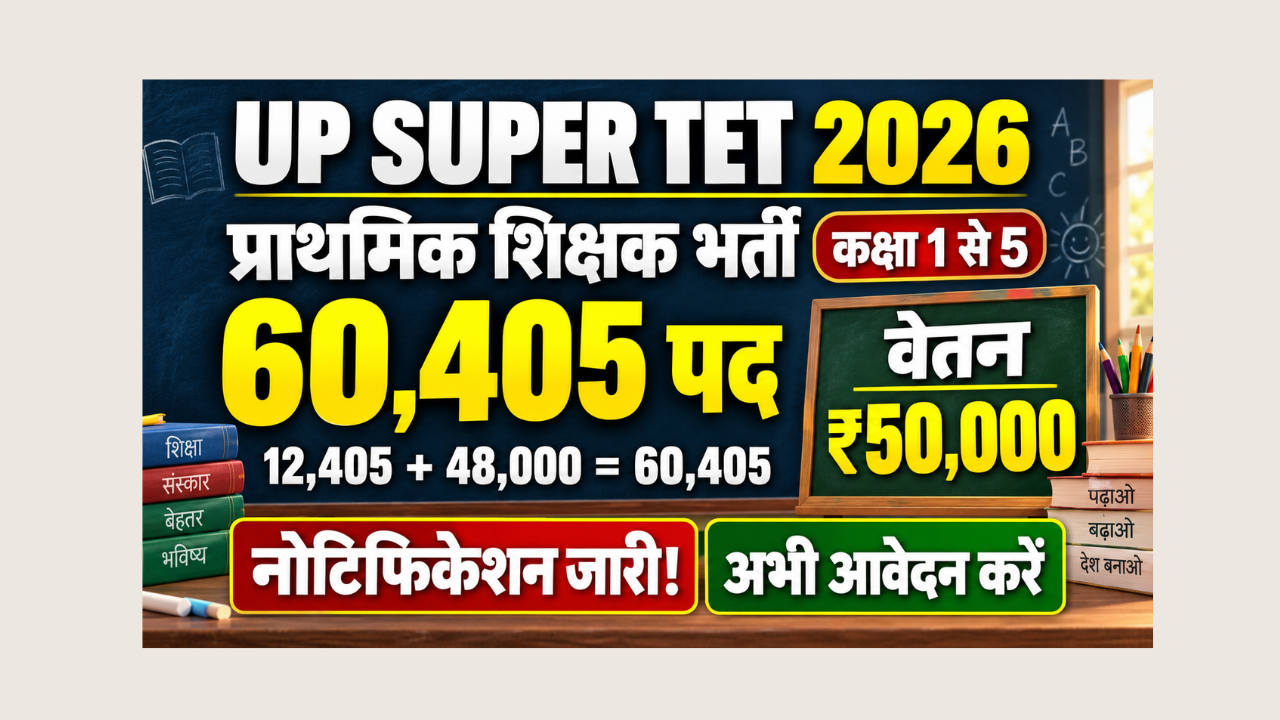
UP Super TET Primary Vacancy 2026 ( 12405+48000 )

UP Super TET Primary Vacancy 2026 ( 12405+48000 )

Uttar Pradesh’s primary teacher recruitment has finally moved from rumour to reality, and if you’ve been tracking the “48,000 vacancy” number circulating online, this article will clear up exactly where that figure comes from, what’s officially notified right now, and what’s still pending. There’s genuine confusion mixing several different numbers together, so let’s untangle it properly before getting into dates, eligibility, and exam pattern.

The 48,000 Figure: What It Actually Means

Here’s the honest picture. Reports from mid-2026 flagged that Uttar Pradesh’s Basic Education Department had identified close to 60,000 vacant primary and upper-primary teaching posts across the state’s council schools. Of that combined figure, roughly 11,508 posts belonged to urban-area primary schools, and the remaining approximately 48,000 posts were identified as vacant in rural-area council primary schools.

That 48,000 rural figure is real, but it has not yet been formally notified as part of a recruitment advertisement. As of now, the department has only sent consolidated vacancy information for the rural posts internally while updating recruitment rules, and candidate groups have publicly demanded that these rural vacancies be added to the ongoing recruitment cycle. So if you came here expecting an active application window for 48,000 posts, that specific notification hasn’t happened yet — but the demand and the identified vacancy pool are both very much on record, and this is widely expected to be the next major addition once the department finalizes the rural recruitment framework.

DetailInformation
Recruitment NameSuper TET (Assistant Teacher, Primary) 2026
Conducting BodyUPESSC, Prayagraj
Advertisement Number05/2026
Notification DateSeptember 15, 2026
Officially Notified Vacancies12,405 (11,508 urban + 897 aided)
Rural Vacancies Identified (Not Yet Notified)Approx. 48,000
Application Start DateSeptember 16, 2026
Application Last DateOctober 15, 2026
Correction Window ClosesOctober 19, 2026
Exam DatesDecember 3–4, 2026
Total Questions / Marks120 Questions / 360 Marks
Negative Marking1 mark deducted per wrong answer
Pay Scale₹35,400 – ₹1,12,400 (Level 6)
Official Websiteupessc.up.gov.in

What’s Officially Notified Right Now

While the rural 48,000 posts remain pending, UPESSC has already released a formal notification for the urban and aided portion of this same overall vacancy pool. Here’s what’s confirmed:

The Uttar Pradesh Education Service Selection Commission (UPESSC), Prayagraj, released the Super TET 2026 notification under Advertisement No. 05/2026 on September 15, 2026. This covers a total of 12,405 Assistant Teacher (Primary) vacancies, split between 11,508 posts in urban primary schools under the Basic Education Department and 897 posts attached to primary schools of aided institutions under the Secondary Education Department.

Online applications opened on September 16, 2026, based on the One Time Registration (OTR) system that UPESSC now uses across its recruitment cycles. The last date to apply and deposit the application fee is October 15, 2026, and the correction window for submitted applications closes on October 19, 2026. The written examination itself is scheduled for December 3 and 4, 2026, to be held across 75 districts of the state.

Interestingly, this isn’t happening in isolation. Alongside the primary teacher notification, UPESSC has also separately notified 2,607 PGT posts for aided secondary schools under Advertisement No. 06/2026, with that exam scheduled for December 15 and 16, 2026. Combined, the two notifications together account for over 15,000 teaching posts being processed in the same recruitment window, which gives you a sense of just how active this recruitment season is for UP’s education sector.

Eligibility Criteria for Super TET Primary 2026

To apply for the Assistant Teacher (Primary) posts under this notification, candidates need to meet the following requirements:

Educational qualification requires graduation along with a recognized teacher-training qualification such as D.El.Ed or BTC. Critically, candidates must also have qualified UPTET or CTET for Classes 1 to 5, since Super TET is a recruitment exam layered on top of TET qualification, not a replacement for it.

For the urban Assistant Teacher posts, the minimum age is 21 years as on July 1, 2026, with a maximum age limit of 40 years as specified in the notification. For the attached primary Assistant Teacher posts, the minimum age is also 21 years, with a retirement-linked upper age boundary of 62 years rather than a fixed maximum. Age relaxation applies as per standard Uttar Pradesh government norms — 5 years for eligible SC, ST, and OBC candidates of the state, 15 years for eligible PwD candidates, and other category-specific relaxations detailed in the official notification.

It’s worth noting that a second Gazette notification has introduced a change specific to BTC-category vacancies in attached primary sections of Intermediate Colleges and High Schools, which will now be filled through direct recruitment. If you fall into this specific category, it’s worth reading that provision carefully in the official document.

Exam Pattern: What Changed From Previous Cycles

The Super TET 2026 exam pattern has been revised compared to earlier cycles, and the shift is significant enough that old preparation material based on the previous structure needs a second look.

The exam is conducted offline in pen-and-paper, OMR-based mode, with the question paper set bilingually in both Hindi and English. Under the revised pattern, the exam consists of 120 objective-type questions, each carrying 3 marks, for a total of 360 marks, to be completed within 2 hours. A notable change from earlier Super TET cycles is the introduction of negative marking — 1 mark is deducted for each incorrect answer. This is a departure from some previous cycles where no negative marking applied, so candidates need to genuinely rethink their guessing strategy rather than attempting every question blindly.

If the exam is conducted in a single shift, raw scores are used directly to prepare the merit list. If it’s held across multiple shifts, UPESSC applies a score-normalization process to ensure fairness across different question sets, as specified in the official notification. Selection is purely merit-based on the written exam score — there is no separate interview or additional weightage for academic marks in the final merit calculation for this cycle. Shortlisted candidates proceed directly to document verification after the result. In case of a tie in marks, preference is given first to the candidate with a higher percentage in graduation.

The subject-wise weightage for the written exam broadly covers Language (Hindi, Sanskrit, and English), Mathematics, Science, Environment and Social Studies, Teaching Aptitude (Shikshan Kaushal), Child Psychology (Bal Manovigyan), General Knowledge and Current Affairs, Logical Reasoning, Information Technology, and Life Skills and Management. Since the syllabus has been revised alongside the pattern, it’s worth downloading the latest official syllabus PDF rather than relying on older subject breakdowns that may not reflect the current question distribution.

Salary and Pay Scale

Selected candidates under this notification are appointed as Assistant Teachers at Pay Level 6 of the Uttar Pradesh government pay matrix, with a pay scale ranging from ₹35,400 to ₹1,12,400. Along with house rent allowance and other standard government benefits applicable as per UP norms, the effective in-hand salary typically works out in a healthy range once postings and allowances are factored in — a meaningful long-term incentive for candidates weighing this against other state-level teaching opportunities.

How to Apply

Candidates need to complete One Time Registration (OTR) before submitting their application, since UPESSC has moved to this centralized registration system across its recruitment drives. Once registered, applicants fill out the Super TET 2026 application form, upload the required documents in the prescribed format, pay the applicable fee, and submit before the October 15, 2026 deadline. It’s worth double-checking every document upload carefully, since incorrect or unclear uploads are one of the most common reasons applications get flagged during verification.

What This Means If You’re Waiting on the Rural Vacancies

If you’ve been specifically waiting for the rural 48,000-post recruitment rather than the urban 12,405 posts currently open, here’s the realistic picture: the vacancy count has been identified and reported by the department, recruitment rules are reportedly being updated to accommodate it, and this would mark the first time the Education Service Selection Commission —rather than the older Examination Regulatory Authority conducts the full selection process for council primary school teachers. But until a formal advertisement number and notification date are issued for these rural posts specifically, treat every date or number you see for that segment as an informed estimate rather than a confirmed detail. The most reliable way to stay ahead of this is to keep checking the official UPESSC portal directly, since that rural notification is realistically one of the more significant education recruitment announcements still pending in Uttar Pradesh.

UP Super TET Junior Teacher (Classes 6th to 8th) 2026 Vacancy, Salary, Eligibility

UP Super TET Junior Teacher (Classes 6th to 8th) 2026 Vacancy, Salary, Eligibility &

Uttar Pradesh’s upcoming teacher recruitment drive has two distinct tracks running in parallel, and mixing them up is the single most common mistake candidates make right now. One track covers Primary Teachers for Classes 1 to 5. The other — the one this article focuses on — covers Junior Teachers for Classes 6th to 8th, commonly referred to as UP Super TET Junior 2026. If you’re a B.Ed graduate with UPTET Paper 2 or CTET Paper 2 in hand, this is the recruitment cycle built specifically for you.

Where Things Currently Stand: Junior vs Primary Recruitment

This distinction matters more than most articles online make clear. On 15 September 2026, the Uttar Pradesh Education Service Selection Commission (UPESSC) released an official notification (Advertisement No. 05/2026) — but that notification covers 12,405 Primary Teacher vacancies only, split between Urban Primary posts under the Basic Education Department and Attached Primary posts in aided institutions. Applications for that cycle opened on 16 September and run until 15 October 2026, with the exam scheduled for 3 and 4 December 2026.

The Junior Teacher recruitment for Classes 6th to 8th is a separate stream and, as of now, its own formal advertisement is still awaited from UPESSC. Industry trackers and recruitment portals have been circulating an expected vacancy figure of around 7,800 posts for this Junior stream, with an anticipated starting salary in the range of ₹52,000 per month once HRA, DA, and other allowances are factored in. These figures are reasonable projections based on current recruitment patterns and reported estimates, but they are not yet confirmed by an official gazetted notification specific to the Junior category. Treat them as the direction things are heading rather than a locked-in fact until UPESSC publishes the dedicated Junior Teacher advertisement.

What Makes the Junior Teacher Post Different from Primary Teacher

Both posts fall under the broader Super TET umbrella, but they’re built for genuinely different candidate profiles:

Primary Teachers (Classes 1–5) work across ten foundational subject areas and require a D.El.Ed or BTC qualification along with UPTET/CTET Paper 1. Junior Teachers (Classes 6th to 8th), on the other hand, teach within specialized subject streams — Language, Social Studies, or Science & Mathematics — in upper primary schools, and eligibility opens up to both B.Ed and D.El.Ed qualified candidates, provided they hold a valid Paper 2 qualification from UPTET or CTET.

That last point is worth underlining for B.Ed holders specifically. Since B.Ed candidates are not eligible for Primary Teacher (Classes 1–5) posts under current rules, the Junior Teacher stream becomes the primary entry point into UP’s government school system for anyone who pursued a straightforward graduation-plus-B.Ed path rather than a D.El.Ed/BTC route.

Expected Vacancy Breakdown

While the district-wise and subject-wise split for the ~7,800 expected Junior vacancies hasn’t been officially released, based on how upper primary recruitment has historically been structured in UP, expect the notification to divide seats across the three subject streams — Language, Social Studies, and Science & Mathematics — with further category-wise reservation applied as per state norms (SC, ST, OBC, EWS, and general category allocations). Once the official advertisement drops, this is the first section worth checking closely, since your specific subject stream’s vacancy count will directly shape how competitive your preparation needs to be.

Salary and Pay Structure

Based on the pay matrix currently applicable to Assistant Teacher posts under Super TET recruitment, the pay scale sits at Level 6, ranging from ₹35,400 to ₹1,12,400. In-hand salary — after HRA, DA, and standard deductions — typically works out to somewhere between ₹45,000 and ₹55,000 per month, depending on posting location (urban postings generally carry higher HRA than rural ones). The commonly cited ₹52,000 figure for Junior Teachers fits comfortably within this range and represents a realistic in-hand estimate for a mid-tier posting location.

Beyond the monthly pay, the post carries the full weight of a permanent government job: pension benefits, General Provident Fund contributions, job security, and periodic increments tied to central and state pay commission revisions. It’s also worth noting that with the 8th Pay Commission expected to influence government salary structures going forward, these figures may see upward revision by the time actual appointments are made.

Eligibility Criteria

Based on the established framework for Super TET Junior recruitment, here’s what you’ll need:

Educational qualification requires a graduation degree along with a B.Ed (or D.El.Ed/BTC, depending on the specific post category), plus a valid UPTET Paper 2 or CTET Paper 2 qualifying certificate. The general age bracket for Super TET recruitment runs from 21 to 40 years, with the standard 5-year upper age relaxation applicable to SC, ST, and OBC candidates as per Uttar Pradesh government reservation rules.

One recent development worth flagging: a second gazette notification issued around 11 September 2026 clarified that BTC-category vacancies in certain attached sections will now be filled through direct recruitment, and reaffirmed that a B.Ed qualification alone is not automatically treated as equivalent to BTC for every post category. If you’re relying on a B.Ed as your sole teaching qualification, it’s worth reading the fine print of the official notification closely once it’s out, rather than assuming blanket eligibility across every Junior Teacher vacancy.

Exam Pattern

The verified Super TET 2026 examination structure applies across both Primary and Junior streams, with subject content naturally differing based on the post applied for:

The exam consists of 120 objective-type multiple-choice questions, to be completed within 120 minutes (2 hours), carrying a maximum of 360 marks. The marking scheme awards +3 marks for every correct answer and deducts −1 mark for each incorrect answer — meaning negative marking is firmly in place, so blind guessing carries real risk. The question paper is bilingual, set in both Hindi and English, and the exam is conducted offline in pen-and-paper, OMR-based mode.

For the Junior Teacher stream specifically, expect your paper to draw from your chosen specialization — Language, Social Studies, or Science & Mathematics — layered with the standard pedagogy, child development, and general awareness components that form the backbone of the broader Super TET syllabus.

Selection is based purely on your written exam score. There’s no separate interview round and no additional weightage given to academic marks in the final merit calculation for this cycle — your rank is determined entirely by your performance in that single 360-mark paper, followed by document verification for shortlisted candidates.

How to Apply Once the Notification Is Released

When the official Junior Teacher advertisement goes live, the application process is expected to follow the same structure UPESSC has used for the Primary Teacher cycle:

First, complete One Time Registration (OTR) on the UPESSC portal if you haven’t already, since this generates the unique OTR ID required before you can apply to any UPESSC recruitment cycle. Once your OTR is active, log in, select the Super TET Junior Teacher recruitment link, and fill in your personal, educational, and category details carefully. Upload the required scanned documents — certificates, photographs, signature, and category proof — in the specified format and size. Pay the prescribed application fee through the available online payment modes, and review every entered detail carefully before final submission, since correction windows are typically short and don’t remain open indefinitely.

Preparation Strategy While You Wait

The gap before the official notification drops is genuinely your most valuable preparation time, not a reason to pause. A few focused steps:

Start by nailing down your subject stream now — Language, Social Studies, or Science & Mathematics — rather than waiting for the notification to decide for you, since deep subject preparation takes months, not weeks. Work through the general Super TET syllabus components (child development and pedagogy, general awareness, and your subject stream) using previous years’ Primary and Junior Teacher papers as a reference for question style and difficulty. Given that negative marking applies, build an elimination-based answering habit early, rather than developing a guessing reflex you’ll need to unlearn later. Keep your UPTET/CTET Paper 2 certificate, degree certificates, and category documents organized and ready, since application windows close faster than most candidates expect.

The Bottom Line

The UP Super TET Junior Teacher 2026 recruitment for Classes 6th to 8th is shaping up to be a genuinely significant opportunity for B.Ed and D.El.Ed qualified candidates holding a valid Paper 2 certificate, with expected numbers around 7,800 vacancies and a realistic in-hand salary near ₹52,000 once fully rolled out. The already-released Primary Teacher notification (12,405 vacancies) confirms that UPESSC’s broader recruitment machinery is actively moving, which makes a dedicated Junior Teacher advertisement a matter of when, not if. Use this waiting period to lock in your subject preparation, organize your documents, and check the official UPESSC portal regularly so you’re among the first to apply the moment the notification lands.

Official Links and Resources

ResourceDescriptionLink
UPESSC Official WebsitePrimary source for all notifications, syllabus, and resultshttps://www.upessc.up.gov.in/
Super TET 2026 Notification (Advt. No. 05/2026)Official notification PDF for the released Primary Teacher cycle (12,405 vacancies)Available under “Latest Notifications” on upessc.up.gov.in
UP Basic Education Board (UPBEB)Departmental portal for basic education recruitment updateshttps://upbeb.org/
UP Education Department PortalAdditional recruitment and policy updateshttps://updeled.gov.in/
One Time Registration (OTR) PortalMandatory registration before applying to any UPESSC recruitmentAccessible via upessc.up.gov.in homepage
50% OFF
📚

Super TET Mock Papers

Complete Exam Solutions with Solutions

50% OFF
📚

Super TET Mock Papers

Complete Exam Solutions with Solutions