Latest

UP PGT Teacher Recruitment 2026 Apply Online

UP PGT Teacher Recruitment 2026 Apply Online

The Uttar Pradesh Education Service Selection Commission (UPESSC) has released the UP PGT Teacher Recruitment 2026 notification for 2,607 Post Graduate Teacher vacancies under Advertisement No. 06/2026. The recruitment is for the Lecturer or Post Graduate Teacher cadre in aided secondary schools across Uttar Pradesh.

According to the recruitment information, the online application process will begin on 18 September 2026 and eligible candidates will be able to submit their applications until 17 October 2026. Candidates should carefully check the subject wise qualification, age requirement, application fee and other conditions before submitting the form.

ParticularDetails
Recruitment AuthorityUttar Pradesh Education Service Selection Commission
Post NamePost Graduate Teacher (PGT)
Recruitment Year2026
Advertisement Number06/2026
Total Vacancies2,607
DepartmentSecondary Education
Job TypeGovernment Aided School Teaching Job
Application ModeOnline
Application Start Date18 September 2026
Application Last Date17 October 2026
Fee Payment Last Date17 October 2026
Correction Last Date21 October 2026
Proposed Examination Date15 and 16 December 2026
Minimum Age21 Years
Maximum Age62 Years
Educational QualificationMaster’s Degree in the relevant subject
Selection ProcessWritten Examination, Interview and Document Verification
Official Websiteupessc.up.gov.in

The recruitment notification is being issued by UPESSC, the Uttar Pradesh Education Service Selection Commission. The detailed advertisement should be treated as the final authority for subject wise qualifications, reservation, vacancies and other recruitment conditions.

UP PGT Vacancy 2026

A total of 2,607 Post Graduate Teacher posts have been announced under Advertisement No. 06/2026.

The posts are intended for the PGT or Lecturer cadre in Uttar Pradesh aided secondary education institutions. The detailed notification should be checked for the complete subject wise and category wise vacancy distribution.

PostTotal Vacancies
Post Graduate Teacher2,607
Total2,607

The 2,607 vacancies in this recruitment are separate from the earlier UP PGT recruitment cycle under Advertisement No. 02/2022, which had 624 PGT vacancies. Candidates should not confuse the earlier 624 post recruitment with the new 2026 notification.

UP PGT Teacher Recruitment 2026 Important Dates

EventDate
Notification Date15 September 2026
Online Application Starts18 September 2026
Last Date to Apply17 October 2026
Last Date for Fee Payment17 October 2026
Correction Last Date21 October 2026
Written Examination15 and 16 December 2026
Admit CardBefore the Examination
ResultTo be announced

Candidates should complete registration and fee payment well before the closing date instead of waiting until the final day. The recruitment page states that applications are to be submitted online and that the application link will become active from 18 September 2026.

UP PGT Teacher Eligibility Criteria 2026

Candidates applying for UP PGT Teacher Recruitment 2026 must satisfy the educational and age requirements prescribed by UPESSC.

Educational Qualification

The basic qualification mentioned for the recruitment is a Master’s Degree in the relevant subject from a recognized university or institution.

However, PGT eligibility can differ according to the teaching subject. Therefore, candidates should not rely only on the general qualification mentioned in short recruitment summaries. They should check the detailed UPESSC notification for the exact subject wise qualification before applying.

For example, a candidate applying for a particular PGT subject generally needs the prescribed postgraduate qualification in that concerned subject or an accepted related subject as specified in the official recruitment rules.

UP PGT Age Limit 2026

The age limit mentioned for UP PGT Teacher Recruitment 2026 is:

Age RequirementDetails
Minimum Age21 Years
Maximum Age62 Years
Age Calculation Date1 July 2026

UPESSC has also provided for age relaxation according to the applicable recruitment rules. Candidates belonging to reserved categories and other eligible groups should check the official notification for the exact relaxation applicable to them.

UP PGT Application Fee 2026

The application fee mentioned for the recruitment is different according to the candidate’s category.

CategoryApplication Fee
General₹1,500
EWS₹1,500
OBC₹1,500
SC₹750
ST₹750
PH₹500

The fee can be paid through the online payment methods provided during the application process, including debit card, credit card, internet banking and other available payment options. Candidates should verify the fee displayed on the official application portal before making payment.

UP PGT Selection Process 2026

The UP PGT recruitment process includes multiple stages. The recruitment information specifies the following stages:

  1. Written Examination
  2. Interview or Viva Voce
  3. Document Verification

Candidates must qualify at the applicable stages to be considered for final selection. The final selection and merit process will be governed by the rules and weightage specified in the official notification.

UP PGT Exam Pattern

Candidates preparing for the UP PGT examination should carefully distinguish the examination pattern applicable to the current recruitment from information relating to previous recruitment cycles.

For the earlier UP PGT examination cycle, the written examination consisted of 125 objective questions carrying 425 marks, with a duration of two hours and no negative marking. The final merit structure also included interview and special qualification components.

ComponentPrevious UP PGT Pattern
Written Questions125 MCQs
Written Examination Marks425
Marks per Question3.4
Duration2 Hours
Negative MarkingNo
Interview50 Marks
Special QualificationUp to 25 Marks
Total Merit Structure500 Marks

Important: Candidates applying under Advertisement No. 06/2026 should follow the examination pattern printed in the new official notification if it differs from the previous cycle. Online sources may continue to display the pattern of the earlier 2022 recruitment.

UP PGT Syllabus 2026

The PGT examination is primarily focused on the candidate’s concerned postgraduate subject. The exact syllabus depends on the subject selected by the applicant.

Subjects that have appeared in previous UP PGT recruitment cycles include:

Subject AreaExamples
LanguagesHindi, English, Sanskrit
SciencePhysics, Chemistry, Biology
MathematicsMathematics
Social SciencesHistory, Geography, Civics, Sociology, Economics
CommerceCommerce
ArtsArt
EducationEducation
AgricultureAgriculture
PsychologyPsychology
Home ScienceHome Science

The previous UP PGT recruitment included 18 subjects, with the vacancy distribution varying significantly from one subject to another. Candidates should therefore download and study the subject specific syllabus applicable to their selected post.

UP PGT Salary 2026

The PGT post has a Pay Level 8 salary structure in the earlier UP TGT and PGT recruitment information.

The reported pay scale for PGT was:

₹47,600 to ₹1,51,100

with a Grade Pay of ₹4,800 under the earlier structure.

The actual monthly salary received by a selected teacher can vary depending on basic pay, allowances, deductions, place of posting and applicable government rules.

UP PGT Teacher Job Profile

A Post Graduate Teacher generally teaches students at the senior secondary level in the concerned subject. The responsibilities can include:

  1. Teaching the assigned subject according to the prescribed curriculum
  2. Preparing lesson plans and classroom activities
  3. Conducting tests and evaluating student performance
  4. Maintaining academic records
  5. Supporting students in examination preparation
  6. Participating in school activities and academic programs
  7. Performing other duties assigned under applicable school and education department rules

The exact responsibilities depend on the institution, subject and applicable service rules.

How to Apply for UP PGT Teacher Recruitment 2026

Eligible candidates can apply through the official UPESSC online portal.

Step 1: Visit the Official Website

Open the UPESSC website at upessc.up.gov.in.

Step 2: Find the PGT Recruitment

Look for the recruitment notification or online application link related to Advertisement No. 06/2026.

Step 3: Complete Registration

Enter the required personal and registration information carefully.

Step 4: Fill the Application Form

Provide educational qualifications, subject information, category details and other required information.

Step 5: Upload Documents

Upload the required photograph, signature and supporting documents in the prescribed format and size.

Step 6: Pay the Application Fee

Pay the applicable fee according to your category using the available online payment method.

Step 7: Review the Form

Before final submission, check your name, date of birth, educational details, category, subject and other information carefully.

Step 8: Submit and Save

Submit the completed application form and download or print the confirmation page for future reference.

The recruitment information advises candidates to read the official notification carefully before completing the form because eligibility, age, qualification and other conditions are governed by the official advertisement.

Documents Required for UP PGT Application

Candidates should keep the following documents and information ready while completing the online form:

  1. Recent passport size photograph
  2. Signature
  3. Master’s degree or marksheet
  4. Graduation documents where required
  5. Category certificate, if applicable
  6. Domicile certificate, where applicable
  7. Valid identity proof
  8. Educational qualification certificates
  9. Relevant special qualification certificates, if applicable
  10. Active mobile number
  11. Email address
  12. Payment details

The exact document requirements, file size and accepted formats should be confirmed from the official application instructions.

UP PGT Admit Card 2026

The UP PGT admit card is expected to be made available before the written examination. Candidates who successfully complete the application process should regularly check the official UPESSC website.

The admit card is an important examination document and generally contains information such as:

  1. Candidate name
  2. Roll number
  3. Examination date
  4. Examination centre
  5. Reporting time
  6. Examination instructions
  7. Candidate photograph and other identification details

Candidates should download the admit card as soon as it becomes available and carefully verify all details.

UP PGT Result 2026

The UP PGT result will be released by the concerned commission after completion of the examination process.

For the previous PGT recruitment cycle, the written examination was conducted on 9 and 10 May 2026, and the written result was subsequently released for candidates shortlisted for the interview stage.

For the new Advertisement No. 06/2026 recruitment, candidates should rely on the official UPESSC website for the result date and merit list.

UP PGT Preparation Strategy

Candidates preparing for the examination should start with the official syllabus and divide the preparation according to their postgraduate subject.

A practical preparation strategy includes:

the Syllabus

Download the subject specific syllabus and identify important units before starting preparation.

Study Core Concepts

Because PGT recruitment is intended for postgraduate level teaching positions, candidates should focus strongly on concepts, theories, important facts and subject specific applications.

Practice Previous Papers

Previous question papers can help candidates the level and style of questions asked in the examination.

Revise Regularly

Create short revision notes for formulas, definitions, theories, dates, important personalities and other subject specific information.

Attempt Mock Tests

Mock tests can help improve speed, accuracy and time management.

Prepare for the Interview

PGT candidates should also prepare for the interview because the selection process includes an interview stage. Candidates should be ready to discuss their subject, teaching methodology, educational background and general awareness.

Important Points for Candidates

Candidates should keep the following points in mind before submitting the UP PGT application:

  1. The new recruitment is being conducted under Advertisement No. 06/2026.
  2. The recruitment contains 2,607 PGT vacancies.
  3. Online applications are scheduled to begin on 18 September 2026.
  4. The application deadline is 17 October 2026.
  5. The correction window is scheduled up to 21 October 2026.
  6. The proposed written examination dates are 15 and 16 December 2026.
  7. The minimum age mentioned is 21 years.
  8. The maximum age mentioned is 62 years as on 1 July 2026.
  9. A Master’s Degree in the relevant subject is the basic qualification mentioned in the recruitment summary.
  10. Candidates should check the detailed official notification for subject wise qualification before applying.
  11. Candidates should use only the official UPESSC portal for the final application and official notices.

UP PGT Recruitment 2026 Frequently Asked Questions

How many vacancies are available in UP PGT Recruitment 2026?

A total of 2,607 Post Graduate Teacher vacancies have been announced under Advertisement No. 06/2026.

When will the UP PGT online application start?

The online application is scheduled to start on 18 September 2026.

What is the last date to apply for UP PGT Recruitment 2026?

The last date for submitting the application is 17 October 2026.

What is the age limit for UP PGT Teacher Recruitment 2026?

The mentioned age limit is 21 to 62 years, calculated as per the recruitment conditions with 1 July 2026 given as the relevant date.

What is the qualification for UP PGT Teacher Recruitment 2026?

Candidates need a Master’s Degree in the relevant subject, with detailed subject specific requirements prescribed in the official notification.

What is the UP PGT application fee?

The listed fee is ₹1,500 for General, EWS and OBC candidates, ₹750 for SC and ST candidates and ₹500 for PH candidates.

What is the UP PGT selection process?

The selection process includes a written examination, interview or viva voce and document verification.

What is the UP PGT salary?

The earlier UP PGT pay structure was Pay Level 8 with a pay scale of ₹47,600 to ₹1,51,100. The applicable salary for the new recruitment should be confirmed from the official advertisement.

When will the UP PGT exam be conducted?

The recruitment information lists 15 and 16 December 2026 as the examination dates.

Official Links

PurposeOfficial Link
UPESSC Official WebsiteClick Here
UP PGT Recruitment NotificationClick Here
UP PGT Online ApplicationClick Here
UPESSC Recruitment SectionClick Here
UPESSC Official NoticesClick Here
Home PageClick Here

UP Super TET Notification 2026 Apply Online

UP Super TET Notification 2026

Uttar Pradesh has one of the largest school education systems in the country, and Super TET remains one of the most sought after routes into a government teaching career in the state. Lakhs of trained graduates who have already cleared CTET or UPTET wait every year for this single exam that decides who gets appointed as an Assistant Teacher in UP’s primary and upper primary schools. Here is a complete, easy to understand guide on the Super TET 2026 notification, based on the latest available information.

Current Status of Super TET 2026 Notification

As of early September 2026, the official Super TET 2026 notification has not yet been released by the Uttar Pradesh Basic Education Board (UPBEB) or the Uttar Pradesh Education Service Selection Commission (UPESSC). Multiple exam preparation portals report that the notification is expected soon, with several sources pointing toward a possible release in September 2026. This timeline is linked to the release of the UPTET 2026 result, since a valid CTET or UPTET score is a mandatory eligibility requirement for Super TET.

Candidates are strongly advised to treat all such expected dates as indicative only. The final and only reliable confirmation will come from the official notification published on the board’s own website.

What Is Super TET

Super TET, short for Super Teacher Eligibility Test, is a state level recruitment examination conducted in Uttar Pradesh. It is not a mere eligibility test like CTET or UPTET; it is the final selection stage for appointment to the posts of Assistant Teacher (Primary and Upper Primary) and, in some cycles, Headmaster or Principal in UP government and government aided schools. Only candidates who have already cleared CTET or UPTET can appear for Super TET.

Organising Body

The exam has historically been conducted by the Uttar Pradesh Basic Education Board. In recent recruitment cycles, the Uttar Pradesh Education Service Selection Commission has also been associated with releasing notifications and vacancy details for teacher recruitment in the state. Candidates should check both updeled.gov.in and the UPESSC portal for authentic updates.

Eligibility Criteria

While final eligibility conditions will be confirmed only in the official notification, based on past cycles the general requirements are expected to include the following.

Educational Qualification: A graduation degree along with a recognised teaching qualification such as B.Ed, D.El.Ed, or BTC.

TET Qualification: A valid CTET or UPTET qualifying certificate is compulsory.

Domicile: Only permanent residents of Uttar Pradesh are generally eligible to apply.

Age Limit: The age limit typically follows the pattern of previous UP teacher recruitment exams, with standard relaxations for reserved categories as per state government rules.

Exam Pattern

Based on the pattern followed in earlier Super TET examinations, the following structure is generally for 2026, subject to final confirmation in the notification.

The exam is conducted offline in pen and paper mode.

It typically consists of 150 objective type questions carrying 150 marks.

The total duration is around 2 hours 30 minutes.

The question paper is usually set bilingually in Hindi and English.

Subjects generally include Child Development and Pedagogy, Hindi, English, Mathematics, Environmental Studies or the relevant subject knowledge area, and General Awareness.

Candidates should not rely on unofficial sources for details such as negative marking. This must always be verified from the official PDF once released.

Selection Process

Selection for Super TET is to continue on a merit basis, combining two components as followed in previous cycles.

Written Exam Score: This usually carries the larger weightage, historically around 60 percent.

Academic Performance Index: This accounts for the remaining weightage, calculated from marks obtained in Class 10, Class 12, Graduation, and the teaching qualification such as B.Ed or D.El.Ed or BTC.

This is followed by document verification, where original academic certificates, teaching mark sheets, category certificates, and domicile proof are physically checked before final appointment.

Vacancy Expectations

Uttar Pradesh has a significant backlog of vacant teacher posts across its primary and upper primary schools. Several education portals expect a substantial number of vacancies to be announced once the Super TET 2026 notification is formally released. The exact number of posts, category wise breakup, and subject wise vacancies will only be confirmed in the official advertisement.

How to Apply

Once the notification is released, applications are to be submitted online through the official portal. The general process, based on earlier cycles, is likely to look like this.

  1. Visit the official website, updeled.gov.in, or the UPESSC portal once live.
  2. Locate and click on the Super TET Recruitment 2026 notification link.
  3. Register using mobile number, email address, and CTET or UPTET roll number.
  4. Log in using the system generated registration number and password.
  5. Fill in personal details, academic scores, qualifications, and category preferences.
  6. Upload scanned photograph and signature as per the specified format.
  7. Pay the application fee through UPI, net banking, or card payment.
  8. Preview and verify all filled details carefully before final submission.
  9. Submit the form and download or print the confirmation page for future reference.

A correction window is typically opened after the initial submission period so that candidates can rectify genuine errors, and this too will be specified in the notification.

Application Fee (Based on Previous Trends)

Exact fee details for 2026 have not been announced. In earlier Super TET cycles, fees were generally category based, with general and OBC candidates paying a higher fee than SC, ST, and PwD candidates. The confirmed fee structure will be published along with the official notification.

Salary and Pay Scale

Assistant Teachers selected through Super TET are placed in the regular pay scale applicable to UP government primary and upper primary school teachers, along with dearness allowance, house rent allowance, and other benefits admissible under state government rules. Exact figures can vary based on posting location and category, and should be confirmed from the official notification or pay commission recommendations applicable at the time of appointment.

How to Prepare While Waiting for the Notification

Since the exam pattern and syllabus are largely to follow earlier trends, candidates can use this waiting period productively.

Revise the syllabus already prescribed in earlier Super TET cycles, since core subjects rarely change drastically.

Practice previous years’ question papers to understand question difficulty and pattern.

Keep all documents, including TET certificates, academic mark sheets, category certificates, and domicile proof, ready and updated.

Follow the official website regularly rather than depending only on third party updates, so that important dates are not missed.

Table of Official and Important Links

PurposeLink
UP Super TET Notification 2026Click Here
Official UP Basic Education Department PortalClick Here
UPBEB Official WebsiteClick Here
UPESSC (UP Education Service Selection Commission)Click Here
UPTET Official InformationClick Here

UP Super TET New Exam Pattern 2026

UP Super TET New Exam Pattern 2026

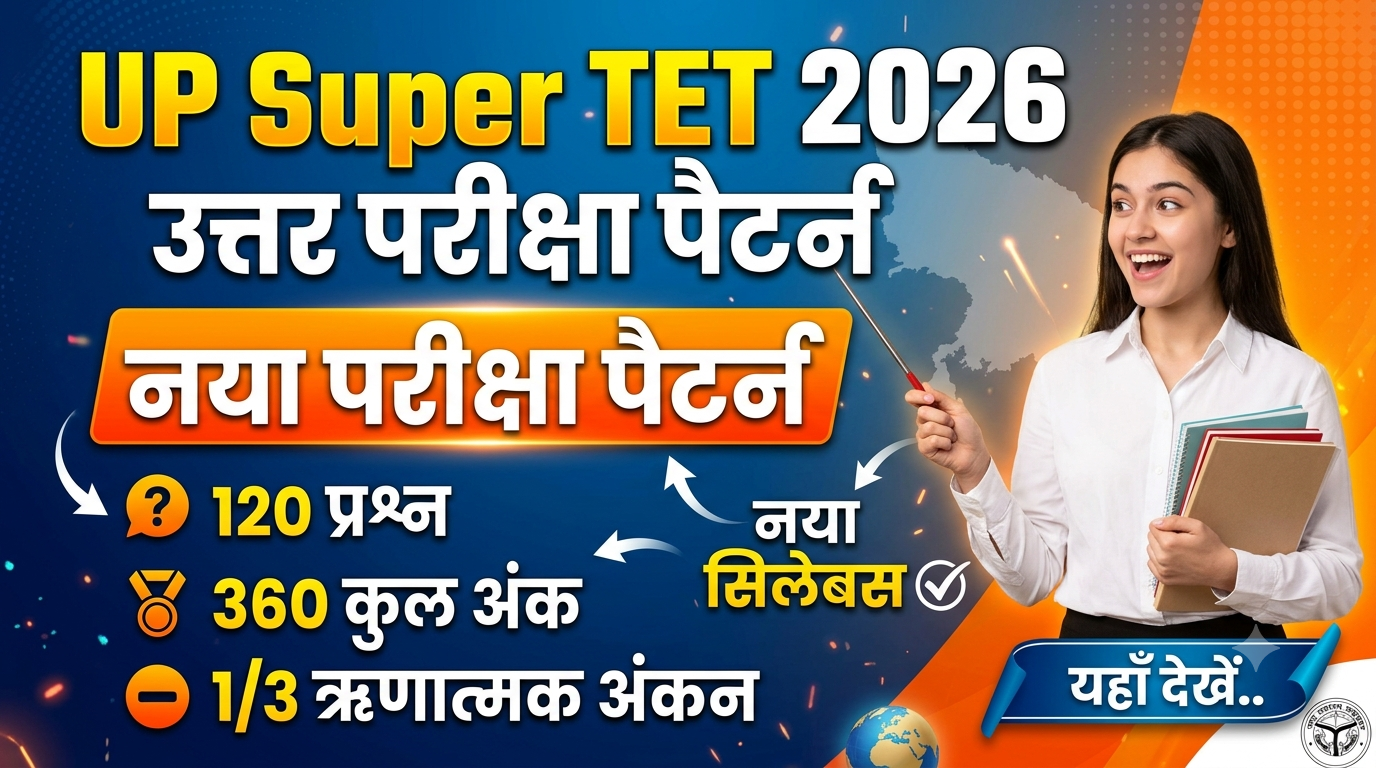
Super TET (Super Teacher Eligibility Test) is the recruitment exam conducted by the Uttar Pradesh Education Service Selection Commission (UPESSC) to select Assistant Teachers for government schools in Uttar Pradesh. Unlike CTET or UPTET, which only confirm teaching eligibility, Super TET is the actual selection exam that decides a candidate’s final merit and appointment.

DetailVersion 1 (Widely Cited)Version 2 (Newer, Fewer Sources)
Conducting BodyUPESSCUPESSC
Total Questions120150
Total Marks360150
Marks per Correct Answer31
Negative Marking-1 per wrong answerNone
Exam Duration120 minutes150 minutes (2.5 hrs)
Exam ModeOffline (Pen & Paper)Offline (Pen & Paper)
Question TypeMCQMCQ
LanguageHindi & EnglishHindi & English
Sections2 (GK + Chosen Subject)Combined subject list

Because the recruitment notification is still pending, candidates preparing right now should focus on the subject list and topics, which remain largely consistent across both versions, rather than locking into one marking strategy too early.

Exam Structure (Version 1)

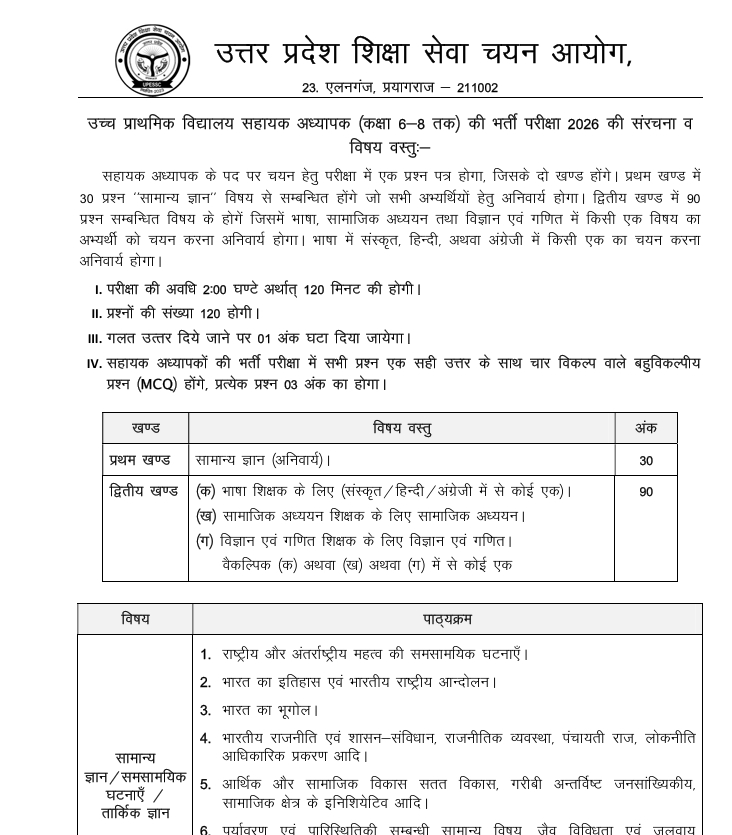
This is the version most syllabus PDFs and coaching platforms currently reference. It splits the paper into two sections:

  • Section 1 – General Knowledge: 30 questions, compulsory for every candidate
  • Section 2 – Chosen Teaching Subject: 90 questions, based on the candidate’s selected subject (Language, Science, Mathematics, or Social Studies)
SectionSubjectQuestions
Section 1General Knowledge30
Section 2Selected Teaching Subject90
Total120

Subject-Wise Marks Distribution (Version 1)

SubjectQuestionsWeightage (%)Marks
Language (Hindi, Sanskrit & English)3025.0%90
General Knowledge & Current Affairs2520.8%75
Mathematics1613.3%48
Science086.7%24
Environmental & Social Studies086.7%24
Teaching Skills086.7%24
Child Psychology086.7%24
Life Skills, Management & Aptitude086.7%24
Logical Reasoning054.2%15
Information Technology (IT)043.3%12
Total120100%360

Subject-Wise Marks Distribution (Version 2)

SubjectQuestionsMarks
Language (Hindi, Sanskrit & English)4040
General Knowledge & Current Affairs3030
Mathematics2020
Science1010
Environment & Social Studies1010
Teaching Aptitude1010
Child Psychology1010
Life Skills, Management & Attitude1010
Logical Reasoning0505
Information Technology (ICT)0505
Total150150

Marking Scheme: What’s Actually Different

The biggest practical difference between the two versions is how mistakes are treated:

  • Version 1 penalizes wrong answers, deducting 1 mark for each incorrect response. This makes guessing risky when a candidate is unsure between options.
  • Version 2 has no negative marking at all, meaning every question is worth attempting since a wrong answer and a blank one both score zero.

Until the official notification confirms which applies, candidates preparing seriously should practice with the same accuracy standard either way — treating every question as if it could be penalized keeps the habit safe regardless of which version is finalized.

Selection Process

Selection for Super TET is not based on the written exam alone. The final merit list combines two components:

  • Written Exam Score: 60% weightage
  • Academic Qualifications: 40% weightage, broken down further as:
    • High School marks
    • Intermediate marks
    • Graduation marks
    • Teacher training (D.El.Ed/B.Ed) marks

Eligibility Snapshot

  • Must have already qualified UPTET or CTET (Paper 1 for Class 1–5 posts, Paper 2 for Class 6–8 posts)
  • Must hold a graduate degree
  • Must have completed D.El.Ed or B.Ed
  • Age typically between 21 and 40 years, as per past cycles

Frequently Asked Questions

Is the Super TET 2026 exam pattern officially confirmed? No. As of now, UPESSC has not released the official Super TET 2026 recruitment notification, so the exam pattern is not yet confirmed. Two versions are being reported by different sources.

Is there negative marking in Super TET 2026? This depends on which version gets confirmed. One reported version deducts 1 mark per wrong answer; another reports no negative marking at all. Candidates should prepare for accuracy regardless.

How many questions are in the Super TET 2026 exam? Sources currently differ between 120 questions (360 marks) and 150 questions (150 marks). This will be confirmed once the official notification is released.

Who conducts the Super TET exam? The Uttar Pradesh Education Service Selection Commission (UPESSC) conducts Super TET for Assistant Teacher recruitment in UP government schools.

Is UPTET or CTET required before applying for Super TET? Yes. Only candidates who have already qualified UPTET or CTET (the relevant paper for their chosen level) are eligible to apply for Super TET.

Where can candidates check the latest official update? Candidates should check updeled.gov.in directly for the official Super TET 2026 notification rather than relying on third-party syllabus pages, since those currently disagree on the exact exam pattern.

UP Assistant Professor Vacancy 2026 (1,936) Posts Apply Online

UP Assistant Professor Vacancy 2026 (1,936) Posts Apply Online

If you’ve completed your NET, SET, SLET, or PhD and have been waiting for a solid opportunity to step into a government degree college in Uttar Pradesh, the wait is finally over. The Uttar Pradesh Education Service Selection Commission (UPESSC) has opened up recruitment for Assistant Professor posts across the state’s degree colleges, and with nearly 2,000 vacancies on offer, this is one of the more significant academic recruitment drives UP has rolled out in recent years.

Here’s everything you need to know, laid out clearly.

Total Vacancies: 1,936 Posts Across 61 Disciplines

The headline number is 1,936 vacancies, spread across 61 different academic disciplines — a spread wide enough that candidates from most postgraduate specializations, from Hindi and History to Physics, Botany, Commerce, and Law, will find relevant openings.

The breakdown by college type looks like this:

  • 1,564 posts in co-educational government degree colleges
  • 372 posts in women’s colleges

This split matters for candidates planning their applications, since it affects both the pool of competing candidates and, in some cases, category-specific reservation calculations depending on the college type you’re applying to.

With 61 disciplines in the mix, this recruitment cycle is genuinely broad-based rather than concentrated in a handful of popular subjects, which is good news if you’ve specialized in a less commonly recruited-for field — competition per seat in smaller disciplines tends to be comparatively less intense than in high-demand subjects like Commerce or English.

Important Dates You Cannot Afford to Miss

Recruitment timelines are unforgiving, and missing a single window can cost you the entire cycle. Here’s the full schedule:

  • Application Start Date: September 8, 2026
  • Last Date to Apply and Pay Fee: October 7, 2026
  • Form Correction Window: Open until October 11, 2026
  • Written Examination Dates: November 19–20, 2026

That gives candidates roughly a month to complete their application, followed by a short correction window before the exam itself, which is scheduled just over five weeks after applications close. If you’re planning to apply, don’t leave the form for the last week — application portals for high-vacancy government recruitments routinely slow down or crash under heavy traffic in the final 48 hours, and a rejected or incomplete form due to a last-minute rush is an entirely avoidable risk.

The correction window deserves special attention too. Many candidates skip reviewing their submitted form carefully, only to notice an error in category, subject code, or personal details weeks later when it’s too late to fix. Since UPESSC is giving a dedicated correction period, use it — go through every field of your submitted application at least once during this window.

Eligibility Criteria: What You Need to Qualify

The eligibility requirements for UP Assistant Professor 2026 follow the standard UGC-aligned framework used for degree college teaching posts across India:

  • A Master’s degree in the relevant subject with a minimum of 55% marks (or an equivalent grade, where applicable, as per standard UGC norms)
  • A qualifying score in NET (National Eligibility Test), SET/SLET (State Eligibility Test), or a PhD in the relevant discipline

This is a fairly standard eligibility bar for Assistant Professor recruitment nationwide, so if you’ve already cleared UGC-NET or hold a doctoral degree, you’re positioned to apply directly without needing to clear any additional qualifying exam solely for eligibility purposes. Category-based relaxation in the minimum percentage requirement is typically available for SC/ST/OBC/PwD candidates as per Uttar Pradesh government reservation norms, though candidates should confirm exact relaxation percentages against the official notification once released.

Pay Scale: What the Job Actually Pays

Selected candidates will be placed under Academic Pay Level-10, with a pay scale ranging from ₹57,700 to ₹1,82,400 per month. This is the standard UGC pay structure applicable to Assistant Professor posts across government-aided institutions in India, and it comes with the additional benefits typically associated with a government academic position — job security, structured career progression through academic pay levels, and eligibility for research and academic grants that come with a formal university-affiliated teaching role.

What the Selection Process Typically Looks Like

While the complete procedural details will be confirmed in the official notification, Assistant Professor recruitment through UPESSC generally follows a written examination as the primary screening stage, testing subject knowledge along with teaching aptitude and general academic awareness relevant to the discipline. Candidates who clear the written exam typically proceed to document verification, and depending on the specific recruitment advertisement, an interview stage may also be included given that Assistant Professor roles, unlike school-level teaching posts, often weigh research background and academic contributions as part of final selection.

Given the exam dates are set for November 19–20, 2026, candidates have a genuine window of roughly two and a half months from the application start date to prepare seriously, provided you begin structuring your revision now rather than waiting for the admit card to arrive.

Why This Recruitment Cycle Is Worth Taking Seriously

A few things make this particular cycle stand out. First, nearly 2,000 vacancies in a single recruitment drive is a substantial number for degree college-level academic hiring in any state, and it reflects a genuine effort by UP to address long-pending faculty shortages across its government colleges. Second, the 61-discipline spread means this isn’t a narrow, subject-specific drive — it’s a broad hiring exercise touching nearly every mainstream postgraduate field.

For candidates who’ve been holding onto a NET qualification or a PhD without a matching opportunity to use it, this is exactly the kind of large-scale, multi-discipline recruitment window that doesn’t come around every year. The gap between now and the written exam is the most valuable preparation time you’ll get, so it’s worth treating the coming weeks as active exam preparation rather than passive waiting.

What You Should Do Right Now

  • Complete your application well before October 7, 2026 to avoid last-minute portal congestion
  • Use the correction window (up to October 11) to carefully review every detail on your submitted form
  • Start subject-specific revision now, since the exam is scheduled just weeks after the application process closes
  • Keep your NET/SET/SLET/PhD certificates and Master’s degree documents organized and ready, since these will be essential both during application and later verification stages
  • Check the official UPESSC website regularly for the detailed notification PDF, which will confirm subject-wise vacancy distribution, exact exam pattern, and any category-wise relaxation details not yet public

Links

UP Assistant Professor Vacancy 2026 Apply LinkClick Here
UP Assistant Professor Vacancy NotificationClick Here
Official SiteClick Here
Home PageClick Here

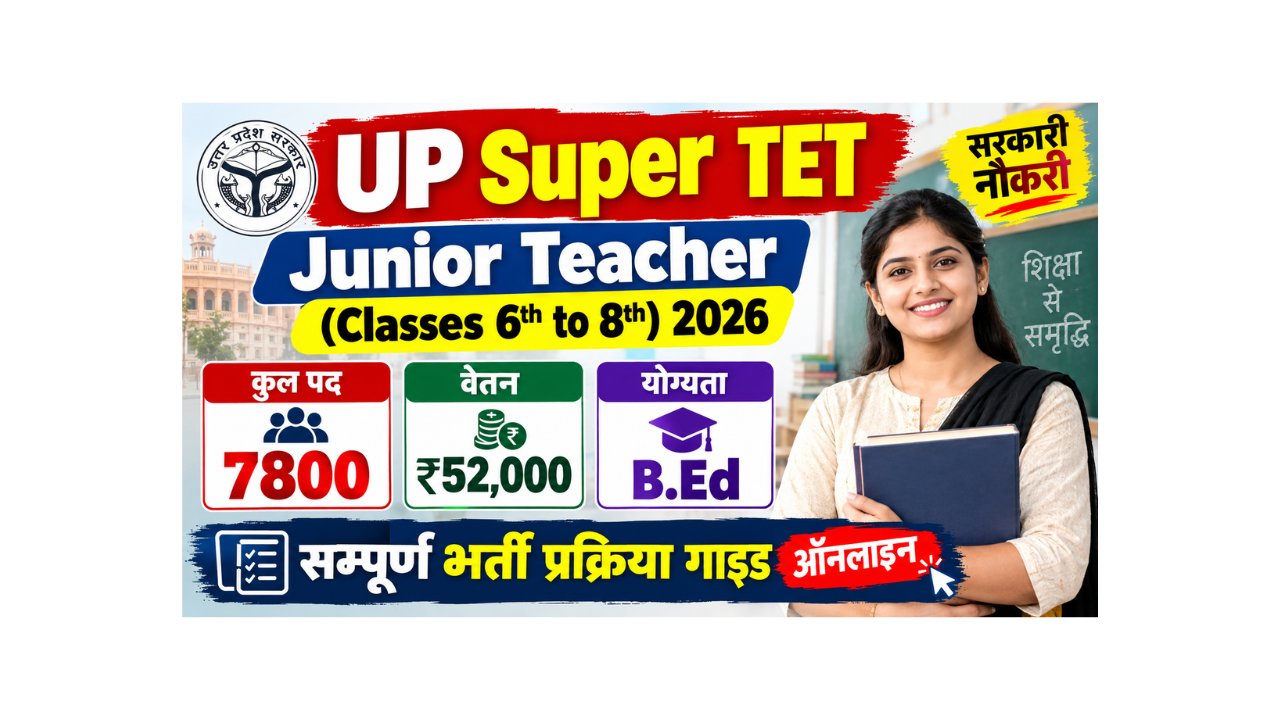
UP Super TET Junior Teacher (Classes 6th to 8th) 2026 Vacancy, Salary, Eligibility

UP Super TET Junior Teacher (Classes 6th to 8th) 2026 Vacancy, Salary, Eligibility &

Uttar Pradesh’s upcoming teacher recruitment drive has two distinct tracks running in parallel, and mixing them up is the single most common mistake candidates make right now. One track covers Primary Teachers for Classes 1 to 5. The other — the one this article focuses on — covers Junior Teachers for Classes 6th to 8th, commonly referred to as UP Super TET Junior 2026. If you’re a B.Ed graduate with UPTET Paper 2 or CTET Paper 2 in hand, this is the recruitment cycle built specifically for you.

Where Things Currently Stand: Junior vs Primary Recruitment

This distinction matters more than most articles online make clear. On 15 September 2026, the Uttar Pradesh Education Service Selection Commission (UPESSC) released an official notification (Advertisement No. 05/2026) — but that notification covers 12,405 Primary Teacher vacancies only, split between Urban Primary posts under the Basic Education Department and Attached Primary posts in aided institutions. Applications for that cycle opened on 16 September and run until 15 October 2026, with the exam scheduled for 3 and 4 December 2026.

The Junior Teacher recruitment for Classes 6th to 8th is a separate stream and, as of now, its own formal advertisement is still awaited from UPESSC. Industry trackers and recruitment portals have been circulating an expected vacancy figure of around 7,800 posts for this Junior stream, with an anticipated starting salary in the range of ₹52,000 per month once HRA, DA, and other allowances are factored in. These figures are reasonable projections based on current recruitment patterns and reported estimates, but they are not yet confirmed by an official gazetted notification specific to the Junior category. Treat them as the direction things are heading rather than a locked-in fact until UPESSC publishes the dedicated Junior Teacher advertisement.

What Makes the Junior Teacher Post Different from Primary Teacher

Both posts fall under the broader Super TET umbrella, but they’re built for genuinely different candidate profiles:

Primary Teachers (Classes 1–5) work across ten foundational subject areas and require a D.El.Ed or BTC qualification along with UPTET/CTET Paper 1. Junior Teachers (Classes 6th to 8th), on the other hand, teach within specialized subject streams — Language, Social Studies, or Science & Mathematics — in upper primary schools, and eligibility opens up to both B.Ed and D.El.Ed qualified candidates, provided they hold a valid Paper 2 qualification from UPTET or CTET.

That last point is worth underlining for B.Ed holders specifically. Since B.Ed candidates are not eligible for Primary Teacher (Classes 1–5) posts under current rules, the Junior Teacher stream becomes the primary entry point into UP’s government school system for anyone who pursued a straightforward graduation-plus-B.Ed path rather than a D.El.Ed/BTC route.

Expected Vacancy Breakdown

While the district-wise and subject-wise split for the ~7,800 expected Junior vacancies hasn’t been officially released, based on how upper primary recruitment has historically been structured in UP, expect the notification to divide seats across the three subject streams — Language, Social Studies, and Science & Mathematics — with further category-wise reservation applied as per state norms (SC, ST, OBC, EWS, and general category allocations). Once the official advertisement drops, this is the first section worth checking closely, since your specific subject stream’s vacancy count will directly shape how competitive your preparation needs to be.

Salary and Pay Structure

Based on the pay matrix currently applicable to Assistant Teacher posts under Super TET recruitment, the pay scale sits at Level 6, ranging from ₹35,400 to ₹1,12,400. In-hand salary — after HRA, DA, and standard deductions — typically works out to somewhere between ₹45,000 and ₹55,000 per month, depending on posting location (urban postings generally carry higher HRA than rural ones). The commonly cited ₹52,000 figure for Junior Teachers fits comfortably within this range and represents a realistic in-hand estimate for a mid-tier posting location.

Beyond the monthly pay, the post carries the full weight of a permanent government job: pension benefits, General Provident Fund contributions, job security, and periodic increments tied to central and state pay commission revisions. It’s also worth noting that with the 8th Pay Commission expected to influence government salary structures going forward, these figures may see upward revision by the time actual appointments are made.

Eligibility Criteria

Based on the established framework for Super TET Junior recruitment, here’s what you’ll need:

Educational qualification requires a graduation degree along with a B.Ed (or D.El.Ed/BTC, depending on the specific post category), plus a valid UPTET Paper 2 or CTET Paper 2 qualifying certificate. The general age bracket for Super TET recruitment runs from 21 to 40 years, with the standard 5-year upper age relaxation applicable to SC, ST, and OBC candidates as per Uttar Pradesh government reservation rules.

One recent development worth flagging: a second gazette notification issued around 11 September 2026 clarified that BTC-category vacancies in certain attached sections will now be filled through direct recruitment, and reaffirmed that a B.Ed qualification alone is not automatically treated as equivalent to BTC for every post category. If you’re relying on a B.Ed as your sole teaching qualification, it’s worth reading the fine print of the official notification closely once it’s out, rather than assuming blanket eligibility across every Junior Teacher vacancy.

Exam Pattern

The verified Super TET 2026 examination structure applies across both Primary and Junior streams, with subject content naturally differing based on the post applied for:

The exam consists of 120 objective-type multiple-choice questions, to be completed within 120 minutes (2 hours), carrying a maximum of 360 marks. The marking scheme awards +3 marks for every correct answer and deducts −1 mark for each incorrect answer — meaning negative marking is firmly in place, so blind guessing carries real risk. The question paper is bilingual, set in both Hindi and English, and the exam is conducted offline in pen-and-paper, OMR-based mode.

For the Junior Teacher stream specifically, expect your paper to draw from your chosen specialization — Language, Social Studies, or Science & Mathematics — layered with the standard pedagogy, child development, and general awareness components that form the backbone of the broader Super TET syllabus.

Selection is based purely on your written exam score. There’s no separate interview round and no additional weightage given to academic marks in the final merit calculation for this cycle — your rank is determined entirely by your performance in that single 360-mark paper, followed by document verification for shortlisted candidates.

How to Apply Once the Notification Is Released

When the official Junior Teacher advertisement goes live, the application process is expected to follow the same structure UPESSC has used for the Primary Teacher cycle:

First, complete One Time Registration (OTR) on the UPESSC portal if you haven’t already, since this generates the unique OTR ID required before you can apply to any UPESSC recruitment cycle. Once your OTR is active, log in, select the Super TET Junior Teacher recruitment link, and fill in your personal, educational, and category details carefully. Upload the required scanned documents — certificates, photographs, signature, and category proof — in the specified format and size. Pay the prescribed application fee through the available online payment modes, and review every entered detail carefully before final submission, since correction windows are typically short and don’t remain open indefinitely.

Preparation Strategy While You Wait

The gap before the official notification drops is genuinely your most valuable preparation time, not a reason to pause. A few focused steps:

Start by nailing down your subject stream now — Language, Social Studies, or Science & Mathematics — rather than waiting for the notification to decide for you, since deep subject preparation takes months, not weeks. Work through the general Super TET syllabus components (child development and pedagogy, general awareness, and your subject stream) using previous years’ Primary and Junior Teacher papers as a reference for question style and difficulty. Given that negative marking applies, build an elimination-based answering habit early, rather than developing a guessing reflex you’ll need to unlearn later. Keep your UPTET/CTET Paper 2 certificate, degree certificates, and category documents organized and ready, since application windows close faster than most candidates expect.

The Bottom Line

The UP Super TET Junior Teacher 2026 recruitment for Classes 6th to 8th is shaping up to be a genuinely significant opportunity for B.Ed and D.El.Ed qualified candidates holding a valid Paper 2 certificate, with expected numbers around 7,800 vacancies and a realistic in-hand salary near ₹52,000 once fully rolled out. The already-released Primary Teacher notification (12,405 vacancies) confirms that UPESSC’s broader recruitment machinery is actively moving, which makes a dedicated Junior Teacher advertisement a matter of when, not if. Use this waiting period to lock in your subject preparation, organize your documents, and check the official UPESSC portal regularly so you’re among the first to apply the moment the notification lands.

Official Links and Resources

ResourceDescriptionLink
UPESSC Official WebsitePrimary source for all notifications, syllabus, and resultshttps://www.upessc.up.gov.in/
Super TET 2026 Notification (Advt. No. 05/2026)Official notification PDF for the released Primary Teacher cycle (12,405 vacancies)Available under “Latest Notifications” on upessc.up.gov.in
UP Basic Education Board (UPBEB)Departmental portal for basic education recruitment updateshttps://upbeb.org/
UP Education Department PortalAdditional recruitment and policy updateshttps://updeled.gov.in/
One Time Registration (OTR) PortalMandatory registration before applying to any UPESSC recruitmentAccessible via upessc.up.gov.in homepage

UP Super TET Syllabus 6-8 in Hindi PDF 2026 ( Junior )

UP Super TET Syllabus 6-8 in Hindi PDF 2026

UP Super TET (Uttar Pradesh Super Teacher Eligibility Test) is an important teacher recruitment examination conducted by the Government of Uttar Pradesh. This exam is held for the post of Sahayak Adhyapak (Assistant Teacher) and aims to select teachers for government schools.

Important Point: Super TET is not merely an eligibility test — it is an actual recruitment examination that determines your final appointment. If you wish to apply for the Upper Primary level (Class 6-8), it is mandatory to have already passed UPTET or CTET Paper-2.

Super TET 2026 Exam Pattern (Class 6-8)

ItemDetails
Total Questions120
Total Marks360
Question TypeMultiple Choice Questions (MCQ)
Exam Duration120 minutes (2 hours)
Exam ModeOffline (pen and paper)
LanguageHindi and English
Marks for Correct Answer3 marks
Marks Deducted for Wrong Answer-1 mark
Conducting BodyUP Education Service Selection Commission (UPESSC)

Exam Structure

The Super TET exam is divided into two sections:

Section 1: General Knowledge (30 Questions)

  • Mandatory for all candidates
  • Covers current affairs, national-international news, awards, and Indian culture

Section 2: Chosen Teaching Subject (90 Questions)

  • For Class 6-8, you can choose your subject:
    • Hindi/Sanskrit/English
    • Science
    • Mathematics
    • Social Studies
    • Etc.

Total = 30 + 90 = 120 Questions

Subject-wise Distribution and Marks for Class 6-8

Detailed Subject-wise Table

S.No.SubjectNumber of QuestionsTotal MarksWeightage %
1.Language (Hindi, Sanskrit, English)309025.0%
2.General Knowledge & Current Affairs257520.8%
3.Mathematics164813.3%
4.Science08246.7%
5.Environment & Social Studies08246.7%
6.Teaching Skills08246.7%
7.Child Psychology08246.7%
8.Life Skills, Management & Attitude08246.7%
9.Logical Reasoning05154.2%
10.Information Technology (IT)04123.3%
Total120360100%

Detailed Subject-wise Syllabus (Class 6-8)

1. Language (Hindi, Sanskrit, English) – 30 Questions (90 Marks)

This is the highest-weightage subject.

Hindi Language

Grammar Topics:

  • Noun, pronoun, adjective, verb
  • Gender, number, case, tense
  • Analysis of predicate relations
  • Sentence formation and types of sentences (simple, compound, complex)
  • Punctuation marks and their usage
  • Figures of speech (Alankar) — Anupras (alliteration), Yamak, Shlesh, Upma (simile), Rupak (metaphor), Utpreksha, Atishayokti (hyperbole)
  • Sandhi (conjunction) — vowel sandhi, consonant sandhi, visarga sandhi
  • Samas (compound words) — Tatpurush, Dvandva, Bahuvrihi, Avyayibhav samas

Vocabulary:

  • Synonyms (Paryayvachi)
  • Antonyms (Viparitarthak)
  • Idioms and proverbs
  • Polysemous words (words with multiple meanings)

Comprehension Topics:

  • Comprehension of unseen prose passages
  • Comprehension of unseen poetry passages
  • Form, merits and demerits of poetry
  • Genres of prose (story, essay, drama)

Language Teaching:

  • Stages of language development
  • Theories of language learning
  • Strategies for language teaching in the classroom
  • Language skills — listening, speaking, reading, writing
  • Teaching language to students from diverse backgrounds
  • Understanding language-related disorders

Sanskrit Language

  • Fundamentals of Sanskrit grammar
  • Sandhi, samas, general vocabulary
  • General introduction to Sanskrit literature
  • Teaching methods

English Language

  • English Grammar (Parts of Speech, Tenses, Sentence Structure)
  • Vocabulary and Word Formation
  • Reading Comprehension
  • Writing Skills
  • English Language Teaching Methodology

2. General Knowledge & Current Affairs – 25 Questions (75 Marks)

This is the second most important subject.

National and International News:

  • Recent national events
  • Important events around the world
  • Political developments
  • International relations

Important Personalities:

  • Important national and international leaders
  • Scientists, writers, artists
  • Famous personalities from the world of sports

Awards and Honours:

  • Bharat Ratna
  • Padma awards (Padma Vibhushan, Padma Bhushan, Padma Shri)
  • Sahitya Akademi Award
  • Nobel Prize
  • International awards

Sports:

  • Olympic Games
  • Cricket and other major sports
  • Indian athletes and their achievements

Indian Culture:

  • Indian art and architecture
  • Indian music and dance
  • Festivals and traditions
  • Religious sites

Government Schemes:

  • Education-related schemes
  • Health-related schemes
  • Economic schemes
  • Women’s welfare schemes

3. Mathematics – 16 Questions (48 Marks)

Arithmetic

  • Number systems (natural, whole, integers, rational, irrational numbers)
  • Divisibility (multiples, factors, prime numbers, prime factorization)
  • Highest Common Factor (HCF) and Least Common Multiple (LCM)
  • Decimals and fractions
  • Percentage and ratio
  • Profit and loss
  • Simple and compound interest
  • Specific types of problems

Algebra

  • Variables, constants, expressions
  • Algebraic equations (linear, quadratic)
  • Solving equations
  • Substitution method, elimination method
  • Polynomials
  • Numerical and expression-based problems

Geometry

  • Basic principles of geometry
  • Point, line, ray, line segment
  • Angles — definition, types, measurement
  • Triangles — properties, types, congruence, similarity
  • Circle — radius, diameter, circumference, area
  • Quadrilaterals — types and properties
  • Pyramid, prism, cylinder, cone, sphere

Mensuration

  • Area calculations:
    • Area of triangle
    • Area of quadrilateral
    • Area of circle
    • Area of plane figures
  • Perimeter calculations
  • Volume and surface area

Statistics

  • Data collection and presentation
  • Mean, median, mode
  • Basic principles of probability
  • Graphs and charts

Mathematics Teaching

  • Methods of teaching mathematics
  • Problem-solving skills
  • Abstract and concrete representation
  • Mathematical reasoning and proof

4. Science – 08 Questions (24 Marks)

Physics

  • Motion, force and laws
  • Newton’s laws of motion
  • Work, power, energy
  • Simple machines
  • Sound — waves, frequency, wavelength
  • Light — reflection, refraction, lenses, mirrors
  • Electricity — current, voltage, resistance
  • Magnetism
  • Heat — temperature, heat transfer

Chemistry

  • Matter and its properties
  • Elements, compounds, mixtures
  • Chemical reactions
  • Acids, bases, salts
  • Metals and non-metals
  • Carbon and its compounds
  • Oxygen, hydrogen, nitrogen
  • Combustion and oxidation

Biology

  • The basic unit of life — the cell
  • Heredity and evolution
  • Plant physiology
  • Animal physiology
  • Plant and animal kingdoms
  • Nutrition — autotrophic, heterotrophic
  • Photosynthesis
  • Respiration

Human Body Systems

  • Digestive system
  • Respiratory system
  • Circulatory system
  • Nervous system
  • Endocrine system
  • Reproductive system
  • Excretory system

Health and Disease

  • Communicable (infectious) diseases
  • Non-communicable diseases
  • Immunity
  • Nutrition and health
  • First aid

Science Teaching

  • Methods of teaching science
  • Experimental and demonstration methods
  • Use of microscope
  • Safety in the science lab

5. Environment & Social Studies – 08 Questions (24 Marks)

Geography

Geography of India:

  • Location, size and boundaries of India
  • Climate and monsoon system
  • Rainfall distribution
  • Indian plateaus, mountain ranges
  • Rivers — Ganga, Brahmaputra, Narmada, Yamuna
  • Types of soil
  • Vegetation and wildlife
  • Climatic zones of India

World Geography:

  • Continents and oceans
  • Geographical features of major countries
  • World climate systems

History

Ancient India:

  • Indus Valley Civilization
  • Vedic period
  • Maurya Empire
  • Ashoka
  • Gupta period
  • Religions — Hinduism, Buddhism, Jainism

Medieval India:

  • Turkish invasions
  • Delhi Sultanate
  • Mughal Empire
  • Akbar, Shah Jahan
  • Kingdoms in the south

Modern India:

  • Arrival of Europeans in India
  • British East India Company
  • Revolt of 1857
  • Indian National Movement
  • Mahatma Gandhi, Jawaharlal Nehru
  • Indian independence struggle
  • 15 August 1947

Civics

Indian Constitution:

  • Making of the Constitution
  • Preamble
  • Fundamental Rights (Articles 12-35)
  • Fundamental Duties
  • Directive Principles of State Policy

Indian Governance:

  • President
  • Prime Minister
  • Council of Ministers
  • Parliament (Lok Sabha and Rajya Sabha)

Judiciary:

  • Supreme Court
  • High Court
  • District Court

State Government:

  • Governor
  • Chief Minister
  • Legislative Assembly
  • Legislative Council

Local Governance:

  • Panchayati Raj
  • Municipality
  • Mayor

Election Process:

  • Indian electoral system
  • Voting rights
  • Election Commission

Economics

  • Production, consumption, distribution
  • Market economy
  • National income
  • Per capita income
  • Economic development
  • Agriculture, industry, services
  • Import-export
  • Currency and banking

Environmental Studies

  • Ecosystem
  • Biodiversity
  • Climate change
  • Pollution (air, water, soil)
  • Conservation of resources
  • Renewable and non-renewable resources
  • Environmental protection programs

6. Teaching Skills – 08 Questions (24 Marks)

  • Modern teaching methods
  • Collaborative learning
  • Problem-based learning
  • Project-based learning
  • Classroom management
  • Discipline and positive reinforcement
  • Student assessment
  • Formative and summative assessment
  • Use of technology (ICT in education)
  • Inclusive classroom
  • Working with students from diverse backgrounds

7. Child Psychology – 08 Questions (24 Marks)

Theories of Development

  • Meaning, need and scope of child development
  • Stages of development:
    • Infancy (0-3 years)
    • Early childhood (3-6 years)
    • Middle childhood (6-12 years)
    • Adolescence (12-18 years)

Dimensions of Development

  • Physical development
  • Mental (cognitive) development
  • Emotional development
  • Social development
  • Moral development
  • Language development

Theories of Learning

  • Thorndike’s trial-and-error theory
  • Pavlov’s classical conditioning
  • Skinner’s operant conditioning
  • Piaget’s theory of cognitive development
    • Sensorimotor stage
    • Preoperational stage
    • Concrete operational stage
    • Formal operational stage
  • Vygotsky’s socio-cultural theory
  • Bloom’s taxonomy

The Learning Process

  • What is learning
  • Types of learning
  • Meaningful learning
  • Cooperative learning
  • Problem-solving
  • Transfer of learning

Individual Differences

  • Intelligence
  • Creativity
  • Personality
  • Aptitude
  • Ability
  • Different types of intelligence

Children with Special Needs

  • Gifted children
  • Children with learning difficulties
  • Physically disabled children
  • Mentally disabled children
  • Concept of inclusive education

Adjustment and Problems

  • Common childhood problems
  • Aggression
  • Fear
  • Shyness
  • Lack of self-confidence
  • Counselling and guidance

8. Life Skills, Management & Attitude – 08 Questions (24 Marks)

Life Skills

  • Communication skills
  • Decision-making ability
  • Problem-solving
  • Self-awareness
  • Emotional intelligence
  • Social skills
  • Empathy
  • Cooperation and teamwork

Management Skills

  • Time management
  • Resource management
  • Classroom management
  • Stress management
  • Change management
  • Leadership skills

Teacher’s Attitude

  • Attitude towards the teaching profession
  • Sensitivity towards children
  • Commitment to equality and inclusion
  • Commitment to lifelong learning
  • Practicality
  • Accountability
  • Respect for Indian culture and values

9. Logical Reasoning – 05 Questions (15 Marks)

  • Similarities and differences
  • Classification
  • Series (number series, letter series)
  • Relationships
  • Ordering/arrangement
  • Coding and decoding
  • Direction test
  • Logical equations
  • Analytical reasoning

10. Information Technology (IT) – 04 Questions (12 Marks)

Computer Basics

  • What is a computer
  • Hardware and software
  • Generations of computers
  • Input and output devices

Operating Systems

  • Windows
  • Linux
  • Mac OS
  • Android

Software Applications

  • Word processing (MS Word)
  • Spreadsheet (MS Excel)
  • Presentation (MS PowerPoint)
  • Database

Internet and Online Safety

  • Introduction to the internet
  • Email
  • Web browsing
  • Cyber security
  • Data security
  • Password management

ICT in Education

  • E-learning
  • Digital resources
  • Online classes
  • Use of technology in education
  • Use of multimedia
  • Teaching software

Important Preparation Tips for Class 6-8

1. Organizing Subject-wise Study Material

High-priority subjects (60% of total time):

  • Language (30 questions)
  • General Knowledge (25 questions)
  • Mathematics (16 questions)

Medium priority (25% of total time):

  • Science (08 questions)
  • Teaching Skills (08 questions)
  • Child Psychology (08 questions)

Lower priority (15% of total time):

  • Life Skills (08 questions)
  • Logical Reasoning (05 questions)
  • Information Technology (04 questions)

2. Time Management

  • Total time: 120 minutes
  • Time per question: approximately 60 seconds
  • Section 1 (General Knowledge): 30 minutes
  • Section 2 (Teaching Subject): 90 minutes

3. Study Strategy

Phase One — Foundation Building (3-4 months)

  • Understand the core concepts of each subject
  • Read NCERT textbooks (Class 6-8 and Class 11-12)
  • Prepare notes

Phase Two — In-depth Study (2-3 months)

  • Deep study of specific subjects
  • Practice questions
  • Solve previous exam papers

Phase Three — Revision and Mock Tests (1-2 months)

  • Take full-length mock tests
  • Practice time management
  • Focus on weak areas

4. Preparing General Knowledge

Daily Study:

  • Read newspapers (15-20 minutes)
  • Use current affairs apps
  • Note down important events

Weekly Review:

  • Summarize the week’s important events
  • Remember awards and honours
  • Note sports news

5. Preparing Language

Grammar:

  • Understand the rules, don’t just memorize them
  • Practice one or two exercises daily
  • Learn from mistakes

Vocabulary:

  • Learn 5-10 new words daily
  • Use them in sentences
  • Build a set of synonyms and antonyms

Comprehension:

  • Regularly read unseen passages
  • Practice by writing answers to questions

Important Points Before the Exam

Check Your Eligibility

  • Have you passed UPTET Paper-2 or CTET Paper-2?
  • Do you have a graduate degree?
  • Have you completed D.El.Ed or B.Ed?

Follow Official Notifications

  • Check www.updeled.gov.in regularly
  • Obtain the official UPESSC notification
  • Don’t miss the application deadline

On Exam Day

  • Keep your documents ready
  • Arrive at the exam center on time
  • Try to attempt all 120 questions
  • Don’t make errors due to haste

Selection Process

Final Merit

The result is calculated based on:

  • Written exam: 60% weightage
  • Academic qualifications: 40% weightage
    • High school marks
    • Intermediate marks
    • Graduation marks
    • D.El.Ed/B.Ed marks

Reservation Policy

  • General category: 45% minimum marks
  • OBC: 45% minimum marks
  • SC/ST: 40% minimum marks
  • EWS: 45% minimum marks

Reservation Distribution

  • SC: 21%
  • ST: 2%
  • OBC: 27%
  • EWS: 10%
  • PwD: 4% (horizontal reservation)

Difference Between Class 1-5 and Class 6-8

AspectClass 1-5Class 6-8
LevelPrimaryUpper Primary
LanguageBasicAdvanced
MathematicsBasic operationsAlgebra, Geometry
ScienceEnvironmental StudiesDetailed Science
Social StudiesBasic geographyHistory, Geography, Civics
Teaching MethodPlay-basedActivity-centered

Mock Test Papers 05

Super TET New Exam Pattern Mock Test Papers 01Click Here
Super TET New Exam Pattern Mock Test Papers 02Click Here
Super TET New Exam Pattern Mock Test Papers 03Click Here
Super TET New Exam Pattern Mock Test Papers 04Click Here
Super TET New Exam Pattern Mock Test Papers 05Click Here

Official Resources and Download Links

Official Super TET 1-5 Primary Click Here
Official Super TET 6-8 Upper – PrimaryClick Here
Official SiteClick Here
Home PageClick Here

UP Special TET 2026 Online Form Apply

UP Special TET 2026

The Uttar Pradesh Education Service Selection Commission (UPESSC) has officially announced the recruitment for Uttar Pradesh Teacher Eligibility Test Special TET 2026. This is an excellent opportunity for aspiring teachers who want to build a career in the education sector of Uttar Pradesh. Candidates interested in applying for this examination should understand all the important details before submitting their applications.

The UP Special TET is a competitive examination designed to identify qualified and skilled teachers for positions in Uttar Pradesh schools. This examination assesses the teaching competency and subject knowledge of candidates. The recruitment process is transparent and follows all government regulations set by UPESSC.

Critical Dates for UP Special TET 2026

It is essential to keep track of important dates to ensure you don’t miss any deadline. Here are the key dates you need to remember:

  • Online Application Start Date: 05 September 2026
  • Online Application Last Date: 04 October 2026
  • Fee Payment Deadline: 04 October 2026
  • Form Correction Window: 08 October 2026
  • Examination Date: 03 November 2026
  • Admit Card Release: Will be issued before the examination date
  • Result Announcement: Will be updated on the official website

Candidates are advised to verify these dates with the official UPESSC website to ensure accuracy, as dates may be subject to change at the discretion of the commission.

Application Fee Structure

The application fee varies based on your category. the fee structure helps you prepare financially for the application process. Here’s the detailed breakdown:

  • For General, EWS, and OBC candidates, the application fee is ₹1000
  • SC and ST candidates need to pay ₹500 as application fee
  • Persons with Disabilities (PH) candidates are required to pay ₹300

The payment mode is entirely online and you can choose from multiple payment options including debit card, credit card, internet banking, IMPS, cash card, or mobile wallet for your convenience.

Age Eligibility Requirements

  • The age eligibility criteria for UP Special TET 2026 is as follows:
  • Minimum Age Requirement: Not Applicable (N/A)
  • Maximum Age Limit: 60 Years

UPESSC provides age relaxation for eligible candidates as per their official regulations. Age relaxation is granted to reserved category candidates and other eligible persons in accordance with government rules. It is recommended that candidates check the official notification for detailed age relaxation provisions applicable to their category.

Educational Qualifications and Eligibility Criteria

To appear for the UP Special TET, candidates must meet specific educational requirements based on the teacher level they are applying for. The eligibility criteria are strictly defined by UPESSC and must be fulfilled before submitting your application.

Position LevelEducational Requirements
Primary Teacher for Classes 1-5Bachelor’s degree from an NCTE-recognized institution with a minimum of 50% marks along with valid teacher training qualification such as BTC, B.El.Ed, or equivalent. Final-year candidates enrolled in these courses are also eligible to apply.
Upper Primary Teacher for Classes 6-8Bachelor’s degree with at least 50% marks (45% in certain cases as per rules) from an NCTE-recognized institution combined with valid teacher training qualification like B.Ed, BTC, B.El.Ed, or equivalent. Final-year candidates are eligible. Additionally, candidates with specialized education qualifications from RCI-recognized institutes and those with 50% marks in intermediate plus a 4-year integrated teaching program can apply.

How to Apply for UP Special TET Online Form 2026

The application process for UP Special TET is completely online. Here’s a step-by-step guide to help you apply successfully:

  • Visit the Official Portal: Go to the official UPESSC website (www.upessc.up.gov.in) to access the application form.
  • Register Yourself: Create a new account by providing your basic information and email address. Ensure you use a valid email address as this will be your communication channel.
  • Fill Application Details: Carefully enter all required information in the application form including personal details, educational qualifications, and category information. Double-check every field to avoid errors.
  • Upload Required Documents: Scan and upload all necessary documents in the specified format. Ensure the documents are clear and legible.
  • Pay Application Fee: Complete the online payment of your application fee using your preferred payment method.
  • Submit Form: Review all information one final time before clicking the submit button.
  • Print Confirmation: Save and print the confirmation receipt for future reference.

Important Note: Candidates are strongly advised to carefully read the official notification before filling their form. Ensure you meet all eligibility criteria regarding last date, age limit, and educational qualification before submitting your application.

Mode of Selection

The selection process for UP Special TET 2026 is based on written examination. Candidates will be required to appear for a written test that evaluates their knowledge and teaching aptitude. The examination pattern and syllabus are defined by UPESSC and are available on their official website.

Points to Remember Before Applying

Verify your educational qualifications match the eligibility criteria specified for your chosen position level.

Ensure your age falls within the stipulated limits or that you are eligible for age relaxation.

Keep all required documents ready in the specified digital format before starting the application.

Use a valid and active email address and mobile number for registration.

Complete your application well before the deadline to avoid technical issues.

Pay the correct application fee based on your category.

Save the application confirmation receipt for your records.

Review all entered information carefully to prevent errors that might cause rejection.

UPESSC and the Recruitment Process

The Uttar Pradesh Education Service Selection Commission is a constitutional body responsible for recruitment and selection of qualified individuals for educational positions in Uttar Pradesh. UPESSC conducts various examinations throughout the year to ensure that only qualified candidates are selected for teaching positions. The commission follows transparent procedures and adheres to government guidelines in all recruitment processes.

Why This Recruitment Matters

The UP Special TET 2026 is significant for candidates seeking a stable and respectable career in education. Teaching positions in government schools come with benefits including job security, pension schemes, and career advancement opportunities. This recruitment represents a golden opportunity for qualified candidates to contribute to the education system while securing their professional future.

Updates and Amendments

The dates, eligibility criteria, and other details mentioned in this article are based on information available as of the notification date. UPESSC may announce amendments or updates to any aspect of this recruitment. Candidates must regularly check the official UPESSC website for any changes or important announcements related to the examination.

Official Links and Resources

ResourceLink
Online Application LinkClick Here ( Activates on 05 September 2026 )
Official NotificationClick Here
Super TET Syllabus and Exam PatternClick Here
Senior Level Syllabus and Exam PatternClick Here
Junior Level Syllabus and Exam PatternClick Here
UPESSC Official WebsiteClick Here

Frequently Asked Questions About UP Special TET 2026

When does the online application process begin?

The online application window opens on 05 September 2026. Candidates can start filling their forms from this date onwards.

What is the final submission deadline?

The last date to submit the online application is 04 October 2026. Applications received after this date will not be accepted.

What are the age requirements?

There is no minimum age requirement. The maximum age limit is 60 years. Age relaxation is provided to eligible candidates as per government norms.

Can final-year candidates apply?

Yes, candidates in their final year of bachelor’s degree and teacher training courses are eligible to apply. They must complete their qualification before the examination date.

What payment methods are accepted?

Online payment is accepted through multiple modes including debit cards, credit cards, internet banking, IMPS, cash cards, and mobile wallets.

How can I download the admit card?

The admit card will be made available on the official UPESSC website before the examination date. Instructions for downloading will be provided on the portal.

Where will the result be announilable?

Yes, age relaxation is provided to reserved category candidates and other eligible persons as per government rules. Details are available in the official notification.

What happens if I miss the deadline?

Late applications are not accepted. It is your responsibility to apply before the specified deadline. No extensions are typically granted.

Where do I find the complete syllabus?

The detailed syllabus for all levels is available on the UPESSC official website in the designated section. Candidates should download and study the prescribed syllabus thoroughly.

UP Super TET Vacancy 2026: 60,000+ Assistant Teacher Posts Expected

UP Super TET Vacancy 2026

Uttar Pradesh is preparing for what could be its largest primary and upper-primary teacher recruitment drive in years. Reports citing the state government’s own internal assessment point to more than 60,000 Assistant Teacher vacancies likely to be filled through the upcoming Super TET cycle, making this one of the most closely watched recruitment announcements for teaching aspirants across the state right now.

If you’ve qualified UPTET or CTET and have been waiting for a large scale recruitment window to open up, this is shaping up to be it. Here’s a complete, honest breakdown of where things currently stand.

Current Status: Notification Awaited, Numbers Taking Shape

As of now, the official Super TET 2026 notification has not been released by the Uttar Pradesh Basic Education Board (UPBEB) or the Uttar Pradesh Education Service Selection Commission (UPESSC). What has emerged, however, is a fairly consistent set of signals from government planning reports and recruitment tracking sources: the state has identified a vacancy pool exceeding 60,000 posts, with some reports specifically citing figures around 69,000 vacancies based on internal assessments.

This recruitment is also being described as directly linked to a broader hiring roadmap the commission is currently executing one that includes Assistant Teacher recruitment for council primary schools alongside separate drives for TGT, PGT, Principal, and Special TET posts. Within that roadmap, a batch of 11,508 council primary school Assistant Teacher posts is already under preparation, which may form part of or run parallel to the larger Super TET cycle.

The honest caveat here, and it’s an important one: 60,000+ is a projected figure, not a confirmed number. Government identified vacancy pools often get revised sometimes upward, sometimes downward once the official notification finalizes district wise and category wise allocations. Treat this number as a strong directional signal of scale rather than a locked-in figure until UPBEB publishes the notification PDF.

What Is Super TET, and Why Does It Matter So Much?

Super TET is the recruitment examination conducted by UPBEB for Assistant Teacher posts in Uttar Pradesh’s government primary schools (Classes 1–5) and upper primary schools (Classes 6–8). Unlike UPTET, which is only an eligibility certificate, Super TET is the actual recruitment exam that leads to a real teaching appointment which is why the stakes, and the competition, run considerably higher.

A crucial eligibility filter applies here: only candidates who have already qualified UPTET or CTET are permitted to sit for Super TET. If you haven’t cleared either of those yet, that has to be your first step before Super TET becomes relevant to you at all.

Expected Eligibility Criteria

Based on the framework used in previous Super TET cycles, the eligibility structure is expected to look like this:

For Primary Teacher posts (Classes 1–5): Class 12th with at least 50% marks, plus a 2-year Diploma in Elementary Education (D.El.Ed) or equivalent, along with a qualifying UPTET Paper I or CTET Paper I score.

For Upper Primary Teacher posts (Classes 6–8): A graduation degree along with a B.Ed qualification, plus a qualifying UPTET Paper II or CTET Paper II score.

Age limits and relaxations are expected to follow standard Uttar Pradesh government norms, with reserved category candidates receiving relaxation as per existing state policy. Final eligibility details, including any amendments, will only be confirmed once the official notification is out the commission’s broader recruitment roadmap has referenced pending eligibility amendments for related teacher recruitment categories, so it’s worth double-checking this specific point once the notification drops rather than assuming last cycle’s rules carry over unchanged.

Exam Pattern: What to Expect

While the final pattern will be confirmed with the official notification, based on the previous Super TET cycle and current syllabus planning, the exam structure is expected to include:

A written examination of 150 multiple-choice questions carrying 150 marks, to be completed in 2.5 hours, covering Hindi, English, Mathematics, Science, Social Studies, General Knowledge, Reasoning, Pedagogy, Information Technology, and Life Skills. Some recent reports have also referenced an alternate structure of 120 questions at 3 marks each a discrepancy that hasn’t been resolved yet across sources, which is exactly the kind of detail only the official notification can settle definitively.

The exam is conducted in offline, pen-and-paper (OMR-based) mode across centres statewide.

Selection Process

Super TET recruitment typically follows a multi-stage process rather than relying on the written exam alone:

The process begins with the written examination, which all applicants must clear to move forward. Candidates who qualify are then called for counseling, where marks from the written exam are considered alongside academic performance metrics. This is followed by document verification, where educational certificates, category certificates, and identity documents are physically checked. Candidates who clear all stages and meet the applicable cutoff receive their final appointment letter.

Notably, some sources reference an interview stage as part of this evaluation, so it’s worth watching the official notification closely to confirm whether counseling alone or counseling plus interview applies to this specific cycle.

Why This Recruitment Cycle Is Generating So Much Attention

A few things make the scale of this drive particularly significant. Uttar Pradesh’s primary and upper-primary schools have accumulated a substantial vacancy backlog over recent years, and a hiring gap at this scale 60,000-plus posts represents one of the largest single opportunities for UPTET/CTET-qualified candidates in recent memory.

It’s also part of a much larger recruitment push happening in parallel. UPESSC has laid out a roadmap covering seven major recruitment exams spanning Assistant Professor, PGT, TGT, Principal, Special TET, and Assistant Teacher posts with a stated target of completing this entire recruitment cycle by December 2026. Super TET sits within that broader push, which suggests the commission is treating this period as a concentrated, high-priority hiring window rather than a routine annual cycle.

For candidates, a larger vacancy pool generally though not guaranteed tends to ease per-seat competition compared to smaller, tightly capped recruitment drives. That said, a vacancy count this large will also likely draw a correspondingly large applicant pool, so strong preparation still matters as much as ever.

How to Prepare While the Notification Is Pending

The period before an official notification drops is exactly when serious candidates build their advantage. A few practical steps worth taking now:

Make sure your UPTET or CTET qualification is current and valid, since this is the non-negotiable entry requirement for Super TET. Begin working through the subject-wise syllabus Hindi, English, Mathematics, Science, Social Studies, GK, Reasoning, Pedagogy, IT, and Life Skills since this breadth means you can’t rely on strength in just one or two areas. Practice previous years’ Super TET papers to understand the question style and difficulty level the board typically favors. Keep your educational and category documents organized and ready, since application windows for large-scale recruitments tend to see heavy last-minute traffic. Most importantly, track the official UPBEB and UPESSC websites directly rather than depending on unverified vacancy figures circulating on social media, since numbers this large tend to get exaggerated or misreported as they spread.

The Bottom Line

The UP Super TET 2026 recruitment, with a projected 60,000+ vacancies, represents a genuinely major opportunity for UPTET and CTET-qualified candidates across Uttar Pradesh. The official notification, exact vacancy breakdown, and confirmed exam pattern are still pending, but the scale and direction of this recruitment drive are clear enough that waiting for the notification to start preparing would mean giving up valuable time. Get your eligibility documents in order, start working through the syllabus now, and keep the official UPBEB portal bookmarked so you’re among the first to know the moment the notification goes live

UP Super TET Syllabus 2026: Complete Subject-Wise Syllabus, New Exam Pattern

upstet syllabus 2026

The Super Teacher Eligibility Test (Super TET) is one of the most significant recruitment examinations in India’s education sector. The Super Teacher Eligibility Test (Super TET) is a competitive recruitment examination conducted by the Uttar Pradesh government to select eligible candidates for Primary (Classes 1–5) and Upper Primary (Classes 6–8) teaching positions in government schools.

Unlike eligibility tests, Super TET is conducted as part of the teacher recruitment process to prepare the final merit list. If you’re aspiring to become an Assistant Teacher (Sahayak Adhyapak) in Uttar Pradesh’s government schools, understanding the 2026 exam pattern is crucial for your success.

What is Super TET 2026?

Super TET is the actual recruitment examination for Assistant Teacher positions in UP government schools. It’s important to understand the distinction: while CTET and UPTET are eligibility tests, Super TET determines your final selection based on merit.

Key Point for Eligibility

Candidates who have qualified CTET or UPTET and meet the prescribed educational qualifications are eligible to appear for the examination.

Super TET 2026: Basic Exam Structure

The 2026 exam follows a streamlined and candidate-friendly format that has remained consistent for recent cycles:

Examination Highlights

AspectDetails
Exam NameSuper Teacher Eligibility Test (Super TET)
Total Questions120
Total Marks360
Question TypeMultiple Choice Questions (MCQs)
Exam Duration120 minutes (2 hours)
ModeOffline (Pen & Paper)
LanguagesHindi and English
Marking per Correct Answer3 marks
Negative Marking1 mark deduction for incorrect answer
Conducting AuthorityUttar Pradesh Education Service Selection Commission (UPESSC)

Important Note on Marking

Each correct answer awards 3 marks, while each incorrect answer results in a 1-mark deduction. Unattempted questions do not affect your score, so strategic attempting is recommended.

Detailed Subject-Wise Breakdown

Subject Weightage and Distribution

The 2026 Super TET exam distributes its 120 questions across 10 major subjects with varying weightage:

SubjectNo. of QuestionsWeightage (%)Total Marks
Languages (Hindi, Sanskrit & English)3025.0%90
General Knowledge & Current Affairs2520.8%75
Mathematics1613.3%48
Science086.7%24
Environmental & Social Studies086.7%24
Teaching Skills086.7%24
Child Psychology086.7%24
Life Skills, Management & Aptitude086.7%24
Logical Reasoning054.2%15
Information Technology (IT)043.3%12
TOTAL120100%360

Subject Analysis

1. Languages (30 Questions – 25% Weightage) Languages carry the highest weightage in Super TET 2026. The exam covers three languages: Hindi, Sanskrit, and English. This section tests candidates’ proficiency in grammar, comprehension, vocabulary, and pedagogical approaches to language teaching.

2. General Knowledge & Current Affairs (25 Questions – 20.8% Weightage) The second-highest weightage subject covers national and international events, important personalities, government schemes, awards, and Indian culture. Daily current affairs revision is essential for this section.

3. Mathematics (16 Questions – 13.3% Weightage) Mathematics contributes significantly to the overall score. Questions focus on basic mathematical concepts, teaching methodologies, and problem-solving skills relevant to classroom instruction.

4. Science (08 Questions – 6.7% Weightage) This section covers fundamental scientific principles, experimental methods, and science teaching pedagogy.

5. Environmental & Social Studies (08 Questions – 6.7% Weightage) Questions include environmental conservation, social fabric, and geography relevant to the Indian context.

6. Teaching Skills (08 Questions – 6.7% Weightage) This section evaluates your understanding of modern teaching methodologies, classroom management, and instructional strategies.

7. Child Psychology (08 Questions – 6.7% Weightage) Questions test knowledge of child development, learning theories, and psychological principles relevant to education.

8. Life Skills, Management & Aptitude (08 Questions – 6.7% Weightage) This section assesses soft skills, decision-making abilities, and personal development aspects.

9. Logical Reasoning (05 Questions – 4.2% Weightage) Though having lower weightage, this section requires critical thinking and analytical abilities.

10. Information Technology (04 Questions – 3.3% Weightage) ICT integration in education is becoming increasingly important. Questions cover basic computer concepts and digital learning tools.

Super TET 2026 Paper Structure: Two Sections

The exam is uniquely structured into two sections to ensure balanced assessment:

Section 1: General Knowledge (30 Questions)

All candidates, regardless of their teaching specialization, must attempt 30 questions from the General Knowledge and Current Affairs section. This ensures every teacher has foundational knowledge across diverse domains.

Section 2: Selected Teaching Subject (90 Questions)

Candidates can choose their specialization based on their educational background and interest. The remaining 90 questions come from the selected teaching subject, allowing for specialized assessment.

Total: 30 + 90 = 120 Questions

This two-section approach ensures that:

  • All teachers have common knowledge base
  • Specialization is valued and assessed thoroughly
  • Teaching expertise in chosen subject is properly evaluated

Marking Scheme (Critical for Strategy)

Understanding the marking scheme is crucial for exam strategy:

Positive Marking

  • Correct Answer = +3 marks
  • Unattempted Question = 0 marks

Negative Marking

  • Wrong Answer = -1 mark

Maximum Score

With 120 questions × 3 marks = 360 marks total

Time Management

  • Total Time = 120 minutes
  • Per Question = 1 minute (approximately 60 seconds)

This tight time constraint means:

  • You must practice speed without compromising accuracy
  • Skip difficult questions initially and come back to them
  • Attempt all questions (since there’s no negative marking for unattempted ones, but attempting gives you a chance to earn marks)

Exam Languages

The exam is conducted in Hindi and English.Candidates can choose the language in which they wish to take the examination, making it accessible to a broader audience of educators across Uttar Pradesh.

Selection Process and Merit-Based Recruitment

Super TET follows a merit-based selection system with the following characteristics:

Final Selection Criteria

Selection is based on 60% weightage of the written exam and 40% weightage from academic qualifications, including high school, intermediate, graduation, and teacher training records.

This means:

  • Written Exam: 60% weightage
  • Academic Credentials: 40% weightage
    • High School performance
    • Intermediate marks
    • Graduation scores
    • Teacher training certification (D.El.Ed/B.Ed)

Qualifying Marks

Candidates must achieve:

  • General Category: Minimum 45% marks
  • OBC/SC/ST Category: Minimum 40% marks

Reservation Policy

As per UP Government norms:

  • SC: 21%
  • ST: 2%
  • OBC: 27%
  • EWS: 10%
  • PwD: 4% (horizontal reservation)

Key Differences: Super TET vs UPTET vs CTET

Understanding the distinction between these tests is vital:

AspectCTETUPTETSuper TET
PurposeEligibilityEligibilityRecruitment/Selection
Conducting BodyCBSE (National)UPBEBUPESSC
DeterminesTeaching eligibilityTeaching eligibilityMerit for appointment
Pre-requisiteGraduation + B.EdGraduation + D.El.EdCTET/UPTET qualified
ScopeAll-IndiaUttar PradeshUttar Pradesh
Final SelectionNot for selectionNot for selectionDirect appointment basis

Critical Point

Unlike UPTET which is a teacher eligibility test, Super TET is the actual Assistant Teacher Recruitment Examination that determines who gets appointed in UP government primary and upper primary schools.

Subject-Wise Preparation Strategy

High-Priority Subjects (60% of your study time)

  1. Languages (30 questions) – Focus on grammar, pedagogy, and comprehension
  2. General Knowledge (25 questions) – Daily current affairs, national events, awards

Medium-Priority Subjects (30% of your study time)

  1. Mathematics (16 questions) – Basic concepts, teaching methods, problem-solving
  2. Teaching Skills (08 questions) – Modern pedagogies, classroom management
  3. Child Psychology (08 questions) – Development stages, learning theories

Lower-Priority Subjects (10% of your study time)

  1. Science, Environmental Studies, Life Skills (24 questions total)
  2. Logical Reasoning (05 questions)
  3. Information Technology (04 questions)

Important Preparation Tips

1. Speed and Accuracy Balance

With only 60 seconds per question, practicing mock tests is essential. Aim for accuracy while building speed.

2. No Negative Marking Strategy

While there is negative marking (-1 for wrong), it’s strategic to:

  • Attempt all 120 questions
  • Skip extremely difficult questions initially
  • Return to them if time permits
  • Never leave a question blank without careful consideration

3. Focus on High-Weightage Subjects

Languages and General Knowledge together comprise 45.8% of the exam. Devote proportionate study time to these subjects.

4. Current Affairs is Non-Negotiable

In General Knowledge:

  • National and international events
  • Important government schemes
  • Awards and honors
  • Sports and culture
  • Science and technology breakthroughs

Daily reading of news sources is mandatory.

5. Previous Years’ Papers

Solving previous Super TET and UPTET papers helps you:

  • Understand question patterns
  • Identify frequently asked topics
  • Practice time management
  • Build confidence

6. Mock Tests

Take full-length mock tests at regular intervals to:

  • Simulate exam conditions
  • Identify weak areas
  • Improve pacing and strategy
  • Track progress

Eligibility Criteria Summary

To be eligible for Super TET 2026, you must:

  1. Have a valid CTET/UPTET qualification
    • CTET Paper 1 OR UPTET Paper 1 (for Primary Teacher position – Classes 1-5)
    • CTET Paper 2 OR UPTET Paper 2 (for Upper Primary position – Classes 6-8)
  2. Meet educational qualifications
    • Graduation degree
    • Teacher training certification (D.El.Ed or B.Ed)
  3. Fulfill age and other criteria
    • As specified in the official notification

Expected Vacancies and Timeline

The UP Government has a substantial backlog of teacher vacancies. The 2026 recruitment cycle is expected to have significant openings distributed across:

  • All 75 districts of Uttar Pradesh
  • Both Primary (Classes 1-5) and Upper Primary (Classes 6-8) levels
  • Multiple subject specializations

Stay updated on the official websites for notification release and exam date announcements.

2026 Exam Pattern: What’s New?

Shift Towards Conceptual Understanding

The newly active Prayagraj-based Commission (UPESSC) is emphasizing conceptual pedagogy over rote learning. The 2026 pattern reflects:

  • Focus on why behind facts, not just facts
  • Increased emphasis on D.El.Ed/BTC concepts
  • ICT integration in teaching methodology
  • National Education Policy (NEP) 2020 implementation

Implications for Candidates

Simply memorizing answers won’t suffice. You need to understand:

  • Teaching philosophy behind pedagogical approaches
  • How to implement modern teaching strategies
  • Integration of technology in classrooms
  • Holistic child development

Official Resources and Links

Primary Sources

  1. Official UPESSC Website: www.updeled.gov.in
    • Download official syllabus and exam pattern PDF
    • Check notifications and important updates
  2. UP Education Service Selection Commission (UPESSC)
    • Official examination conducting authority
    • Released the 2026 syllabus

TOP 05 Mock Tests

Super TET New Exam Pattern Mock Test Papers 01Click Here
Super TET New Exam Pattern Mock Test Papers 02Click Here
Super TET New Exam Pattern Mock Test Papers 03Click Here
Super TET New Exam Pattern Mock Test Papers 04Click Here
Super TET New Exam Pattern Mock Test Papers 05Click Here

The UP Super TET 2026 represents a pivotal opportunity for teachers aiming to secure government positions in Uttar Pradesh. With a well-structured exam pattern distributing 120 questions across diverse subjects, success requires:

  1. Clear understanding of the exam pattern and syllabus
  2. Strategic preparation focusing on high-weightage subjects
  3. Regular practice through mock tests and previous papers
  4. Conceptual learning over rote memorization
  5. Consistent effort and time management

The two-section structure ensures balanced assessment of general knowledge and subject-specific expertise. The 60% weightage to the written exam and 40% to academic credentials means your hard work in preparation will be substantial factor in your final selection.

Start your preparation today, stay updated with official notifications, and utilize the resources mentioned above to achieve your goal of becoming an Assistant Teacher in UP government schools.

Best of luck with your Super TET 2026 preparation

50% OFF
📚

Super TET Mock Papers

Complete Exam Solutions with Solutions

50% OFF
📚

Super TET Mock Papers

Complete Exam Solutions with Solutions