Uttar Pradesh’s primary teacher recruitment has finally moved from rumour to reality, and if you’ve been tracking the “48,000 vacancy” number circulating online, this article will clear up exactly where that figure comes from, what’s officially notified right now, and what’s still pending. There’s genuine confusion mixing several different numbers together, so let’s untangle it properly before getting into dates, eligibility, and exam pattern.
The 48,000 Figure: What It Actually Means
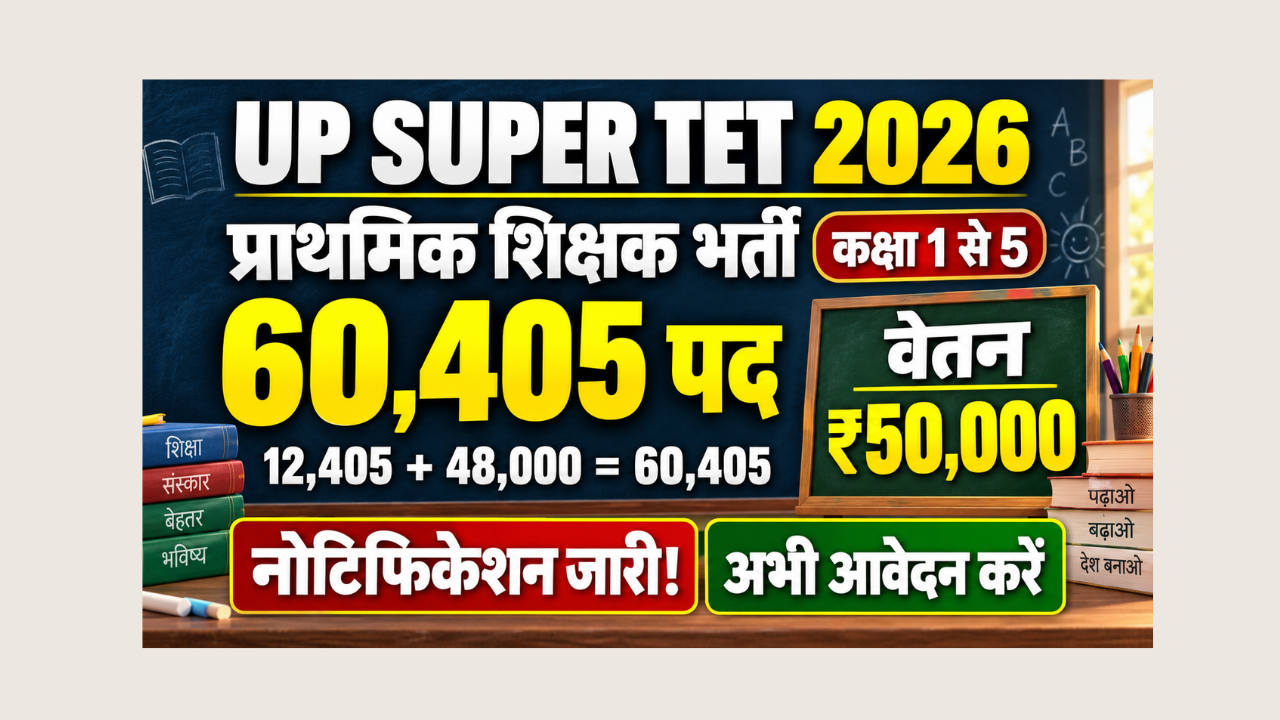
Here’s the honest picture. Reports from mid-2026 flagged that Uttar Pradesh’s Basic Education Department had identified close to 60,000 vacant primary and upper-primary teaching posts across the state’s council schools. Of that combined figure, roughly 11,508 posts belonged to urban-area primary schools, and the remaining approximately 48,000 posts were identified as vacant in rural-area council primary schools.
That 48,000 rural figure is real, but it has not yet been formally notified as part of a recruitment advertisement. As of now, the department has only sent consolidated vacancy information for the rural posts internally while updating recruitment rules, and candidate groups have publicly demanded that these rural vacancies be added to the ongoing recruitment cycle. So if you came here expecting an active application window for 48,000 posts, that specific notification hasn’t happened yet — but the demand and the identified vacancy pool are both very much on record, and this is widely expected to be the next major addition once the department finalizes the rural recruitment framework.
Detail
Information
Recruitment Name
Super TET (Assistant Teacher, Primary) 2026
Conducting Body
UPESSC, Prayagraj
Advertisement Number
05/2026
Notification Date
September 15, 2026
Officially Notified Vacancies
12,405 (11,508 urban + 897 aided)
Rural Vacancies Identified (Not Yet Notified)
Approx. 48,000
Application Start Date
September 16, 2026
Application Last Date
October 15, 2026
Correction Window Closes
October 19, 2026
Exam Dates
December 3–4, 2026
Total Questions / Marks
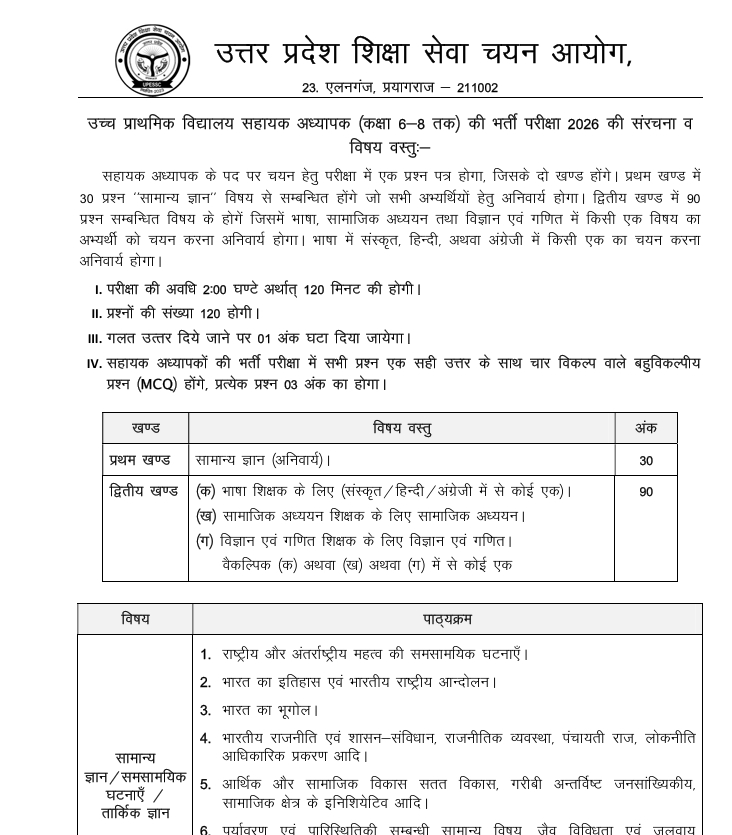
120 Questions / 360 Marks
Negative Marking
1 mark deducted per wrong answer
Pay Scale
₹35,400 – ₹1,12,400 (Level 6)
Official Website
upessc.up.gov.in
What’s Officially Notified Right Now
While the rural 48,000 posts remain pending, UPESSC has already released a formal notification for the urban and aided portion of this same overall vacancy pool. Here’s what’s confirmed:
The Uttar Pradesh Education Service Selection Commission (UPESSC), Prayagraj, released the Super TET 2026 notification under Advertisement No. 05/2026 on September 15, 2026. This covers a total of 12,405 Assistant Teacher (Primary) vacancies, split between 11,508 posts in urban primary schools under the Basic Education Department and 897 posts attached to primary schools of aided institutions under the Secondary Education Department.
Online applications opened on September 16, 2026, based on the One Time Registration (OTR) system that UPESSC now uses across its recruitment cycles. The last date to apply and deposit the application fee is October 15, 2026, and the correction window for submitted applications closes on October 19, 2026. The written examination itself is scheduled for December 3 and 4, 2026, to be held across 75 districts of the state.
Interestingly, this isn’t happening in isolation. Alongside the primary teacher notification, UPESSC has also separately notified 2,607 PGT posts for aided secondary schools under Advertisement No. 06/2026, with that exam scheduled for December 15 and 16, 2026. Combined, the two notifications together account for over 15,000 teaching posts being processed in the same recruitment window, which gives you a sense of just how active this recruitment season is for UP’s education sector.
Eligibility Criteria for Super TET Primary 2026
To apply for the Assistant Teacher (Primary) posts under this notification, candidates need to meet the following requirements:
Educational qualification requires graduation along with a recognized teacher-training qualification such as D.El.Ed or BTC. Critically, candidates must also have qualified UPTET or CTET for Classes 1 to 5, since Super TET is a recruitment exam layered on top of TET qualification, not a replacement for it.
For the urban Assistant Teacher posts, the minimum age is 21 years as on July 1, 2026, with a maximum age limit of 40 years as specified in the notification. For the attached primary Assistant Teacher posts, the minimum age is also 21 years, with a retirement-linked upper age boundary of 62 years rather than a fixed maximum. Age relaxation applies as per standard Uttar Pradesh government norms — 5 years for eligible SC, ST, and OBC candidates of the state, 15 years for eligible PwD candidates, and other category-specific relaxations detailed in the official notification.
It’s worth noting that a second Gazette notification has introduced a change specific to BTC-category vacancies in attached primary sections of Intermediate Colleges and High Schools, which will now be filled through direct recruitment. If you fall into this specific category, it’s worth reading that provision carefully in the official document.
Exam Pattern: What Changed From Previous Cycles
The Super TET 2026 exam pattern has been revised compared to earlier cycles, and the shift is significant enough that old preparation material based on the previous structure needs a second look.
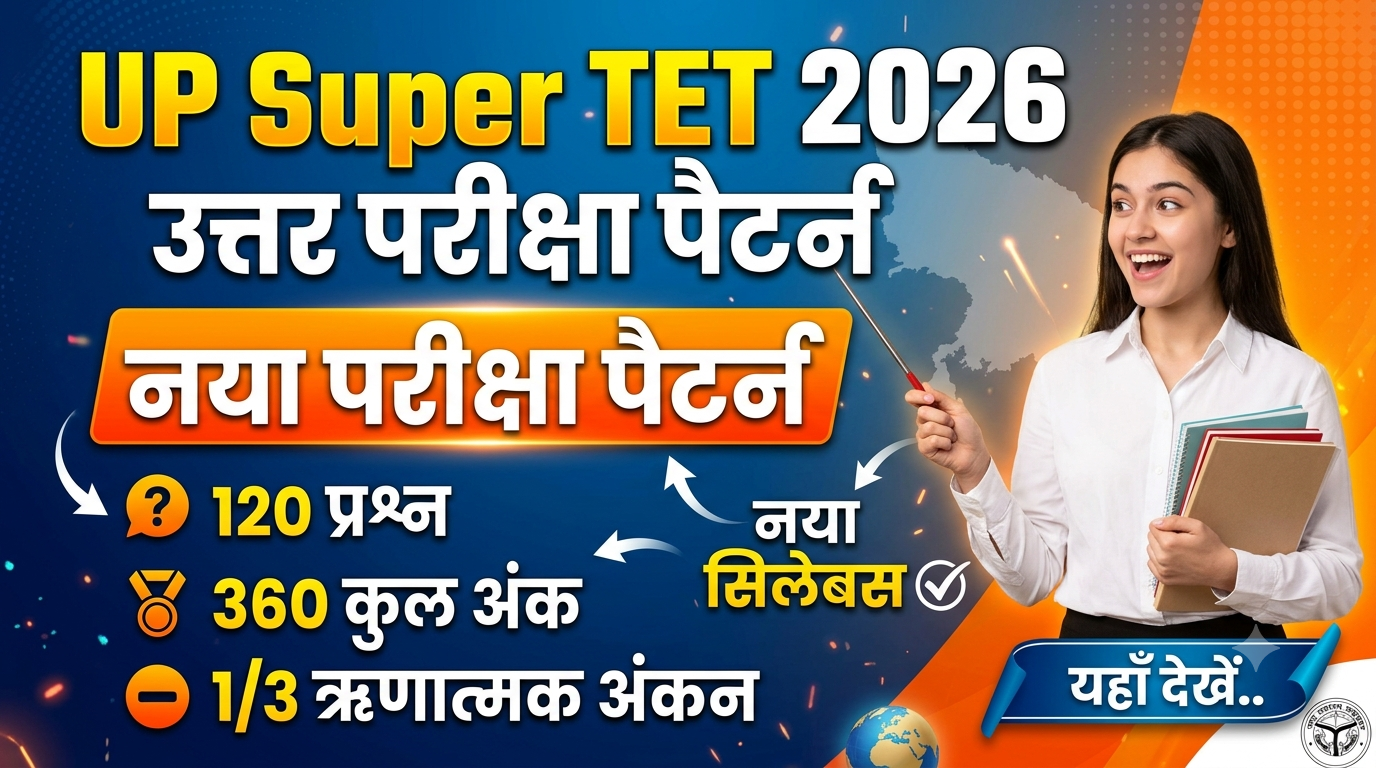
The exam is conducted offline in pen-and-paper, OMR-based mode, with the question paper set bilingually in both Hindi and English. Under the revised pattern, the exam consists of 120 objective-type questions, each carrying 3 marks, for a total of 360 marks, to be completed within 2 hours. A notable change from earlier Super TET cycles is the introduction of negative marking — 1 mark is deducted for each incorrect answer. This is a departure from some previous cycles where no negative marking applied, so candidates need to genuinely rethink their guessing strategy rather than attempting every question blindly.
If the exam is conducted in a single shift, raw scores are used directly to prepare the merit list. If it’s held across multiple shifts, UPESSC applies a score-normalization process to ensure fairness across different question sets, as specified in the official notification. Selection is purely merit-based on the written exam score — there is no separate interview or additional weightage for academic marks in the final merit calculation for this cycle. Shortlisted candidates proceed directly to document verification after the result. In case of a tie in marks, preference is given first to the candidate with a higher percentage in graduation.
The subject-wise weightage for the written exam broadly covers Language (Hindi, Sanskrit, and English), Mathematics, Science, Environment and Social Studies, Teaching Aptitude (Shikshan Kaushal), Child Psychology (Bal Manovigyan), General Knowledge and Current Affairs, Logical Reasoning, Information Technology, and Life Skills and Management. Since the syllabus has been revised alongside the pattern, it’s worth downloading the latest official syllabus PDF rather than relying on older subject breakdowns that may not reflect the current question distribution.
Salary and Pay Scale
Selected candidates under this notification are appointed as Assistant Teachers at Pay Level 6 of the Uttar Pradesh government pay matrix, with a pay scale ranging from ₹35,400 to ₹1,12,400. Along with house rent allowance and other standard government benefits applicable as per UP norms, the effective in-hand salary typically works out in a healthy range once postings and allowances are factored in — a meaningful long-term incentive for candidates weighing this against other state-level teaching opportunities.
How to Apply
Candidates need to complete One Time Registration (OTR) before submitting their application, since UPESSC has moved to this centralized registration system across its recruitment drives. Once registered, applicants fill out the Super TET 2026 application form, upload the required documents in the prescribed format, pay the applicable fee, and submit before the October 15, 2026 deadline. It’s worth double-checking every document upload carefully, since incorrect or unclear uploads are one of the most common reasons applications get flagged during verification.
What This Means If You’re Waiting on the Rural Vacancies
If you’ve been specifically waiting for the rural 48,000-post recruitment rather than the urban 12,405 posts currently open, here’s the realistic picture: the vacancy count has been identified and reported by the department, recruitment rules are reportedly being updated to accommodate it, and this would mark the first time the Education Service Selection Commission —rather than the older Examination Regulatory Authority conducts the full selection process for council primary school teachers. But until a formal advertisement number and notification date are issued for these rural posts specifically, treat every date or number you see for that segment as an informed estimate rather than a confirmed detail. The most reliable way to stay ahead of this is to keep checking the official UPESSC portal directly, since that rural notification is realistically one of the more significant education recruitment announcements still pending in Uttar Pradesh.
Uttar Pradesh has one of the largest school education systems in the country, and Super TET remains one of the most sought after routes into a government teaching career in the state. Lakhs of trained graduates who have already cleared CTET or UPTET wait every year for this single exam that decides who gets appointed as an Assistant Teacher in UP’s primary and upper primary schools. Here is a complete, easy to understand guide on the Super TET 2026 notification, based on the latest available information.
Current Status of Super TET 2026 Notification
As of early September 2026, the official Super TET 2026 notification has not yet been released by the Uttar Pradesh Basic Education Board (UPBEB) or the Uttar Pradesh Education Service Selection Commission (UPESSC). Multiple exam preparation portals report that the notification is expected soon, with several sources pointing toward a possible release in September 2026. This timeline is linked to the release of the UPTET 2026 result, since a valid CTET or UPTET score is a mandatory eligibility requirement for Super TET.
Candidates are strongly advised to treat all such expected dates as indicative only. The final and only reliable confirmation will come from the official notification published on the board’s own website.
What Is Super TET
Super TET, short for Super Teacher Eligibility Test, is a state level recruitment examination conducted in Uttar Pradesh. It is not a mere eligibility test like CTET or UPTET; it is the final selection stage for appointment to the posts of Assistant Teacher (Primary and Upper Primary) and, in some cycles, Headmaster or Principal in UP government and government aided schools. Only candidates who have already cleared CTET or UPTET can appear for Super TET.
Organising Body
The exam has historically been conducted by the Uttar Pradesh Basic Education Board. In recent recruitment cycles, the Uttar Pradesh Education Service Selection Commission has also been associated with releasing notifications and vacancy details for teacher recruitment in the state. Candidates should check both updeled.gov.in and the UPESSC portal for authentic updates.
Eligibility Criteria
While final eligibility conditions will be confirmed only in the official notification, based on past cycles the general requirements are expected to include the following.
Educational Qualification: A graduation degree along with a recognised teaching qualification such as B.Ed, D.El.Ed, or BTC.
TET Qualification: A valid CTET or UPTET qualifying certificate is compulsory.
Domicile: Only permanent residents of Uttar Pradesh are generally eligible to apply.
Age Limit: The age limit typically follows the pattern of previous UP teacher recruitment exams, with standard relaxations for reserved categories as per state government rules.
Exam Pattern
Based on the pattern followed in earlier Super TET examinations, the following structure is generally for 2026, subject to final confirmation in the notification.
The exam is conducted offline in pen and paper mode.
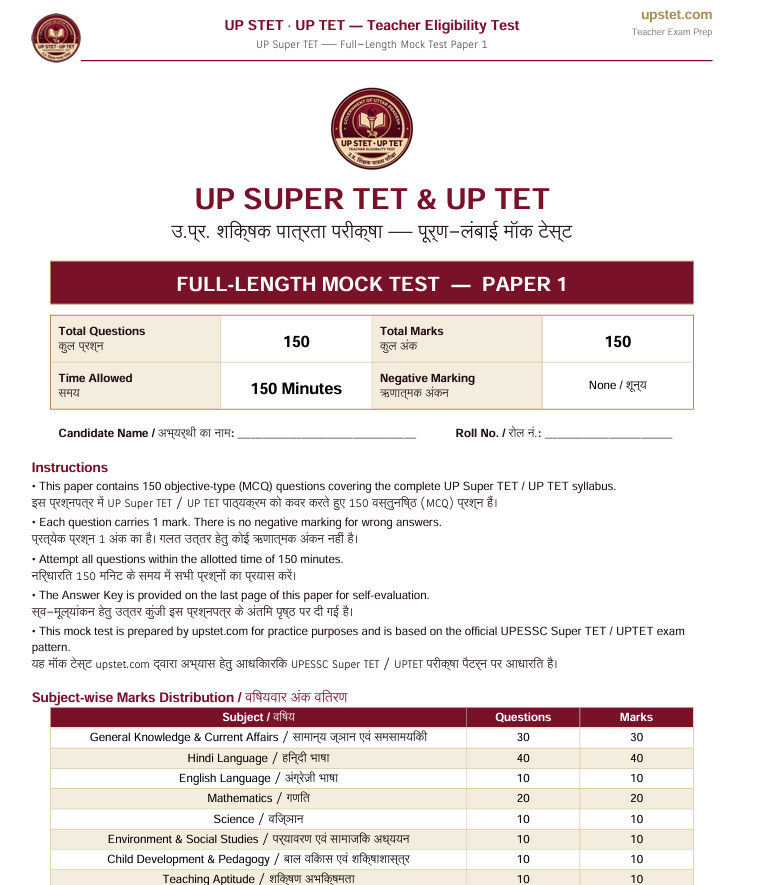
It typically consists of 150 objective type questions carrying 150 marks.
The total duration is around 2 hours 30 minutes.
The question paper is usually set bilingually in Hindi and English.
Subjects generally include Child Development and Pedagogy, Hindi, English, Mathematics, Environmental Studies or the relevant subject knowledge area, and General Awareness.
Candidates should not rely on unofficial sources for details such as negative marking. This must always be verified from the official PDF once released.
Selection Process
Selection for Super TET is to continue on a merit basis, combining two components as followed in previous cycles.
Written Exam Score: This usually carries the larger weightage, historically around 60 percent.
Academic Performance Index: This accounts for the remaining weightage, calculated from marks obtained in Class 10, Class 12, Graduation, and the teaching qualification such as B.Ed or D.El.Ed or BTC.
This is followed by document verification, where original academic certificates, teaching mark sheets, category certificates, and domicile proof are physically checked before final appointment.
Vacancy Expectations
Uttar Pradesh has a significant backlog of vacant teacher posts across its primary and upper primary schools. Several education portals expect a substantial number of vacancies to be announced once the Super TET 2026 notification is formally released. The exact number of posts, category wise breakup, and subject wise vacancies will only be confirmed in the official advertisement.
How to Apply
Once the notification is released, applications are to be submitted online through the official portal. The general process, based on earlier cycles, is likely to look like this.
Visit the official website, updeled.gov.in, or the UPESSC portal once live.
Locate and click on the Super TET Recruitment 2026 notification link.
Register using mobile number, email address, and CTET or UPTET roll number.
Log in using the system generated registration number and password.
Fill in personal details, academic scores, qualifications, and category preferences.
Upload scanned photograph and signature as per the specified format.
Pay the application fee through UPI, net banking, or card payment.
Preview and verify all filled details carefully before final submission.
Submit the form and download or print the confirmation page for future reference.
A correction window is typically opened after the initial submission period so that candidates can rectify genuine errors, and this too will be specified in the notification.
Application Fee (Based on Previous Trends)
Exact fee details for 2026 have not been announced. In earlier Super TET cycles, fees were generally category based, with general and OBC candidates paying a higher fee than SC, ST, and PwD candidates. The confirmed fee structure will be published along with the official notification.
Salary and Pay Scale
Assistant Teachers selected through Super TET are placed in the regular pay scale applicable to UP government primary and upper primary school teachers, along with dearness allowance, house rent allowance, and other benefits admissible under state government rules. Exact figures can vary based on posting location and category, and should be confirmed from the official notification or pay commission recommendations applicable at the time of appointment.
How to Prepare While Waiting for the Notification
Since the exam pattern and syllabus are largely to follow earlier trends, candidates can use this waiting period productively.
Revise the syllabus already prescribed in earlier Super TET cycles, since core subjects rarely change drastically.
Practice previous years’ question papers to understand question difficulty and pattern.
Keep all documents, including TET certificates, academic mark sheets, category certificates, and domicile proof, ready and updated.
Follow the official website regularly rather than depending only on third party updates, so that important dates are not missed.
Super TET (Super Teacher Eligibility Test) is the recruitment exam conducted by the Uttar Pradesh Education Service Selection Commission (UPESSC) to select Assistant Teachers for government schools in Uttar Pradesh. Unlike CTET or UPTET, which only confirm teaching eligibility, Super TET is the actual selection exam that decides a candidate’s final merit and appointment.
Detail
Version 1 (Widely Cited)
Version 2 (Newer, Fewer Sources)
Conducting Body
UPESSC
UPESSC
Total Questions
120
150
Total Marks
360
150
Marks per Correct Answer
3
1
Negative Marking
-1 per wrong answer
None
Exam Duration
120 minutes
150 minutes (2.5 hrs)
Exam Mode
Offline (Pen & Paper)
Offline (Pen & Paper)
Question Type
MCQ
MCQ
Language
Hindi & English
Hindi & English
Sections
2 (GK + Chosen Subject)
Combined subject list
Because the recruitment notification is still pending, candidates preparing right now should focus on the subject list and topics, which remain largely consistent across both versions, rather than locking into one marking strategy too early.
Exam Structure (Version 1)
This is the version most syllabus PDFs and coaching platforms currently reference. It splits the paper into two sections:
Section 1 – General Knowledge: 30 questions, compulsory for every candidate
Section 2 – Chosen Teaching Subject: 90 questions, based on the candidate’s selected subject (Language, Science, Mathematics, or Social Studies)
Section
Subject
Questions
Section 1
General Knowledge
30
Section 2
Selected Teaching Subject
90
Total
120
Subject-Wise Marks Distribution (Version 1)
Subject
Questions
Weightage (%)
Marks
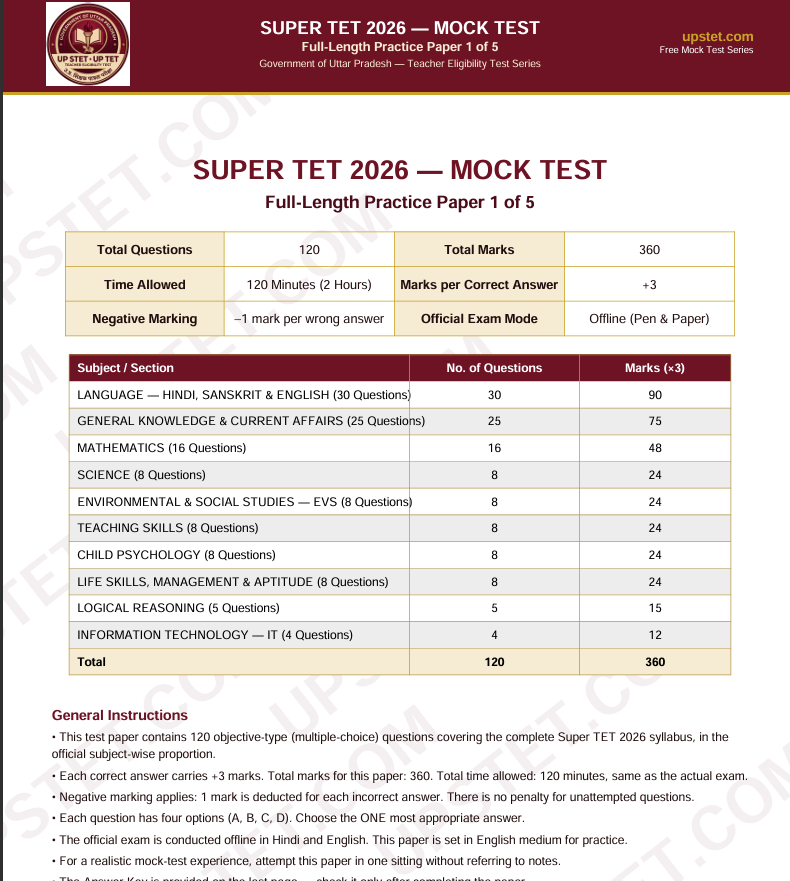
Language (Hindi, Sanskrit & English)
30
25.0%
90
General Knowledge & Current Affairs
25
20.8%
75
Mathematics
16
13.3%
48
Science
08
6.7%
24
Environmental & Social Studies
08
6.7%
24
Teaching Skills
08
6.7%
24
Child Psychology
08
6.7%
24
Life Skills, Management & Aptitude
08
6.7%
24
Logical Reasoning
05
4.2%
15
Information Technology (IT)
04
3.3%
12
Total
120
100%
360
Subject-Wise Marks Distribution (Version 2)
Subject
Questions
Marks
Language (Hindi, Sanskrit & English)
40
40
General Knowledge & Current Affairs
30
30
Mathematics
20
20
Science
10
10
Environment & Social Studies
10
10
Teaching Aptitude
10
10
Child Psychology
10
10
Life Skills, Management & Attitude
10
10
Logical Reasoning
05
05
Information Technology (ICT)
05
05
Total
150
150
Marking Scheme: What’s Actually Different
The biggest practical difference between the two versions is how mistakes are treated:
Version 1 penalizes wrong answers, deducting 1 mark for each incorrect response. This makes guessing risky when a candidate is unsure between options.
Version 2 has no negative marking at all, meaning every question is worth attempting since a wrong answer and a blank one both score zero.
Until the official notification confirms which applies, candidates preparing seriously should practice with the same accuracy standard either way — treating every question as if it could be penalized keeps the habit safe regardless of which version is finalized.
Selection Process
Selection for Super TET is not based on the written exam alone. The final merit list combines two components:
Written Exam Score: 60% weightage
Academic Qualifications: 40% weightage, broken down further as:
High School marks
Intermediate marks
Graduation marks
Teacher training (D.El.Ed/B.Ed) marks
Eligibility Snapshot
Must have already qualified UPTET or CTET (Paper 1 for Class 1–5 posts, Paper 2 for Class 6–8 posts)
Must hold a graduate degree
Must have completed D.El.Ed or B.Ed
Age typically between 21 and 40 years, as per past cycles
Frequently Asked Questions
Is the Super TET 2026 exam pattern officially confirmed? No. As of now, UPESSC has not released the official Super TET 2026 recruitment notification, so the exam pattern is not yet confirmed. Two versions are being reported by different sources.
Is there negative marking in Super TET 2026? This depends on which version gets confirmed. One reported version deducts 1 mark per wrong answer; another reports no negative marking at all. Candidates should prepare for accuracy regardless.
How many questions are in the Super TET 2026 exam? Sources currently differ between 120 questions (360 marks) and 150 questions (150 marks). This will be confirmed once the official notification is released.
Who conducts the Super TET exam? The Uttar Pradesh Education Service Selection Commission (UPESSC) conducts Super TET for Assistant Teacher recruitment in UP government schools.
Is UPTET or CTET required before applying for Super TET? Yes. Only candidates who have already qualified UPTET or CTET (the relevant paper for their chosen level) are eligible to apply for Super TET.
Where can candidates check the latest official update? Candidates should check updeled.gov.in directly for the official Super TET 2026 notification rather than relying on third-party syllabus pages, since those currently disagree on the exact exam pattern.
Mock tests are the backbone of successful exam preparation. For candidates aspiring to become Assistant Teachers in Uttar Pradesh’s government schools through the Super TET 2026 examination, understanding how to effectively use mock tests can be the difference between success and failure.
Mock tests are practice exams designed to prepare students for the final one. Taking mock tests regularly helps students improve time management skills and boost confidence. This guide will walk you through everything you need to know about Super TET mock tests in 2026.
A Super TET mock test is a practice examination designed to mirror the actual exam pattern, difficulty level, and marking scheme. It is a practice paper based on the latest exam pattern and syllabus, designed to help you assess your preparation level.
Why Mock Tests Matter
Mock tests serve multiple critical purposes in your preparation journey. They help with familiarization of the exam pattern before the actual exam, assessment of your preparation level, identification of performance gaps, practice for time management skills, building of confidence before the exam, recognition of common mistakes, and objective performance tracking to monitor improvement over time.
Super TET 2026 Mock Test Pattern
Exam Structure Recap
Remember the actual exam structure:
Parameter
Details
Total Questions
120
Total Marks
360
Marks per Question
3 marks
Negative Marking
-1 mark for wrong answer
Duration
120 minutes (2 hours)
Question Type
Multiple Choice (MCQs)
Sections
2 (General Knowledge: 30 + Teaching Subject: 90)
Mock Test Pattern Components
Section 1: General Knowledge & Current Affairs
30 questions
Time allocation: ~30 minutes
Covers national/international events, awards, government schemes, Indian culture
Section 2: Selected Teaching Subject
90 questions
Time allocation: ~90 minutes
Covers your chosen subject specialization
Key Features of a Good Mock Test
A good mock test should be based on latest syllabus and updated with 2026 exam pattern changes, match exact exam difficulty level with questions mirroring actual exam difficulty, simulate time pressure of real exam in timed environment, provide detailed solutions with step-by-step explanations, offer comprehensive performance analysis with scorecard and weak area identification, allow multiple attempts for practice, and be available in bilingual options (Hindi and English).
Uttar Pradesh Super TET Mock Test New Pattern 2026
Super TET New Exam Pattern Mock Test Papers Bundle ( 05 Mock Tests )
Critical Benefits of Mock Tests for Super TET 2026
Time Management Mastery
Mock tests will help improve your time management and thus increase your momentum in the actual exam. How mock tests help includes practicing answering 120 questions in exactly 120 minutes, developing strategies for skipping and returning to difficult questions, learning optimal time allocation between sections, building pace without compromising accuracy, and reducing anxiety about completing the exam on time.
A good strategy is to spend maximum 45-50 seconds per question initially, reserve 5-10 minutes for revision at the end, mark and skip difficult questions then revisit if time permits, and never waste time being stuck on a single question.
Accuracy and Speed Development
Mock tests help in improving the time management skills of candidates and boosts the speed and accuracy of the aspirants in the exam. The relationship between speed and accuracy is crucial throughout your preparation phases.
Early Attempts: Focus on accuracy, not speed Mid-Preparation: Gradually increase speed while maintaining accuracy Final Week: Simulate exam conditions with full speed and accuracy
Identifying Strengths and Weaknesses
After completing a mock test, candidates receive a detailed analysis of their performance. This includes a breakdown of correct and incorrect answers, enabling them to focus on areas that need improvement.
Analysis should include correct vs. incorrect answers, subject-wise performance, topic-wise performance, time spent per section, comparison with other candidates (All-India Rank), and suggested improvement areas.
Confidence Building
By practicing a series of mock tests, candidates become well-acquainted with the types of questions asked, the marking scheme, and the overall format of the exam. This familiarity helps candidates feel more confident and prepared on the actual exam day.
Regular mock test practice leads to mental readiness for exam day, reduced exam anxiety, improved problem-solving confidence, better decision-making under pressure, and increased self-assurance.
Pattern Recognition
Mock tests help you identify frequently asked topics which subjects repeat most often, common question formats and trick patterns, misleading options and common mistakes, confirmation of subject importance through questions asked, and new question styles introduced in 2026.
Detailed Solutions and Learning
Quality mock tests provide step-by-step solutions for every question, explanation of why the correct answer is right, clarification of why other options are wrong, pedagogical insights for teaching-related questions, and additional learning resources for difficult topics.
Types of Super TET Mock Tests Available
Full-Length Mock Tests
What They Include: All 120 questions, complete 120-minute duration, both sections (General Knowledge + Teaching Subject), real exam-like interface
When to Use: Weekly during active preparation phase, at least 2-3 times per week in final month, to simulate final exam conditions, for comprehensive performance assessment
Expected Duration: 120 minutes + 15-20 minutes for analysis
Sectional Tests
What They Include: 30 questions from General Knowledge section only, OR 90 questions from selected teaching subject
When to Use: When focusing on specific weak areas, to improve speed in particular sections, for topic-wise conceptual clarity, during specific subject preparation phases
Expected Duration: 30-60 minutes depending on section
Chapter-Wise/Topic-Wise Tests
What They Include: Questions from specific topics within a subject, usually 10-30 questions per test, focused on concept building
When to Use: During initial learning phase, after completing a particular topic, to strengthen conceptual foundation, for targeted weak area improvement
Expected Duration: 15-30 minutes per test
Current Affairs Booster Tests
What They Include: Special focus on General Knowledge section, recent events, awards, government schemes, national and international news, Indian culture and sports
When to Use: 2-3 times per week, during lunch breaks or free time, to stay updated with daily news, to strengthen the highest-weightage section
Expected Duration: 10-15 minutes
Previous Year Question Papers (PYQs)
What They Include: Actual questions from previous Super TET/UPTET exams, real exam difficulty and pattern, trend analysis opportunities
When to Use: During revision phase, to understand actual question quality, for trend analysis, in final 2 weeks before exam
Expected Duration: 120 minutes full paper
Revision Tests
What They Include: High-frequency topics only, most important concepts, common mistake patterns, last-minute review format
When to Use: In final week before exam, for quick revision, to boost confidence, for final performance check
Expected Duration: 60-90 minutes
Performance Analysis: Understanding Your Mock Test Report
Key Metrics to Track
A comprehensive mock test report should provide overall score including raw score, percentage, percentile, and all-india rank calculation.
Section-Wise Breakdown should show correct answers, incorrect answers, unattempted questions, accuracy percentage, time spent, and average time per question.
Subject-Wise Analysis for each subject should include number of questions attempted, correct answers, incorrect answers, accuracy percentage, performance vs. expected, and improvement suggestions.
Weak Area Identification identifies topics where accuracy is below 40%, topics requiring more practice, conceptual gaps needing clarification, and high-weightage weak areas (priority areas).
Comparison Metrics show how you performed vs. other candidates, gap analysis with high scorers, performance compared to your category, and how your performance is trending over time.
After each mock test, you should review all answers (correct and incorrect), understand why correct answers are right, understand why other options are wrong, note down common mistake patterns, and learn alternative solving methods.
Smart Mock Test Strategy: When and How to Take Them
Pre-Exam Preparation Timeline
Phase 1: Foundation Building (Months 1-2 of Preparation)
Focus: Topic-wise and chapter-wise tests
Frequency: 2-3 tests per week
Duration: 15-45 minutes each
Purpose: Concept reinforcement and foundation building
Action: Take tests after completing 2-3 topics, identify conceptual gaps early, build confidence before full-length tests, gradually increase pace
Phase 2: Active Preparation (Months 2-3)
Focus: Sectional tests and full-length tests
Frequency: 2-3 full-length tests per week + daily sectional tests
Duration: 120 minutes for full tests
Purpose: Pattern familiarization and strategy development
Action: Take 1-2 full-length tests on weekends, do sectional/topic tests on weekdays, analyze performance deeply, work on identified weak areas, develop time management strategies
Phase 3: Refinement Phase (Final Month)
Focus: Full-length tests and PYQ papers
Frequency: 3-4 full-length tests per week
Duration: Full 120 minutes under exam conditions
Purpose: Final performance check and confidence building
Action: Take at least 2 full-length tests per week, practice in actual exam time, simulate exact exam conditions, review only high-value corrections, focus on speed optimization
Phase 4: Revision Phase (Final 2 Weeks)
Focus: Previous year papers and revision tests
Frequency: 2-3 tests per week
Duration: Full-length or sectional
Purpose: Final review and confidence maintenance
Action: Solve previous year question papers, take revision-focused tests, quick error review (30 minutes per test), maintain momentum without exhaustion, trust your preparation
Saturday: Current affairs + GK booster (15 min) + Topic-wise test for weak area (30 min)
Daily (15 minutes): Practice 5-10 GK questions and review 1-2 previous incorrect answers
Common Mistakes to Avoid While Taking Mock Tests
Mistake 1: Taking Mock Tests Without Proper Time Simulation
Wrong: Taking a test over multiple sittings, pausing to look up answers
Right: Complete 120 questions in exactly 120 minutes continuously
Mistake 2: Not Reviewing Thoroughly After Mock Tests
Wrong: Just checking the score and moving on
Right: Spending 30-45 minutes analyzing every question (correct and wrong)
Mistake 3: Focusing Only on Score, Not Learning
Wrong: Chasing high percentile numbers
Right: Understanding conceptual gaps and weaknesses
Mistake 4: Taking Too Many Mock Tests Without Learning
Wrong: Attempting 5-6 tests per week without analysis
Right: Taking fewer tests with deep analysis and learning
Mistake 5: Ignoring Weak Areas
Wrong: Repeating strong areas for higher scores
Right: Focusing practice on identified weak areas
Mistake 6: Not Tracking Progress
Wrong: Taking random tests without tracking improvement
Right: Maintaining a score sheet to monitor trends
Mistake 7: Changing Strategy Based on One Mock Test
Wrong: Drastically changing approach after one bad test
Right: Looking at trends over 3-4 tests before changing strategy
Mistake 8: Neglecting Sectional Time Management
Wrong: Spending 45 minutes on General Knowledge section
Right: Allocating ~25 minutes for GK and ~95 minutes for Teaching Subject
Top Mock Test Platforms for Super TET 2026
Adda247 – Super TET Mock Tests
URL: www.adda247.com/super-tet/mock-test
Features: Practice full-length and subject-wise online tests covering Child Development & Pedagogy, Hindi, English, Mathematics, Science, and Social Studies. Tests designed per latest 2026 syllabus. Detailed performance analysis. Multiple language options. Regular updates with new questions.
Test Types Available: Full-length tests, subject-wise tests, topic-wise tests, free tests for trial
Best For: Comprehensive practice with varied test types
Testbook – UP Assistant Teacher Mock Tests
URL: testbook.com/super-tet/test-series
Features: Designed by experts with years of experience, based on latest pattern, with subject-wise and topic-wise tests for practice. Detailed analysis and solutions. Subject-wise weak area identification. All-India Rank calculation. Free tests available.
Test Types Available: Full-length tests, sectional tests, chapter-wise tests, previous year papers (115+ PYQs), current affairs booster tests
Best For: Comprehensive test series with extensive previous papers
Toppersexam – Super TET Mock Test Series
URL: toppersexam.com/TEACHING-EXAMS/SUPER-TET/
Features: Latest 2026 exam pattern. Sectional and subject-wise tests available. Detailed step-by-step solutions. Combo packages with question banks. Free demo test. Re-attempt option for practice.
Test Types Available: Full-length tests (10-20 tests in packages), sectional tests, question bank (1000-2000 questions), current affairs MCQ PDFs, GK MCQ materials
Pricing: Affordable combo packages
Best For: Budget-friendly comprehensive preparation with detailed solutions
PrepResults.in – Super TET Mock Test Series
URL: prepresults.in/super-tet-mock-test.html
Features: 480+ mock tests available. 17 Full-Length Tests. 142 Chapter Tests. 44 Sectional Tests. 115+ Previous Year Papers. Section-wise analysis and All-India Rank. Free tests (4 completely free, no registration required). Bilingual (Hindi and English).
Unique Features: Detailed scorecard with section-wise analysis. Real exam-like interface. Personalised study roadmap. No registration required for free tests.
Best For: Extensive mock test practice with free trials
Features: Comprehensive question bank covering all subjects. Timer feature for time-bound practice. Detailed performance analysis. User-friendly platform accessible on multiple devices. Mobile and desktop compatibility.
Analysis Provided: Breakdown of correct and incorrect answers. Focus areas for improvement. Performance tracking. Weak area identification.
Best For: User-friendly platform with strong mobile accessibility
EduRev – Super TET Mock Tests
URL: edurev.in/test/49406/Super-TET-Mock-Test-1
Features: Mock tests designed with the analysis of important topics, recent trends of the exam, and previous year questions of the last 3-years. All-India Rank after each test. Weak area identification. Free mock tests available. Part of comprehensive test series.
Special Features: Analysis of 3+ years of previous questions. Question explanation in simplest way possible. Mobile app available. Free tests for trial.
Best For: Learning-focused preparation with detailed explanations
Unictest – Super TET 2026 Mock Tests
URL: unictest.com/exam/super-tet-2026
Features: Free mock tests rolling out regularly. Latest pattern questions. Complete practice approach. Mobile app available (India’s best exam prep app). Bilingual support.
Best For: Frequent practice with regularly updated questions
Platform Comparison Table
Platform
Free Tests
Full Tests
Sectional
PYQ
Analysis Quality
Price
Adda247
Yes
Yes
Yes
Limited
Excellent
₹300-1000
Testbook
Yes
Yes
Yes
115+
Excellent
₹500-2000
Toppersexam
Yes (1 demo)
Yes
Yes
Included
Very Good
₹200-800
PrepResults.in
4 Free
Yes
Yes
115+
Excellent
₹400-1200
Test Vidya
Limited
Yes
Yes
Limited
Good
₹300-1000
EduRev
Yes
Yes
Limited
Included
Good
₹200-600
Unictest
Yes (regular)
Yes
Limited
Limited
Good
Free-500
Advanced Mock Test Strategy: Maximizing Your Score
Strategy 1: The 80-20 Approach
Focus 80% of your mock test practice on high-weightage subjects (Languages 25%, GK 20.8%, Math 13.3%), frequently repeated topics, and your identified weak areas. Use remaining 20% for low-weightage subjects (just maintenance), building confidence in strong areas, and exploring new question patterns.
Strategy 2: The Weakness to Strength Conversion
Step 1: Identify Weakness using first 3-4 mock tests Step 2: Targeted Learning with 2-3 weeks of intensive learning Step 3: Targeted Testing with 3-4 mock tests focusing on these areas Step 4: Re-Assessment to check if weakness has become strength Step 5: Maintenance including these topics in regular revision tests
Strategy 3: Speed Building Without Accuracy Sacrifice
Week 1-2: Focus on accuracy
Spend more time on difficult questions
Don’t worry about completing all 120 questions
Goal: 70%+ accuracy on attempted questions
Week 3-4: Balance speed and accuracy
Try to complete all 120 questions
Accept slightly lower accuracy (65-70%)
Build comfortable pace
Week 5-6: Full speed mode
Complete all 120 questions in 120 minutes
Target 70%+ accuracy
Develop rhythm and flow
Final Week: Refinement
Maintain speed with highest possible accuracy
Reduce careless mistakes
Build confidence
Strategy 4: The Mistake Analysis Protocol
After every mock test, create a Mistake Notebook. For each wrong answer, record the question number & topic, what you did (your approach/reasoning), why it was wrong (conceptual gap or careless mistake), correct approach (the right method), and prevention strategy (how to avoid this mistake again).
Review this notebook daily during final month, before taking next mock test, and a day before actual exam.
Strategy 5: The Peer Comparison Strategy
Check how you performed compared to others, identify if your weak areas are common weak areas, benchmark against top performers, and learn from others’ successful strategies through discussion forums.
Expected Mock Test Score vs. Actual Exam Performance
If your average mock test score across 5+ tests is:
240+ (66%+) → Good chance of qualifying (High) 200-240 (55-66%) → Moderate chance of qualifying (Medium) 160-200 (44-55%) → Need improvement (Lower) Below 160 (<44%) → Significant improvement needed (Low)
Important Notes: Mock tests may be slightly harder while actual exam might be easier. Your exam performance could be better due to less time pressure. Don’t rely only on mock score. Use them as guidance, not prediction. Trend is more important than single score. Look at score progression over 5-10 tests. Consistency matters more than individual high scores.
Ask any candidate who’s actually cleared Super TET what made the real difference in their preparation, and you’ll rarely hear “I read every textbook cover to cover.” What you’ll hear, almost every time, is some version of: “I solved as many previous year papers as I could get my hands on.” There’s a reason for that — and it’s not just exam superstition.
Super TET (the exam that recruits Assistant Teachers for Uttar Pradesh’s primary and upper primary government schools) has a fairly consistent question style year over year, even when the specific topics shift. Previous year papers are, quite simply, the closest thing you’ll get to a preview of what the actual exam feels like under time pressure. This article walks through why they matter, how to use them properly, and what the exam pattern looks like so your practice sessions actually mean something.
What Is Super TET, Quickly
Super TET is conducted by the Uttar Pradesh Basic Education Board (UPBEB) to recruit Assistant Teachers for classes 1 to 5 (and in some cycles, extending toward upper primary levels) in UP’s government schools. It’s a mandatory second-stage exam for candidates who’ve already cleared UPTET or CTET — think of UPTET as your eligibility certificate, and Super TET as the actual competitive recruitment exam that gets you the job.
Because it’s a genuinely competitive, high-stakes exam with lakhs of applicants chasing a limited number of seats, the margin between clearing and missing out often comes down to fractions of a mark. That’s exactly the kind of exam where solved-paper practice pays off disproportionately.
Why Previous Year Papers Matter More Than Generic Practice Sets
It’s tempting to treat “previous year papers” and “mock tests” as interchangeable. They’re not, and the difference matters:
They reveal the commission’s actual question style, not a coaching institute’s guess at it. Every exam-setting body has quirks — how they phrase Child Development questions, how numerical Math problems are structured, which Environmental Studies topics get repeated. You only learn these patterns from the real thing.
They show you genuine difficulty calibration. Mock tests can run easier or harder than the actual paper. Previous year papers are the actual paper — no guessing involved.
They expose recurring topics. If a particular Pedagogy concept or a specific type of EVS question has shown up across multiple past cycles, that’s a strong signal it’s worth mastering, not a coincidence to ignore.
They train your timing instincts. With 150 objective questions to attempt in a tightly bound window, knowing roughly how long a “typical” question of each type takes you is something only repeated practice on real papers can teach.
They build genuine exam-day composure. The first time you see the real paper shouldn’t be on exam day. If you’ve already sat through several previous papers under timed conditions, the actual exam feels familiar rather than intimidating.
Super TET Exam Pattern: What You’re Practicing For
Before diving into old papers, it helps to be clear on the current structure so your practice sessions are calibrated correctly:
Mode: Offline, pen-and-paper (OMR-based)
Question Type: Multiple Choice Questions (MCQs), objective format
Total Questions: 150
Paper Structure: Paper I carries 150 marks; where applicable, Paper II carries 50 marks
Duration: Approximately 2 hours to 2 hours 30 minutes, depending on the specific cycle’s notification
Subjects Covered: Hindi, English, Sanskrit (Language sections), Mathematics, Science, Environmental & Social Studies, Teaching Methodology, Child Psychology, General Knowledge/Current Affairs, Reasoning/Logical Ability, and Information Technology
Since exact marks distribution and section-wise weightage can shift slightly between recruitment cycles, always cross-verify against the latest official notification before finalizing your practice plan — treat the pattern above as a reliable general framework rather than a locked-in guarantee for every cycle.
How to Actually Use Previous Year Papers (Not Just Skim Them)
Downloading a stack of PDFs and glancing through the questions is the least effective way to use this resource. Here’s a more disciplined approach that actually moves your preparation forward:
Simulate real exam conditions. Set a timer for the actual duration, sit through the full paper without interruptions, and resist the urge to check answers mid-attempt. The value of a previous year paper drops sharply the moment you turn it into an open-book exercise.
Score yourself honestly, then analyze — don’t just check right or wrong. For every question you got wrong, ask why: was it a knowledge gap, a silly calculation error, a misread question, or a time-pressure mistake? Each of these needs a different fix.
Track recurring topics across multiple years. Keep a running note of topics that show up repeatedly — certain Pedagogy themes, specific EVS chapters, particular grammar rules in Hindi or English. These deserve extra revision time precisely because they’re not one-off appearances.
Solve in Hindi if that’s your exam medium. Many candidates practice in English out of habit even though they’ll attempt the actual exam in Hindi. Practicing in your actual exam language matters more than it seems — it affects both comprehension speed and how comfortable you feel reading dense questions under pressure.
Revisit the same paper a second time after a gap. A few weeks after your first attempt, redo the same paper without looking at your previous answers. If your accuracy has genuinely improved, that’s a good sign your revision is sticking; if not, that topic needs another pass.
Don’t stop at just the current cycle’s format. Even papers from earlier recruitment drives (like the 68500 and 69000 Assistant Teacher cycles) remain useful for building subject familiarity and question-style intuition, even where the exact pattern has since evolved.
A Realistic Study Plan Using Past Papers
If you’re wondering how to actually slot this into your weekly routine, here’s a simple structure many successful candidates follow:
Early preparation phase: Solve one previous year paper per week, focused purely on identifying knowledge gaps subject by subject — don’t worry about timing yet.
Mid preparation phase: Increase to two to three papers per week, now under strict timed conditions, and start tracking your accuracy trend across attempts.
Final few weeks before the exam: Solve a paper every one to two days, prioritizing full-length, timed, exam-condition attempts to build stamina and reduce exam-day anxiety.
Throughout all three phases, keep a single running document of “topics I keep getting wrong” — this becomes your most valuable revision tool in the final stretch, far more targeted than re-reading entire textbooks from scratch.
A Word of Caution on Where You Download Papers From
Not every “previous year paper” floating around online is what it claims to be. A few sensible precautions:
Cross-check that the paper’s marking scheme and question count actually match the year it claims to be from — mismatched or mislabeled PDFs circulate more often than you’d expect.
Prefer sources that provide papers with verified answer keys rather than unsolved question dumps with no way to check your accuracy.
If a “previous year paper” looks suspiciously similar to a generic mock test with UP-specific details bolted on, treat it with skepticism — genuine past papers tend to have UP Board-specific phrasing and topic emphasis that’s hard to fake convincingly.
Final Thoughts
Previous year papers aren’t a supplementary resource for Super TET preparation — for most successful candidates, they’re the backbone of it. Textbooks teach you the subject; past papers teach you the exam. The two are related but not the same thing, and candidates who only do the former often walk into the exam hall knowing the syllabus well but still getting caught off guard by the actual question style, timing pressure, or phrasing quirks that only real papers reveal.
Build a disciplined routine around solving, timing, and honestly analyzing past papers rather than passively reading through them, and you’ll walk in on exam day with something more valuable than last-minute revision — genuine familiarity.
Frequently Asked Questions
Q: How many previous year papers should I solve before the exam?
There’s no fixed magic number, but candidates who clear competitive exams like Super TET typically solve papers consistently over months rather than cramming a handful in the final week — quality of analysis matters more than raw quantity.
Q: Are older papers (like the 68500/69000 cycles) still useful?
Yes, for building subject familiarity and understanding question style, even though the exact exam pattern has evolved somewhat since those cycles.
Q: Should I solve papers in Hindi or English?
Solve in whichever language you’ll actually attempt the real exam in — practicing in a different language than your exam medium reduces the real-world value of the exercise.
Q: Where can I find the official, verified papers?
The most reliable source is always the official UPBEB website, supplemented by well-established educational platforms that provide answer keys alongside the papers.
Useful Links & Resources
For downloading previous year papers, checking exam updates, and verifying details directly from primary sources, the following are worth bookmarking.
Uttar Pradesh’s upcoming teacher recruitment drive has two distinct tracks running in parallel, and mixing them up is the single most common mistake candidates make right now. One track covers Primary Teachers for Classes 1 to 5. The other — the one this article focuses on — covers Junior Teachers for Classes 6th to 8th, commonly referred to as UP Super TET Junior 2026. If you’re a B.Ed graduate with UPTET Paper 2 or CTET Paper 2 in hand, this is the recruitment cycle built specifically for you.
Where Things Currently Stand: Junior vs Primary Recruitment
This distinction matters more than most articles online make clear. On 15 September 2026, the Uttar Pradesh Education Service Selection Commission (UPESSC) released an official notification (Advertisement No. 05/2026) — but that notification covers 12,405 Primary Teacher vacancies only, split between Urban Primary posts under the Basic Education Department and Attached Primary posts in aided institutions. Applications for that cycle opened on 16 September and run until 15 October 2026, with the exam scheduled for 3 and 4 December 2026.
The Junior Teacher recruitment for Classes 6th to 8th is a separate stream and, as of now, its own formal advertisement is still awaited from UPESSC. Industry trackers and recruitment portals have been circulating an expected vacancy figure of around 7,800 posts for this Junior stream, with an anticipated starting salary in the range of ₹52,000 per month once HRA, DA, and other allowances are factored in. These figures are reasonable projections based on current recruitment patterns and reported estimates, but they are not yet confirmed by an official gazetted notification specific to the Junior category. Treat them as the direction things are heading rather than a locked-in fact until UPESSC publishes the dedicated Junior Teacher advertisement.
What Makes the Junior Teacher Post Different from Primary Teacher
Both posts fall under the broader Super TET umbrella, but they’re built for genuinely different candidate profiles:
Primary Teachers (Classes 1–5) work across ten foundational subject areas and require a D.El.Ed or BTC qualification along with UPTET/CTET Paper 1. Junior Teachers (Classes 6th to 8th), on the other hand, teach within specialized subject streams — Language, Social Studies, or Science & Mathematics — in upper primary schools, and eligibility opens up to both B.Ed and D.El.Ed qualified candidates, provided they hold a valid Paper 2 qualification from UPTET or CTET.
That last point is worth underlining for B.Ed holders specifically. Since B.Ed candidates are not eligible for Primary Teacher (Classes 1–5) posts under current rules, the Junior Teacher stream becomes the primary entry point into UP’s government school system for anyone who pursued a straightforward graduation-plus-B.Ed path rather than a D.El.Ed/BTC route.
Expected Vacancy Breakdown
While the district-wise and subject-wise split for the ~7,800 expected Junior vacancies hasn’t been officially released, based on how upper primary recruitment has historically been structured in UP, expect the notification to divide seats across the three subject streams — Language, Social Studies, and Science & Mathematics — with further category-wise reservation applied as per state norms (SC, ST, OBC, EWS, and general category allocations). Once the official advertisement drops, this is the first section worth checking closely, since your specific subject stream’s vacancy count will directly shape how competitive your preparation needs to be.
Salary and Pay Structure
Based on the pay matrix currently applicable to Assistant Teacher posts under Super TET recruitment, the pay scale sits at Level 6, ranging from ₹35,400 to ₹1,12,400. In-hand salary — after HRA, DA, and standard deductions — typically works out to somewhere between ₹45,000 and ₹55,000 per month, depending on posting location (urban postings generally carry higher HRA than rural ones). The commonly cited ₹52,000 figure for Junior Teachers fits comfortably within this range and represents a realistic in-hand estimate for a mid-tier posting location.
Beyond the monthly pay, the post carries the full weight of a permanent government job: pension benefits, General Provident Fund contributions, job security, and periodic increments tied to central and state pay commission revisions. It’s also worth noting that with the 8th Pay Commission expected to influence government salary structures going forward, these figures may see upward revision by the time actual appointments are made.
Eligibility Criteria
Based on the established framework for Super TET Junior recruitment, here’s what you’ll need:
Educational qualification requires a graduation degree along with a B.Ed (or D.El.Ed/BTC, depending on the specific post category), plus a valid UPTET Paper 2 or CTET Paper 2 qualifying certificate. The general age bracket for Super TET recruitment runs from 21 to 40 years, with the standard 5-year upper age relaxation applicable to SC, ST, and OBC candidates as per Uttar Pradesh government reservation rules.
One recent development worth flagging: a second gazette notification issued around 11 September 2026 clarified that BTC-category vacancies in certain attached sections will now be filled through direct recruitment, and reaffirmed that a B.Ed qualification alone is not automatically treated as equivalent to BTC for every post category. If you’re relying on a B.Ed as your sole teaching qualification, it’s worth reading the fine print of the official notification closely once it’s out, rather than assuming blanket eligibility across every Junior Teacher vacancy.
Exam Pattern
The verified Super TET 2026 examination structure applies across both Primary and Junior streams, with subject content naturally differing based on the post applied for:
The exam consists of 120 objective-type multiple-choice questions, to be completed within 120 minutes (2 hours), carrying a maximum of 360 marks. The marking scheme awards +3 marks for every correct answer and deducts −1 mark for each incorrect answer — meaning negative marking is firmly in place, so blind guessing carries real risk. The question paper is bilingual, set in both Hindi and English, and the exam is conducted offline in pen-and-paper, OMR-based mode.
For the Junior Teacher stream specifically, expect your paper to draw from your chosen specialization — Language, Social Studies, or Science & Mathematics — layered with the standard pedagogy, child development, and general awareness components that form the backbone of the broader Super TET syllabus.
Selection is based purely on your written exam score. There’s no separate interview round and no additional weightage given to academic marks in the final merit calculation for this cycle — your rank is determined entirely by your performance in that single 360-mark paper, followed by document verification for shortlisted candidates.
How to Apply Once the Notification Is Released
When the official Junior Teacher advertisement goes live, the application process is expected to follow the same structure UPESSC has used for the Primary Teacher cycle:
First, complete One Time Registration (OTR) on the UPESSC portal if you haven’t already, since this generates the unique OTR ID required before you can apply to any UPESSC recruitment cycle. Once your OTR is active, log in, select the Super TET Junior Teacher recruitment link, and fill in your personal, educational, and category details carefully. Upload the required scanned documents — certificates, photographs, signature, and category proof — in the specified format and size. Pay the prescribed application fee through the available online payment modes, and review every entered detail carefully before final submission, since correction windows are typically short and don’t remain open indefinitely.
Preparation Strategy While You Wait
The gap before the official notification drops is genuinely your most valuable preparation time, not a reason to pause. A few focused steps:
Start by nailing down your subject stream now — Language, Social Studies, or Science & Mathematics — rather than waiting for the notification to decide for you, since deep subject preparation takes months, not weeks. Work through the general Super TET syllabus components (child development and pedagogy, general awareness, and your subject stream) using previous years’ Primary and Junior Teacher papers as a reference for question style and difficulty. Given that negative marking applies, build an elimination-based answering habit early, rather than developing a guessing reflex you’ll need to unlearn later. Keep your UPTET/CTET Paper 2 certificate, degree certificates, and category documents organized and ready, since application windows close faster than most candidates expect.
The Bottom Line
The UP Super TET Junior Teacher 2026 recruitment for Classes 6th to 8th is shaping up to be a genuinely significant opportunity for B.Ed and D.El.Ed qualified candidates holding a valid Paper 2 certificate, with expected numbers around 7,800 vacancies and a realistic in-hand salary near ₹52,000 once fully rolled out. The already-released Primary Teacher notification (12,405 vacancies) confirms that UPESSC’s broader recruitment machinery is actively moving, which makes a dedicated Junior Teacher advertisement a matter of when, not if. Use this waiting period to lock in your subject preparation, organize your documents, and check the official UPESSC portal regularly so you’re among the first to apply the moment the notification lands.
Official Links and Resources
Resource
Description
Link
UPESSC Official Website
Primary source for all notifications, syllabus, and results
https://www.upessc.up.gov.in/
Super TET 2026 Notification (Advt. No. 05/2026)
Official notification PDF for the released Primary Teacher cycle (12,405 vacancies)
Available under “Latest Notifications” on upessc.up.gov.in
UP Basic Education Board (UPBEB)
Departmental portal for basic education recruitment updates
https://upbeb.org/
UP Education Department Portal
Additional recruitment and policy updates
https://updeled.gov.in/
One Time Registration (OTR) Portal
Mandatory registration before applying to any UPESSC recruitment
UP Super TET (Uttar Pradesh Super Teacher Eligibility Test) is an important teacher recruitment examination conducted by the Government of Uttar Pradesh. This exam is held for the post of Sahayak Adhyapak (Assistant Teacher) and aims to select teachers for government schools.
Important Point: Super TET is not merely an eligibility test — it is an actual recruitment examination that determines your final appointment. If you wish to apply for the Upper Primary level (Class 6-8), it is mandatory to have already passed UPTET or CTET Paper-2.
Super TET 2026 Exam Pattern (Class 6-8)
Item
Details
Total Questions
120
Total Marks
360
Question Type
Multiple Choice Questions (MCQ)
Exam Duration
120 minutes (2 hours)
Exam Mode
Offline (pen and paper)
Language
Hindi and English
Marks for Correct Answer
3 marks
Marks Deducted for Wrong Answer
-1 mark
Conducting Body
UP Education Service Selection Commission (UPESSC)
Exam Structure
The Super TET exam is divided into two sections:
Section 1: General Knowledge (30 Questions)
Mandatory for all candidates
Covers current affairs, national-international news, awards, and Indian culture
Section 2: Chosen Teaching Subject (90 Questions)
For Class 6-8, you can choose your subject:
Hindi/Sanskrit/English
Science
Mathematics
Social Studies
Etc.
Total = 30 + 90 = 120 Questions
Subject-wise Distribution and Marks for Class 6-8
Detailed Subject-wise Table
S.No.
Subject
Number of Questions
Total Marks
Weightage %
1.
Language (Hindi, Sanskrit, English)
30
90
25.0%
2.
General Knowledge & Current Affairs
25
75
20.8%
3.
Mathematics
16
48
13.3%
4.
Science
08
24
6.7%
5.
Environment & Social Studies
08
24
6.7%
6.
Teaching Skills
08
24
6.7%
7.
Child Psychology
08
24
6.7%
8.
Life Skills, Management & Attitude
08
24
6.7%
9.
Logical Reasoning
05
15
4.2%
10.
Information Technology (IT)
04
12
3.3%
Total
120
360
100%
Detailed Subject-wise Syllabus (Class 6-8)
1. Language (Hindi, Sanskrit, English) – 30 Questions (90 Marks)
This is the highest-weightage subject.
Hindi Language
Grammar Topics:
Noun, pronoun, adjective, verb
Gender, number, case, tense
Analysis of predicate relations
Sentence formation and types of sentences (simple, compound, complex)
If you’re preparing for the Super TET exam for Primary Assistant Teacher posts in Uttar Pradesh, you’ve probably already collected a stack of PDFs, YouTube playlists, and WhatsApp-forwarded “important questions” files. But here’s the honest truth most toppers will tell you: reading notes and solving practice sets are two completely different skills, and it’s the second one that actually decides your score on exam day. This guide breaks down what a good Primary Super TET practice set should look like, how to use one properly, and where to find reliable resources without wasting your limited prep time.
What Is the Super TET Exam, Exactly?
Super TET, formally the Uttar Pradesh Assistant Teacher Recruitment Exam, is the gateway exam for candidates who want to teach classes 1 to 5 in UP’s government primary schools. It’s conducted offline in objective format, and only candidates who’ve already cleared UPTET or CTET are eligible to sit for it. For the Assistant Teacher post, the paper typically runs to 150 questions, while candidates applying for Principal-level posts face a slightly longer 200-question paper. Given how competitive this exam gets every cycle, simply knowing the syllabus isn’t enough you need repeated, structured practice under exam-like conditions to actually perform well when it counts.
Why Practice Sets Matter More Than You Think
A lot of candidates fall into the trap of over-consuming theory and under-practicing application. You can read child development and pedagogy notes ten times over, but if you haven’t actually sat down and answered 150 questions in the allotted time, you won’t know how your preparation holds up under real exam pressure.
A well-designed practice set does three things that passive reading simply can’t:
It reveals your actual weak areas. You might feel confident about Environmental Studies until a practice set shows you’re consistently missing questions on specific NCERT-based concepts.
It builds your speed and time management. Super TET rewards candidates who can move through questions efficiently without getting stuck. Practice sets, especially timed ones, train this instinct.
It familiarizes you with the real question style. UP’s exam-setting pattern has its own flavor a certain phrasing style, a certain difficulty curve and previous years’ papers combined with well-modeled practice sets are the closest thing you’ll get to a preview of the actual exam.
What a Good Primary Super TET Practice Set Should Cover
The Super TET syllabus for Primary Assistant Teachers is broadly divided into five sections, and a genuinely useful practice set should give you proportionate coverage across all of them rather than skewing heavily toward one or two “easy” areas:
Child Development and Pedagogy This section tests your understanding of how children learn, developmental psychology, inclusive education, and teaching methodology. It’s conceptually heavy and benefits enormously from scenario-based practice questions, not just definitions.
Language I and Language II (Hindi and English/Urdu/Sanskrit) Grammar, comprehension, and language pedagogy. Practice sets here should include passage-based comprehension questions, not just isolated grammar rules, since that’s closer to what the actual exam tests.
Mathematics — Arithmetic, geometry, and math pedagogy for primary-level teaching. This is one of the highest-scoring sections if you practice consistently, since the concepts, once mastered, don’t really change.
Environmental Studies (EVS) — A mix of science, social studies, and general environmental awareness aimed at primary-level teaching content.
General Knowledge and Current Affairs — Often underestimated, but a meaningful chunk of marks comes from here, especially UP-specific current affairs.
If a practice set you’re using skips or under-weighs any of these five areas, it’s not giving you a realistic picture of exam-day difficulty.
How to Actually Use a Practice Set (Most People Do This Wrong)
Simply solving a practice set and checking your score isn’t enough. Here’s a more effective approach:
Solve it strictly timed, exactly as you would in the real exam no pausing, no looking things up mid-attempt. This is the only way to genuinely test your speed and stamina.
Review every wrong answer, not just the ones you got right. Understanding why an answer is correct matters far more than confirming what you already knew.
Track your section-wise performance across multiple practice sets, not just one. A single test can be misleading patterns across five or six attempts tell you where your real gaps are.
Revisit previous years’ actual question papers alongside fresh practice sets. Previous year papers show you the real difficulty and phrasing style the commission uses; practice sets from coaching institutes are useful for volume, but the actual papers are your most authentic benchmark.
Space your practice sets out over your prep schedule rather than solving twenty of them in the final week. Spaced practice retains better than cramming, especially for a fact-heavy exam like this.
A Simple Weekly Practice Rhythm
If you’re not sure how to structure your practice sets into your existing study routine, a reasonably balanced approach looks like this: two to three full-length timed practice sets per week during your core preparation phase, ramping up to one every alternate day in the final month before the exam. Mix full-length sets with occasional section-wise sets when you know a specific area say, Mathematics or EVS needs isolated attention.
Don’t neglect revision between practice sets either. A practice set without a proper review session afterward is only half as useful as it should be.
Choosing Reliable Practice Set Resources
With so many PDFs and books floating around, it’s worth being selective. Look for practice sets that are explicitly aligned with the current, most recent syllabus and pattern, ideally ones that reference actual previous year Super TET papers (2018, 2019, and more recent cycles) as their foundation rather than generic recycled question banks. Books and platforms that clearly state their analytical basis showing trends from real past papers tend to be more reliable than unattributed PDF forwards circulating on social media.
Passing Super TET isn’t just about how much you’ve studied it’s about how well you can apply what you’ve studied under real exam conditions. A disciplined practice set routine, reviewed honestly and repeated consistently, is what closes the gap between “I’ve covered the syllabus” and “I can actually clear the cutoff.” Treat your practice sets as diagnostic tools, not just score trackers, and let them guide where your remaining preparation time actually goes.
Uttar Pradesh has officially opened one of its biggest primary-level teacher recruitment drives in recent years. The Uttar Pradesh Education Service Selection Commission (UPESSC) has released the notification for Assistant Teacher (Primary Teacher / PRT) posts under Advertisement No. 05/2026, and this cycle is bringing a substantial 12,405 vacancies to the table. If you’re BTC, D.El.Ed, or B.El.Ed qualified and have been waiting for a solid opportunity to step into a government primary school classroom, this is the recruitment to pay close attention to.
Total Vacancies: 12,405 Posts
This is a meaningful number by any recent standard for UP’s primary education recruitment. The vacancies are split across two categories of primary teacher posts, each carrying slightly different eligibility conditions, so it’s worth checking which one applies to your qualifications before you start filling the form.
Important Dates You Need to Track
Online Application Start Date: 16 September 2026
Online Application Last Date: 15 October 2026
Last Date for Fee Payment: 15 October 2026
Correction Window Closes: 19 October 2026
Written Exam Date: 3–4 December 2026
Admit Card Release: Before the exam (exact date to be announced)
Result Date: To be updated once announced by UPESSC
Given the tight window between the application closing (mid-October) and the exam (early December), candidates have roughly six weeks after applications close to prepare seriously. That’s not a lot of runway, so starting your preparation now — rather than waiting for the admit card — is a genuinely smart move here.
Age Limit (As on 1 July 2026)
Minimum Age: 21 years
Maximum Age: 40 years
Age relaxation is applicable for reserved categories as per standard Uttar Pradesh government recruitment norms
Application Fee
General, EWS, OBC candidates: ₹1,000
SC/ST candidates: ₹500
PH (Persons with Disability) candidates: ₹300
Payment can be made online through debit card, credit card, internet banking, IMPS, or mobile wallet/cash card options.
Eligibility Criteria: Two Post Categories, Slightly Different Requirements
This recruitment covers two distinct primary teacher post types, and the eligibility conditions differ in one important detail:
Assistant Teacher (Primary – Urban) Candidates need a graduation degree along with BTC, D.El.Ed, B.El.Ed, or Special D.El.Ed qualification, and must have cleared STET or CTET Paper-I.
Assistant Teacher (Attached Primary) Candidates need the same graduation degree and BTC/D.El.Ed/B.El.Ed/Special D.El.Ed qualification, but must have cleared UPTET or CTET Paper-I instead.
Notice the difference in the qualifying test accepted for each — Urban posts specifically look for STET or CTET Paper-I, while Attached Primary posts ask for UPTET or CTET Paper-I. If you’ve cleared both UPTET and CTET, you’re likely eligible for either category, but if you’ve only cleared one of these, double-check which post type matches your specific qualifying exam before applying.
It’s also worth noting that current teacher eligibility norms restrict Primary Teacher (PRT) posts specifically to BTC/D.El.Ed/B.El.Ed-qualified candidates — this is different from TGT and PGT recruitment, where B.Ed holders are also eligible. If your teacher training qualification is a B.Ed rather than a BTC or D.El.Ed, this particular recruitment cycle is not the right fit for you.
Selection Process
The recruitment follows a three-stage selection process:
Written Examination
Interview (Viva-Voce)
Document Verification
The inclusion of an interview stage is worth noting here, since it means your final selection depends on more than just your written test score. Candidates who clear the written exam cutoff should start preparing for the interview stage well in advance rather than treating it as a formality — communication clarity and confidence in discussing your subject and teaching approach genuinely matter in these rounds.
How to Apply
The application process will open on 16 September 2026 and run through 15 October 2026. Here’s the general approach:
Visit the official UPESSC website
Locate the notification for Assistant Teacher (Primary Teacher PRT) Recruitment 2026 (Advt. No. 05/2026)
Read the complete official notification thoroughly before starting your form — pay close attention to the exact eligibility clause, last date, and age limit sections
Register and fill in your application details carefully
Upload the required documents and photographs as per specified format
Pay the applicable application fee based on your category
Submit the form and download a copy for your records
A quick but important reminder: read the full official notification PDF before filling your form, not just a summary like this one. Details around document requirements, photo specifications, and category-specific clauses are easy to get wrong if you’re working only from secondhand information, and corrections after the window closes on 19 October 2026 won’t be possible.
Why This Recruitment Matters
At over 12,000 posts, this is a significant hiring push for UP’s primary education system, and it comes at a time when the state has been visibly working to strengthen its teaching workforce across primary, TGT, and PGT levels simultaneously. For BTC and D.El.Ed qualified candidates who’ve been waiting for a large-scale opportunity, this notification represents one of the more substantial primary teacher recruitment windows UP has opened in recent years.
Given the six-week gap between the application deadline and the exam date, candidates serious about this opportunity should treat the current application window as preparation time too — get your documents in order, revise your qualifying exam concepts, and start subject and pedagogy revision now rather than waiting until admit cards are issued.
If you’re preparing for UP Super TET, you already know that reading theory alone won’t get you across the finish line. What actually moves the needle — consistently, across every serious candidate’s experience — is practicing under exam-like conditions with well-structured mock papers. Mock tests do something textbooks simply can’t: they show you exactly where you stand, how fast you can work under time pressure, and which topics quietly keep tripping you up no matter how many times you’ve “read” them.
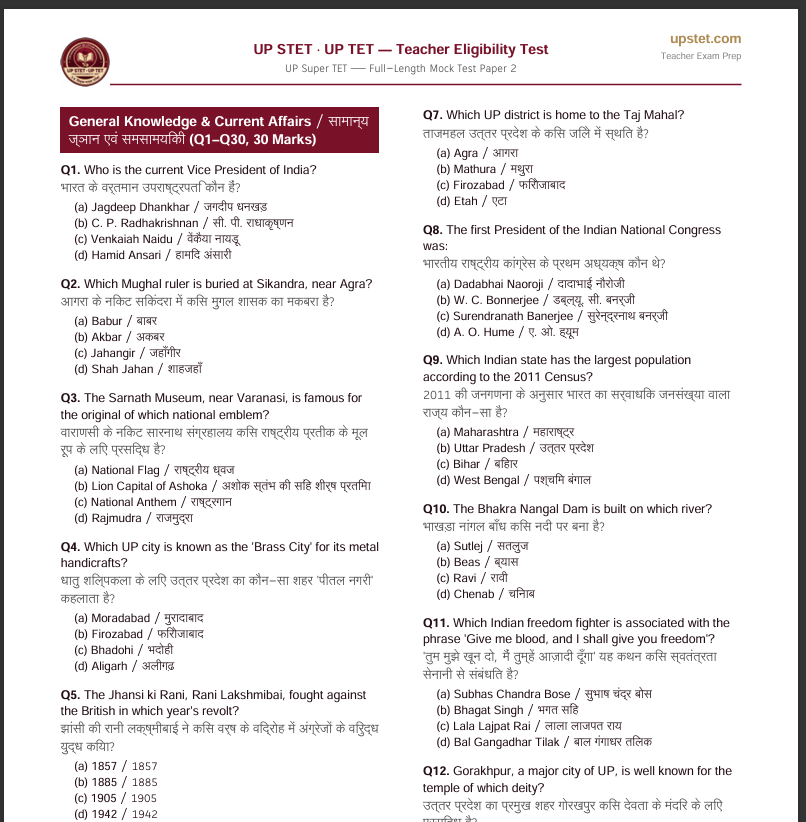
This article gives you access to a free UP Super TET mock test paper to start with, along with a set of additional structured practice papers for candidates who want to go deeper into their preparation.
Why Mock Tests Matter More Than Candidates Realize
A lot of aspirants spend weeks going through notes and textbooks, feel reasonably confident, and then get a rude shock the first time they sit for a timed mock paper. That gap between “I know this” and “I can recall and apply this correctly in 60 seconds under exam pressure” is exactly what mock tests are designed to close.
Here’s what a well-structured mock test actually does for your preparation:
Reveals your real accuracy, not your perceived accuracy. It’s common to feel confident about a topic while your actual test performance says otherwise.
Builds time management instincts. UP Super TET is a timed exam, and knowing how long you can afford to spend per question — before you’re even in the exam hall — is a skill in itself.
Simulates exam-day pressure. The first time you experience timed pressure shouldn’t be on the actual exam day. Mock tests let you get that adrenaline spike out of your system beforehand.
Identifies weak areas with precision. A mock test result doesn’t just tell you “Child Development needs work” — it tells you exactly which sub-topics within Child Development are costing you marks.
Improves question-reading speed. Many candidates lose marks not because they don’t know the answer, but because they misread the question under time pressure. Repeated mock practice fixes this almost automatically.
What This Mock Test Series Covers
The mock test papers in this series are structured to reflect the actual UP Super TET exam pattern, covering the core sections candidates are tested on:
Child Development and Pedagogy — learning theories, developmental stages, inclusive education, and classroom application
Language I and Language II — grammar, comprehension, and language pedagogy
Mathematics — arithmetic, algebra, geometry, and teaching methodology for the subject
Environmental Studies / Science — foundational concepts aligned with the primary and upper-primary teaching syllabus
Social Studies — history, geography, civics, and pedagogy where applicable
Each paper is built to mirror realistic exam-level difficulty rather than oversimplified practice questions, since practicing with artificially easy papers tends to build false confidence that falls apart on the real exam.
Paper 1: Free Mock Test
This is a complete, no-cost mock paper you can download and attempt right away — ideal if you want to get a genuine baseline reading of where your preparation currently stands before deciding how to structure the rest of your revision.
Download UP Super TET Mock Test Paper 1 (Free): The link is available in the Links section at the end of this article.
Treat this first attempt seriously — sit in a quiet space, time yourself strictly, and resist the urge to check your notes mid-test. A mock test only gives you an honest signal if you take it under honest conditions.
Papers 2–5: Extended Practice Series
Once you’ve attempted Paper 1 and have a sense of your starting point, Papers 2 through 5 continue the practice series with fresh question sets covering the same core sections at a similarly rigorous difficulty level. These are made available as part of a paid practice bundle — each link below takes you to a secure checkout page to access that specific paper.
This structure exists for a simple reason: one free paper is enough to sample the format and test your baseline, but real improvement comes from repeated, varied practice across multiple full-length papers — which is what the extended series is built for.
How to Use This Mock Test Series Effectively
Simply attempting papers back-to-back without reviewing them properly is one of the most common ways candidates waste the value of mock practice. Here’s a more effective approach:
Attempt Paper 1 under strict timed conditions — no notes, no pausing, full focus, exactly as you would on exam day.
Review every question afterward, not just the ones you got wrong. Even correct answers can reveal whether you got there through solid reasoning or a lucky guess.
Log your weak areas in a simple list. After each paper, note down the specific topics — not just subjects — where you lost marks.
Space out your attempts. Don’t do all five papers in two days. Give yourself time between papers to actually revise the weak areas you identified, or you’ll just keep repeating the same mistakes.
Track your score trend across papers, not just your score on any single paper. A rising trend across Papers 1 through 5 is a far better predictor of exam-day readiness than any one good score.
Simulate real exam conditions as closely as possible for at least your final one or two attempts — same time of day as your actual exam slot, same seating setup, minimal distractions.
A Quick Word on Consistency
No mock test series, free or paid, replaces consistent study — it sharpens and directs it. The candidates who benefit most from structured mock practice are the ones who treat each paper as a diagnostic tool, not a pass/fail judgment. A weak score on Paper 2 isn’t a bad sign; it’s useful information that tells you exactly where to focus before Paper 3. Use these papers that way, and your preparation will improve measurably with each attempt.
Good luck with your UP Super TET preparation — steady, honest practice really is the difference-maker here.