Super TET (Super Teacher Eligibility Test) is the recruitment exam conducted by the Uttar Pradesh Education Service Selection Commission (UPESSC) to select Assistant Teachers for government schools in Uttar Pradesh. Unlike CTET or UPTET, which only confirm teaching eligibility, Super TET is the actual selection exam that decides a candidate’s final merit and appointment.
Detail
Version 1 (Widely Cited)
Version 2 (Newer, Fewer Sources)
Conducting Body
UPESSC
UPESSC
Total Questions
120
150
Total Marks
360
150
Marks per Correct Answer
3
1
Negative Marking
-1 per wrong answer
None
Exam Duration
120 minutes
150 minutes (2.5 hrs)
Exam Mode
Offline (Pen & Paper)
Offline (Pen & Paper)
Question Type
MCQ
MCQ
Language
Hindi & English
Hindi & English
Sections
2 (GK + Chosen Subject)
Combined subject list
Because the recruitment notification is still pending, candidates preparing right now should focus on the subject list and topics, which remain largely consistent across both versions, rather than locking into one marking strategy too early.
Exam Structure (Version 1)
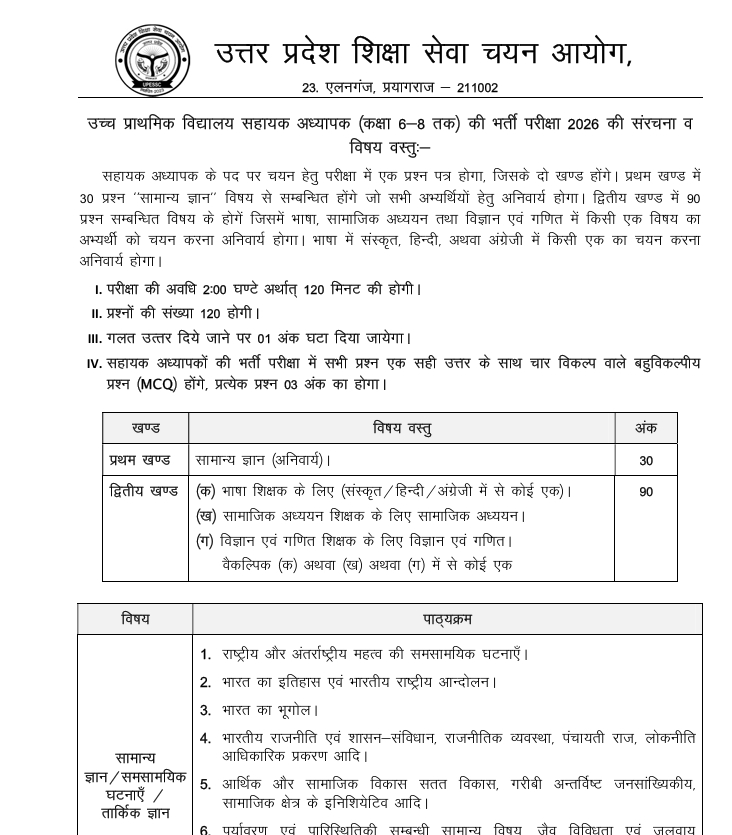
This is the version most syllabus PDFs and coaching platforms currently reference. It splits the paper into two sections:
Section 1 – General Knowledge: 30 questions, compulsory for every candidate
Section 2 – Chosen Teaching Subject: 90 questions, based on the candidate’s selected subject (Language, Science, Mathematics, or Social Studies)
Section
Subject
Questions
Section 1
General Knowledge
30
Section 2
Selected Teaching Subject
90
Total
120
Subject-Wise Marks Distribution (Version 1)
Subject
Questions
Weightage (%)
Marks
Language (Hindi, Sanskrit & English)
30
25.0%
90
General Knowledge & Current Affairs
25
20.8%
75
Mathematics
16
13.3%
48
Science
08
6.7%
24
Environmental & Social Studies
08
6.7%
24
Teaching Skills
08
6.7%
24
Child Psychology
08
6.7%
24
Life Skills, Management & Aptitude
08
6.7%
24
Logical Reasoning
05
4.2%
15
Information Technology (IT)
04
3.3%
12
Total
120
100%
360
Subject-Wise Marks Distribution (Version 2)
Subject
Questions
Marks
Language (Hindi, Sanskrit & English)
40
40
General Knowledge & Current Affairs
30
30
Mathematics
20
20
Science
10
10
Environment & Social Studies
10
10
Teaching Aptitude
10
10
Child Psychology
10
10
Life Skills, Management & Attitude
10
10
Logical Reasoning
05
05
Information Technology (ICT)
05
05
Total
150
150
Marking Scheme: What’s Actually Different
The biggest practical difference between the two versions is how mistakes are treated:
Version 1 penalizes wrong answers, deducting 1 mark for each incorrect response. This makes guessing risky when a candidate is unsure between options.
Version 2 has no negative marking at all, meaning every question is worth attempting since a wrong answer and a blank one both score zero.
Until the official notification confirms which applies, candidates preparing seriously should practice with the same accuracy standard either way — treating every question as if it could be penalized keeps the habit safe regardless of which version is finalized.
Selection Process
Selection for Super TET is not based on the written exam alone. The final merit list combines two components:
Written Exam Score: 60% weightage
Academic Qualifications: 40% weightage, broken down further as:
High School marks
Intermediate marks
Graduation marks
Teacher training (D.El.Ed/B.Ed) marks
Eligibility Snapshot
Must have already qualified UPTET or CTET (Paper 1 for Class 1–5 posts, Paper 2 for Class 6–8 posts)
Must hold a graduate degree
Must have completed D.El.Ed or B.Ed
Age typically between 21 and 40 years, as per past cycles
Frequently Asked Questions
Is the Super TET 2026 exam pattern officially confirmed? No. As of now, UPESSC has not released the official Super TET 2026 recruitment notification, so the exam pattern is not yet confirmed. Two versions are being reported by different sources.
Is there negative marking in Super TET 2026? This depends on which version gets confirmed. One reported version deducts 1 mark per wrong answer; another reports no negative marking at all. Candidates should prepare for accuracy regardless.
How many questions are in the Super TET 2026 exam? Sources currently differ between 120 questions (360 marks) and 150 questions (150 marks). This will be confirmed once the official notification is released.
Who conducts the Super TET exam? The Uttar Pradesh Education Service Selection Commission (UPESSC) conducts Super TET for Assistant Teacher recruitment in UP government schools.
Is UPTET or CTET required before applying for Super TET? Yes. Only candidates who have already qualified UPTET or CTET (the relevant paper for their chosen level) are eligible to apply for Super TET.
Where can candidates check the latest official update? Candidates should check updeled.gov.in directly for the official Super TET 2026 notification rather than relying on third-party syllabus pages, since those currently disagree on the exact exam pattern.
UP Super TET (Uttar Pradesh Super Teacher Eligibility Test) is an important teacher recruitment examination conducted by the Government of Uttar Pradesh. This exam is held for the post of Sahayak Adhyapak (Assistant Teacher) and aims to select teachers for government schools.
Important Point: Super TET is not merely an eligibility test — it is an actual recruitment examination that determines your final appointment. If you wish to apply for the Upper Primary level (Class 6-8), it is mandatory to have already passed UPTET or CTET Paper-2.
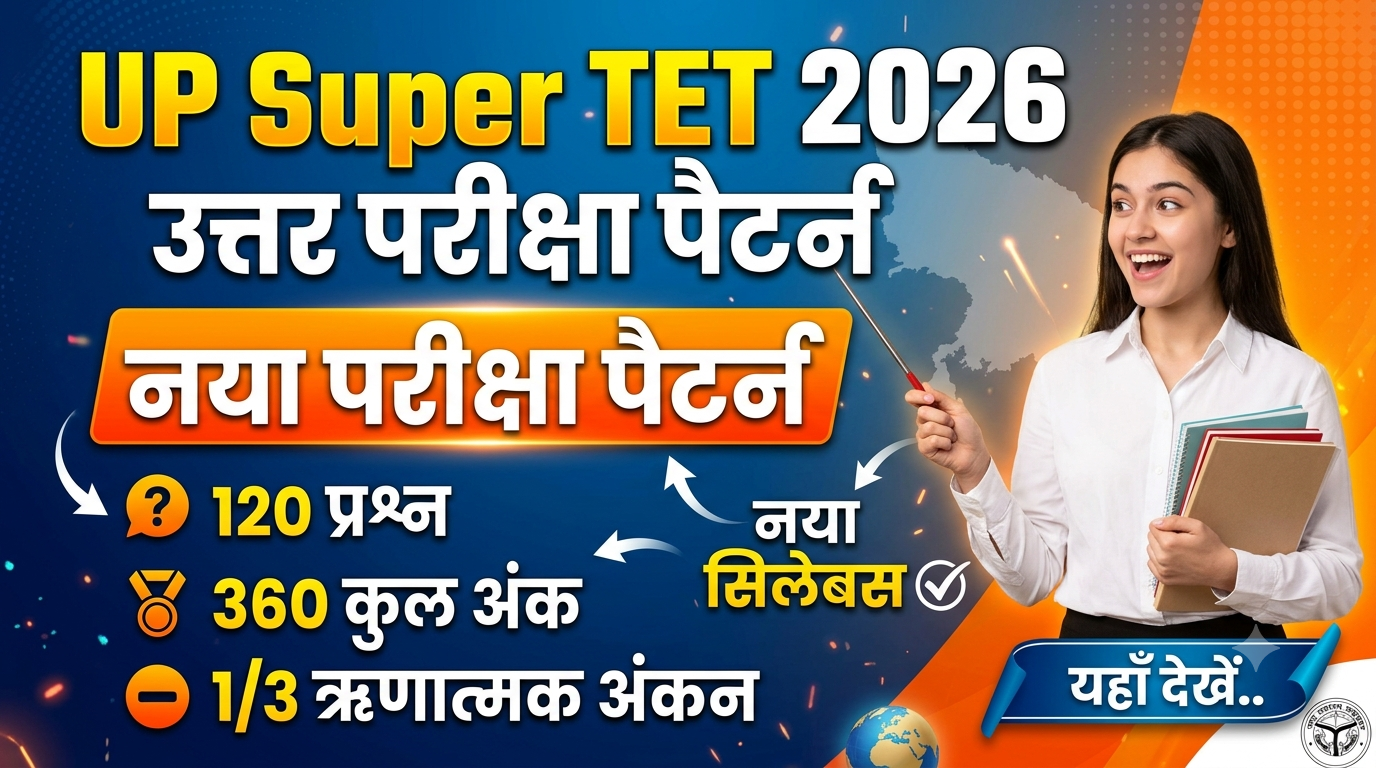
Super TET 2026 Exam Pattern (Class 6-8)
Item
Details
Total Questions
120
Total Marks
360
Question Type
Multiple Choice Questions (MCQ)
Exam Duration
120 minutes (2 hours)
Exam Mode
Offline (pen and paper)
Language
Hindi and English
Marks for Correct Answer
3 marks
Marks Deducted for Wrong Answer
-1 mark
Conducting Body
UP Education Service Selection Commission (UPESSC)
Exam Structure
The Super TET exam is divided into two sections:
Section 1: General Knowledge (30 Questions)
Mandatory for all candidates
Covers current affairs, national-international news, awards, and Indian culture
Section 2: Chosen Teaching Subject (90 Questions)
For Class 6-8, you can choose your subject:
Hindi/Sanskrit/English
Science
Mathematics
Social Studies
Etc.
Total = 30 + 90 = 120 Questions
Subject-wise Distribution and Marks for Class 6-8
Detailed Subject-wise Table
S.No.
Subject
Number of Questions
Total Marks
Weightage %
1.
Language (Hindi, Sanskrit, English)
30
90
25.0%
2.
General Knowledge & Current Affairs
25
75
20.8%
3.
Mathematics
16
48
13.3%
4.
Science
08
24
6.7%
5.
Environment & Social Studies
08
24
6.7%
6.
Teaching Skills
08
24
6.7%
7.
Child Psychology
08
24
6.7%
8.
Life Skills, Management & Attitude
08
24
6.7%
9.
Logical Reasoning
05
15
4.2%
10.
Information Technology (IT)
04
12
3.3%
Total
120
360
100%
Detailed Subject-wise Syllabus (Class 6-8)
1. Language (Hindi, Sanskrit, English) – 30 Questions (90 Marks)
This is the highest-weightage subject.
Hindi Language
Grammar Topics:
Noun, pronoun, adjective, verb
Gender, number, case, tense
Analysis of predicate relations
Sentence formation and types of sentences (simple, compound, complex)
The Super Teacher Eligibility Test (Super TET) is one of the most significant recruitment examinations in India’s education sector. The Super Teacher Eligibility Test (Super TET) is a competitive recruitment examination conducted by the Uttar Pradesh government to select eligible candidates for Primary (Classes 1–5) and Upper Primary (Classes 6–8) teaching positions in government schools.
Unlike eligibility tests, Super TET is conducted as part of the teacher recruitment process to prepare the final merit list. If you’re aspiring to become an Assistant Teacher (Sahayak Adhyapak) in Uttar Pradesh’s government schools, understanding the 2026 exam pattern is crucial for your success.
What is Super TET 2026?
Super TET is the actual recruitment examination for Assistant Teacher positions in UP government schools. It’s important to understand the distinction: while CTET and UPTET are eligibility tests, Super TET determines your final selection based on merit.
Key Point for Eligibility
Candidates who have qualified CTET or UPTET and meet the prescribed educational qualifications are eligible to appear for the examination.
Super TET 2026: Basic Exam Structure
The 2026 exam follows a streamlined and candidate-friendly format that has remained consistent for recent cycles:
Examination Highlights
Aspect
Details
Exam Name
Super Teacher Eligibility Test (Super TET)
Total Questions
120
Total Marks
360
Question Type
Multiple Choice Questions (MCQs)
Exam Duration
120 minutes (2 hours)
Mode
Offline (Pen & Paper)
Languages
Hindi and English
Marking per Correct Answer
3 marks
Negative Marking
1 mark deduction for incorrect answer
Conducting Authority
Uttar Pradesh Education Service Selection Commission (UPESSC)
Important Note on Marking
Each correct answer awards 3 marks, while each incorrect answer results in a 1-mark deduction. Unattempted questions do not affect your score, so strategic attempting is recommended.
Detailed Subject-Wise Breakdown
Subject Weightage and Distribution
The 2026 Super TET exam distributes its 120 questions across 10 major subjects with varying weightage:
Subject
No. of Questions
Weightage (%)
Total Marks
Languages (Hindi, Sanskrit & English)
30
25.0%
90
General Knowledge & Current Affairs
25
20.8%
75
Mathematics
16
13.3%
48
Science
08
6.7%
24
Environmental & Social Studies
08
6.7%
24
Teaching Skills
08
6.7%
24
Child Psychology
08
6.7%
24
Life Skills, Management & Aptitude
08
6.7%
24
Logical Reasoning
05
4.2%
15
Information Technology (IT)
04
3.3%
12
TOTAL
120
100%
360
Subject Analysis
1. Languages (30 Questions – 25% Weightage) Languages carry the highest weightage in Super TET 2026. The exam covers three languages: Hindi, Sanskrit, and English. This section tests candidates’ proficiency in grammar, comprehension, vocabulary, and pedagogical approaches to language teaching.
2. General Knowledge & Current Affairs (25 Questions – 20.8% Weightage) The second-highest weightage subject covers national and international events, important personalities, government schemes, awards, and Indian culture. Daily current affairs revision is essential for this section.
3. Mathematics (16 Questions – 13.3% Weightage) Mathematics contributes significantly to the overall score. Questions focus on basic mathematical concepts, teaching methodologies, and problem-solving skills relevant to classroom instruction.
4. Science (08 Questions – 6.7% Weightage) This section covers fundamental scientific principles, experimental methods, and science teaching pedagogy.
5. Environmental & Social Studies (08 Questions – 6.7% Weightage) Questions include environmental conservation, social fabric, and geography relevant to the Indian context.
6. Teaching Skills (08 Questions – 6.7% Weightage) This section evaluates your understanding of modern teaching methodologies, classroom management, and instructional strategies.
7. Child Psychology (08 Questions – 6.7% Weightage) Questions test knowledge of child development, learning theories, and psychological principles relevant to education.
8. Life Skills, Management & Aptitude (08 Questions – 6.7% Weightage) This section assesses soft skills, decision-making abilities, and personal development aspects.
9. Logical Reasoning (05 Questions – 4.2% Weightage) Though having lower weightage, this section requires critical thinking and analytical abilities.
10. Information Technology (04 Questions – 3.3% Weightage) ICT integration in education is becoming increasingly important. Questions cover basic computer concepts and digital learning tools.
Super TET 2026 Paper Structure: Two Sections
The exam is uniquely structured into two sections to ensure balanced assessment:
Section 1: General Knowledge (30 Questions)
All candidates, regardless of their teaching specialization, must attempt 30 questions from the General Knowledge and Current Affairs section. This ensures every teacher has foundational knowledge across diverse domains.
Candidates can choose their specialization based on their educational background and interest. The remaining 90 questions come from the selected teaching subject, allowing for specialized assessment.
Total: 30 + 90 = 120 Questions
This two-section approach ensures that:
All teachers have common knowledge base
Specialization is valued and assessed thoroughly
Teaching expertise in chosen subject is properly evaluated
Marking Scheme (Critical for Strategy)
Understanding the marking scheme is crucial for exam strategy:
Positive Marking
Correct Answer = +3 marks
Unattempted Question = 0 marks
Negative Marking
Wrong Answer = -1 mark
Maximum Score
With 120 questions × 3 marks = 360 marks total
Time Management
Total Time = 120 minutes
Per Question = 1 minute (approximately 60 seconds)
This tight time constraint means:
You must practice speed without compromising accuracy
Skip difficult questions initially and come back to them
Attempt all questions (since there’s no negative marking for unattempted ones, but attempting gives you a chance to earn marks)
Exam Languages
The exam is conducted in Hindi and English.Candidates can choose the language in which they wish to take the examination, making it accessible to a broader audience of educators across Uttar Pradesh.
Selection Process and Merit-Based Recruitment
Super TET follows a merit-based selection system with the following characteristics:
Final Selection Criteria
Selection is based on 60% weightage of the written exam and 40% weightage from academic qualifications, including high school, intermediate, graduation, and teacher training records.
This means:
Written Exam: 60% weightage
Academic Credentials: 40% weightage
High School performance
Intermediate marks
Graduation scores
Teacher training certification (D.El.Ed/B.Ed)
Qualifying Marks
Candidates must achieve:
General Category: Minimum 45% marks
OBC/SC/ST Category: Minimum 40% marks
Reservation Policy
As per UP Government norms:
SC: 21%
ST: 2%
OBC: 27%
EWS: 10%
PwD: 4% (horizontal reservation)
Key Differences: Super TET vs UPTET vs CTET
Understanding the distinction between these tests is vital:
Aspect
CTET
UPTET
Super TET
Purpose
Eligibility
Eligibility
Recruitment/Selection
Conducting Body
CBSE (National)
UPBEB
UPESSC
Determines
Teaching eligibility
Teaching eligibility
Merit for appointment
Pre-requisite
Graduation + B.Ed
Graduation + D.El.Ed
CTET/UPTET qualified
Scope
All-India
Uttar Pradesh
Uttar Pradesh
Final Selection
Not for selection
Not for selection
Direct appointment basis
Critical Point
Unlike UPTET which is a teacher eligibility test, Super TET is the actual Assistant Teacher Recruitment Examination that determines who gets appointed in UP government primary and upper primary schools.
Subject-Wise Preparation Strategy
High-Priority Subjects (60% of your study time)
Languages (30 questions) – Focus on grammar, pedagogy, and comprehension
General Knowledge (25 questions) – Daily current affairs, national events, awards
Teaching Skills (08 questions) – Modern pedagogies, classroom management
Child Psychology (08 questions) – Development stages, learning theories
Lower-Priority Subjects (10% of your study time)
Science, Environmental Studies, Life Skills (24 questions total)
Logical Reasoning (05 questions)
Information Technology (04 questions)
Important Preparation Tips
1. Speed and Accuracy Balance
With only 60 seconds per question, practicing mock tests is essential. Aim for accuracy while building speed.
2. No Negative Marking Strategy
While there is negative marking (-1 for wrong), it’s strategic to:
Attempt all 120 questions
Skip extremely difficult questions initially
Return to them if time permits
Never leave a question blank without careful consideration
3. Focus on High-Weightage Subjects
Languages and General Knowledge together comprise 45.8% of the exam. Devote proportionate study time to these subjects.
4. Current Affairs is Non-Negotiable
In General Knowledge:
National and international events
Important government schemes
Awards and honors
Sports and culture
Science and technology breakthroughs
Daily reading of news sources is mandatory.
5. Previous Years’ Papers
Solving previous Super TET and UPTET papers helps you:
Understand question patterns
Identify frequently asked topics
Practice time management
Build confidence
6. Mock Tests
Take full-length mock tests at regular intervals to:
Simulate exam conditions
Identify weak areas
Improve pacing and strategy
Track progress
Eligibility Criteria Summary
To be eligible for Super TET 2026, you must:
Have a valid CTET/UPTET qualification
CTET Paper 1 OR UPTET Paper 1 (for Primary Teacher position – Classes 1-5)
CTET Paper 2 OR UPTET Paper 2 (for Upper Primary position – Classes 6-8)
Meet educational qualifications
Graduation degree
Teacher training certification (D.El.Ed or B.Ed)
Fulfill age and other criteria
As specified in the official notification
Expected Vacancies and Timeline
The UP Government has a substantial backlog of teacher vacancies. The 2026 recruitment cycle is expected to have significant openings distributed across:
All 75 districts of Uttar Pradesh
Both Primary (Classes 1-5) and Upper Primary (Classes 6-8) levels
Multiple subject specializations
Stay updated on the official websites for notification release and exam date announcements.
2026 Exam Pattern: What’s New?
Shift Towards Conceptual Understanding
The newly active Prayagraj-based Commission (UPESSC) is emphasizing conceptual pedagogy over rote learning. The 2026 pattern reflects:
Focus on why behind facts, not just facts
Increased emphasis on D.El.Ed/BTC concepts
ICT integration in teaching methodology
National Education Policy (NEP) 2020 implementation
Implications for Candidates
Simply memorizing answers won’t suffice. You need to understand:
The UP Super TET 2026 represents a pivotal opportunity for teachers aiming to secure government positions in Uttar Pradesh. With a well-structured exam pattern distributing 120 questions across diverse subjects, success requires:
Clear understanding of the exam pattern and syllabus
Strategic preparation focusing on high-weightage subjects
Regular practice through mock tests and previous papers
Conceptual learning over rote memorization
Consistent effort and time management
The two-section structure ensures balanced assessment of general knowledge and subject-specific expertise. The 60% weightage to the written exam and 40% to academic credentials means your hard work in preparation will be substantial factor in your final selection.
Start your preparation today, stay updated with official notifications, and utilize the resources mentioned above to achieve your goal of becoming an Assistant Teacher in UP government schools.
Best of luck with your Super TET 2026 preparation
50%OFF
📚
Super TET Mock Papers
Complete Exam Solutions with Solutions
⭐ Limited Time Offer: Get all 5 premium mock test papers at 50% discount!
Perfect for the New Super TET Exam Pattern 2024-2025