Latest

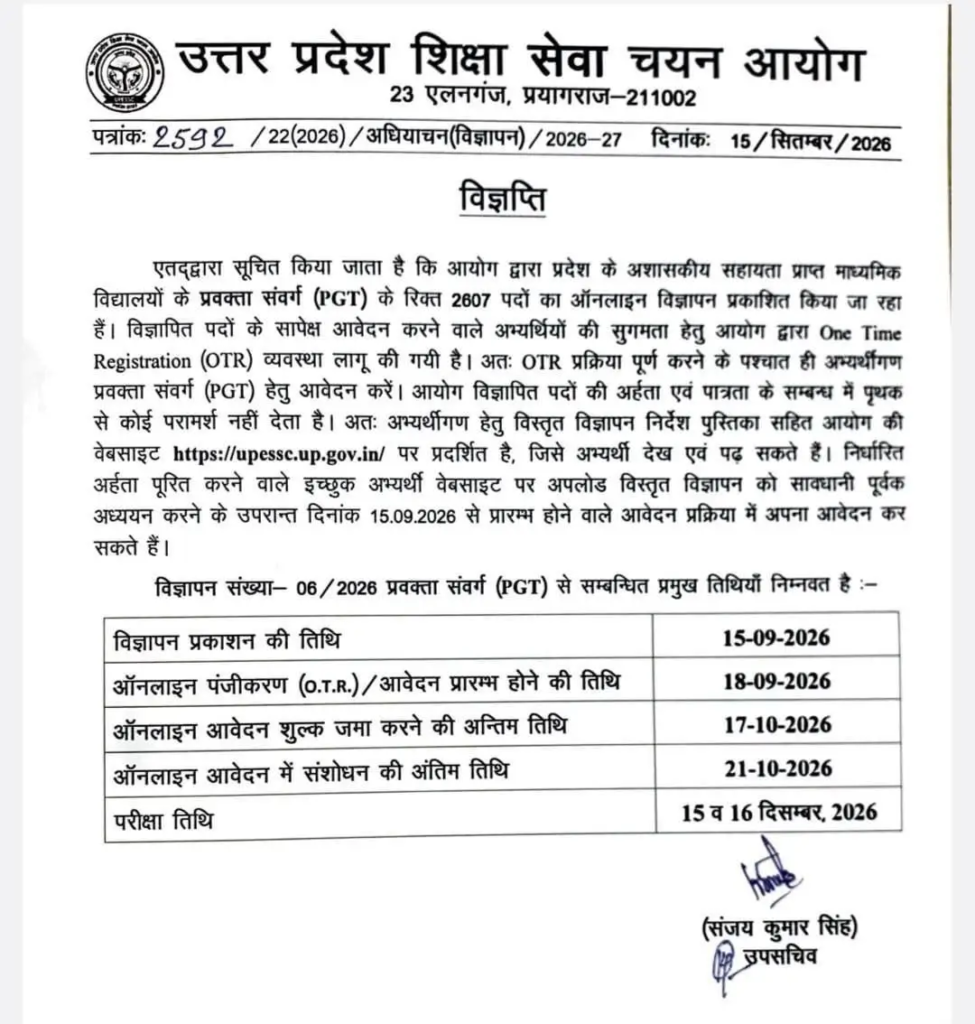
UP PGT New Recruitment 2026 Notification OUT For 2607 Posts

UP PGT New Recruitment 2026 Notification Date, Application Start Date

Getting a Post Graduate Teacher (PGT) position in Uttar Pradesh’s government-aided schools is one of the most sought-after teaching careers in the state better pay scale, senior classroom responsibility (grades 11 and 12), and long-term job security that few other education-sector roles offer. If you’ve got a master’s degree and a B.Ed sitting in your folder, waiting to be put to use, the UP PGT New Recruitment 2026 cycle is probably the update you’ve been refreshing your browser for.

This guide pulls together everything currently known about the recruitment official figures where they exist, realistic estimates where they don’t, and a clear line between the two so you’re not left guessing what’s confirmed and what isn’t.

Where Things Currently Stand

Let’s start with what’s actually settled. The previous PGT recruitment cycle (Advertisement No. 02/2022) conducted its interviews on 9th and 10th May 2026, and that process has been running toward its final merit list. That cycle was built around 624 PGT vacancies spread across subjects like English, Sanskrit, Home Science, and Economics, among others.

The next cycle UP PGT Recruitment 2026 has not had its official notification released yet at the time of writing. What we do have are strong, recurring signals from multiple recruitment-tracking sources pointing to a vacancy count of roughly 2607 PGT posts, depending on which report and which stage of planning you’re looking at. Some broader estimates that bundle PGT together with TGT and primary teacher (PRT) hiring put the combined figure well above 20,000, even touching numbers as high as 46,000+ when all three cadres are counted together across a phased hiring plan.

Here’s the honest caveat you deserve: none of these numbers are final until the Uttar Pradesh Education Service Selection Commission (UPESSC), formerly UPSESSB, publishes the actual notification PDF. Pre-notification vacancy figures circulating online are compiled estimates, not official confirmations, and they can shift sometimes significantly once the commission finalizes district-wise and subject-wise data. Treat every number in this article, including these, as directional rather than final.

Who Is Eligible to Apply?

Based on the established eligibility framework the commission has used in previous PGT cycles, here’s what you’ll typically need:

  • Educational Qualification: A Master’s degree in the relevant subject, along with a B.Ed (Bachelor of Education) or equivalent teacher training qualification from a recognized university
  • Minimum Age: 21 years at the time of application
  • Age Relaxation: Standard relaxations apply for SC/ST/OBC, PwD, and other reserved categories as per Uttar Pradesh government norms

One detail worth understanding clearly: recent Supreme Court rulings on teacher eligibility have clarified that B.Ed-qualified candidates remain eligible for TGT and PGT posts, but not for Primary Teacher (PRT) positions, which are reserved specifically for BTC/D.El.Ed holders. If you’ve been confused by mixed information floating around on this point, that’s the current legal position worth double-checking against the final notification once it’s out, since eligibility rules occasionally get revised.

Exam Pattern: What the Written Test Looks Like

The UP PGT written examination has historically followed this structure:

  • Total Marks: 425
  • Question Format: Objective-type (multiple choice), with 125 questions carrying 3.4 marks each
  • Negative Marking: None there is no penalty for incorrect or unattempted answers

That last point matters more than candidates often realize. With zero negative marking, leaving a question blank literally cannot help your score an educated guess, even a partial one, is always the mathematically better choice over skipping.
Selection Process: PGT Is Slightly Different from TGT

This is a distinction many candidates miss when they lump TGT and PGT preparation together. While TGT recruitment typically ends at document verification with no interview, PGT recruitment includes an interview round after the written exam. If you’re preparing for PGT specifically, don’t neglect this stage subject depth, communication clarity, and your ability to discuss pedagogy convincingly all come into play here in a way they simply don’t for TGT candidates.

The general selection flow looks like this:

  1. Written Examination (425 marks, objective type)
  2. Document Verification for candidates who clear the cutoff
  3. Interview Round a stage unique to PGT among UP’s teacher recruitment cadres
  4. Final Merit List based on combined performance

Subject-Wise Demand: Where the Opportunities Are

Based on the previous cycle’s vacancy distribution, PGT vacancies in UP are typically spread across subjects including English, Hindi, Sanskrit, Mathematics, Physics, Chemistry, Biology, Economics, History, Civics, Geography, Commerce, and Home Science. Subject-wise splits for the 2026 cycle haven’t been officially released yet, but if past patterns hold, expect the detailed breakdown to arrive alongside the notification PDF this is usually one of the first things worth checking the moment it drops, since it directly affects how competitive your specific subject will be.

Why This Recruitment Cycle Matters More Than Usual

A few factors make the 2026 cycle worth paying closer attention to compared to a typical year:

  • A visible backlog is being cleared. The 2022 cycle (624 posts) was comparatively small, and demand for PGT-level teachers across UP’s higher secondary schools has been building for a while.
  • It’s part of a larger hiring push. State education officials have signaled a broader effort to strengthen secondary and higher secondary school staffing, with PGT recruitment forming one part of a combined TGT-PGT-PRT hiring plan.
  • Larger vacancy pools tend to soften cutoffs. This isn’t a guarantee, but historically, when a recruitment cycle expands significantly in scale, the qualifying cutoff per subject tends to become somewhat more accessible than in tightly capped cycles.

How to Prepare While You Wait for the Notification

The gap between “recruitment is expected” and “notification is officially out” is exactly the window serious candidates use to their advantage. A few practical steps:

  1. Revisit your subject fundamentals at the postgraduate level, not just what you’d need for a TGT-level test PGT exams probe deeper into your subject specialization.
  2. Practice previous years’ UP PGT question papers to get a feel for the exact difficulty curve and question framing style the commission favors.
  3. Prepare for the interview stage early. Since PGT (unlike TGT) includes an interview, start thinking now about how you’d discuss your subject, your teaching philosophy, and classroom management approaches this isn’t something you can cram in a week.
  4. Organize your documents now: master’s degree certificates, B.Ed marksheets, category certificates, identity proof, and photographs in the specified format. Application windows are often short, and document gathering under time pressure is a completely avoidable source of stress.
  5. Bookmark the official sources upessc.up.gov.in and upsessb.org and check them directly rather than relying on unverified forwards or secondhand screenshots.

A Note on Reliable Information

Teacher recruitment cycles in UP tend to generate a lot of noise competing vacancy figures, unverified “leaked” notification dates, and recycled old PDFs being passed around as if they’re current. As a rule of thumb: if a source doesn’t explicitly say “official notification released on [date] by UPESSC/UPSESSB,” treat the figure as an estimate, however confidently it’s presented. This article follows the same standard where information is confirmed, it’s stated plainly; where it’s a projection based on multiple reports, that’s flagged clearly too.

The UP PGT New Recruitment 2026 cycle looks set to be a genuinely significant opportunity for postgraduate-qualified, B.Ed-trained candidates aiming for a stable, respected teaching career in Uttar Pradesh’s higher secondary education system. The vacancy count, exact dates, and subject-wise breakdown are still pending official confirmation but the direction of travel is clear, and the preparation window you have right now is the most valuable time you’ll get before the application race begins.

Keep your documents ready, sharpen both your subject knowledge and your interview readiness, and check the official commission website directly and often. When the notification does land, the candidates who benefit most will be the ones who were already prepared long before it did.

Frequently Asked Questions

Q: Has the official UP PGT 2026 notification been released?

As of the latest available updates, the official notification has not yet been released. Vacancy figures currently in circulation are estimates based on recruitment-tracking reports, not confirmed commission data.

Q: What is the minimum qualification required for UP PGT?

A Master’s degree in the relevant subject along with a B.Ed or equivalent teacher training qualification from a recognized institution.

Q: Is there an interview for UP PGT recruitment?

Yes. Unlike UP TGT recruitment, which typically ends at document verification, UP PGT recruitment includes an interview round after the written exam.

Q: Is there negative marking in the UP PGT exam?

No, there is no negative marking for incorrect or unattempted answers in the UP PGT written examination.

Q: Can B.Ed candidates apply for PGT posts?

Yes. Based on current judicial rulings, B.Ed-qualified candidates are eligible for TGT and PGT posts. B.Ed candidates are not eligible for Primary Teacher (PRT) posts, which require BTC/D.El.Ed qualifications instead.

Important Links

UP PGT Teacher Recruitment 2026 Apply LinkClick Here
UP PGT Teacher Notification PDFClick Here
UP Super TET Notification Click Here
Home PageClick Here

UP Super TET Previous Year Paper PDF (FREE)

UP Super TET Previous Year Paper PDF

Ask any candidate who’s actually cleared Super TET what made the real difference in their preparation, and you’ll rarely hear “I read every textbook cover to cover.” What you’ll hear, almost every time, is some version of: “I solved as many previous year papers as I could get my hands on.” There’s a reason for that — and it’s not just exam superstition.

Super TET (the exam that recruits Assistant Teachers for Uttar Pradesh’s primary and upper primary government schools) has a fairly consistent question style year over year, even when the specific topics shift. Previous year papers are, quite simply, the closest thing you’ll get to a preview of what the actual exam feels like under time pressure. This article walks through why they matter, how to use them properly, and what the exam pattern looks like so your practice sessions actually mean something.

What Is Super TET, Quickly

Super TET is conducted by the Uttar Pradesh Basic Education Board (UPBEB) to recruit Assistant Teachers for classes 1 to 5 (and in some cycles, extending toward upper primary levels) in UP’s government schools. It’s a mandatory second-stage exam for candidates who’ve already cleared UPTET or CTET — think of UPTET as your eligibility certificate, and Super TET as the actual competitive recruitment exam that gets you the job.

Because it’s a genuinely competitive, high-stakes exam with lakhs of applicants chasing a limited number of seats, the margin between clearing and missing out often comes down to fractions of a mark. That’s exactly the kind of exam where solved-paper practice pays off disproportionately.

Why Previous Year Papers Matter More Than Generic Practice Sets

It’s tempting to treat “previous year papers” and “mock tests” as interchangeable. They’re not, and the difference matters:

  • They reveal the commission’s actual question style, not a coaching institute’s guess at it. Every exam-setting body has quirks — how they phrase Child Development questions, how numerical Math problems are structured, which Environmental Studies topics get repeated. You only learn these patterns from the real thing.
  • They show you genuine difficulty calibration. Mock tests can run easier or harder than the actual paper. Previous year papers are the actual paper — no guessing involved.
  • They expose recurring topics. If a particular Pedagogy concept or a specific type of EVS question has shown up across multiple past cycles, that’s a strong signal it’s worth mastering, not a coincidence to ignore.
  • They train your timing instincts. With 150 objective questions to attempt in a tightly bound window, knowing roughly how long a “typical” question of each type takes you is something only repeated practice on real papers can teach.
  • They build genuine exam-day composure. The first time you see the real paper shouldn’t be on exam day. If you’ve already sat through several previous papers under timed conditions, the actual exam feels familiar rather than intimidating.

Super TET Exam Pattern: What You’re Practicing For

Before diving into old papers, it helps to be clear on the current structure so your practice sessions are calibrated correctly:

  • Mode: Offline, pen-and-paper (OMR-based)
  • Question Type: Multiple Choice Questions (MCQs), objective format
  • Total Questions: 150
  • Paper Structure: Paper I carries 150 marks; where applicable, Paper II carries 50 marks
  • Duration: Approximately 2 hours to 2 hours 30 minutes, depending on the specific cycle’s notification
  • Subjects Covered: Hindi, English, Sanskrit (Language sections), Mathematics, Science, Environmental & Social Studies, Teaching Methodology, Child Psychology, General Knowledge/Current Affairs, Reasoning/Logical Ability, and Information Technology

Since exact marks distribution and section-wise weightage can shift slightly between recruitment cycles, always cross-verify against the latest official notification before finalizing your practice plan — treat the pattern above as a reliable general framework rather than a locked-in guarantee for every cycle.

How to Actually Use Previous Year Papers (Not Just Skim Them)

Downloading a stack of PDFs and glancing through the questions is the least effective way to use this resource. Here’s a more disciplined approach that actually moves your preparation forward:

  1. Simulate real exam conditions. Set a timer for the actual duration, sit through the full paper without interruptions, and resist the urge to check answers mid-attempt. The value of a previous year paper drops sharply the moment you turn it into an open-book exercise.
  2. Score yourself honestly, then analyze — don’t just check right or wrong. For every question you got wrong, ask why: was it a knowledge gap, a silly calculation error, a misread question, or a time-pressure mistake? Each of these needs a different fix.
  3. Track recurring topics across multiple years. Keep a running note of topics that show up repeatedly — certain Pedagogy themes, specific EVS chapters, particular grammar rules in Hindi or English. These deserve extra revision time precisely because they’re not one-off appearances.
  4. Solve in Hindi if that’s your exam medium. Many candidates practice in English out of habit even though they’ll attempt the actual exam in Hindi. Practicing in your actual exam language matters more than it seems — it affects both comprehension speed and how comfortable you feel reading dense questions under pressure.
  5. Revisit the same paper a second time after a gap. A few weeks after your first attempt, redo the same paper without looking at your previous answers. If your accuracy has genuinely improved, that’s a good sign your revision is sticking; if not, that topic needs another pass.
  6. Don’t stop at just the current cycle’s format. Even papers from earlier recruitment drives (like the 68500 and 69000 Assistant Teacher cycles) remain useful for building subject familiarity and question-style intuition, even where the exact pattern has since evolved.

A Realistic Study Plan Using Past Papers

If you’re wondering how to actually slot this into your weekly routine, here’s a simple structure many successful candidates follow:

  • Early preparation phase: Solve one previous year paper per week, focused purely on identifying knowledge gaps subject by subject — don’t worry about timing yet.
  • Mid preparation phase: Increase to two to three papers per week, now under strict timed conditions, and start tracking your accuracy trend across attempts.
  • Final few weeks before the exam: Solve a paper every one to two days, prioritizing full-length, timed, exam-condition attempts to build stamina and reduce exam-day anxiety.

Throughout all three phases, keep a single running document of “topics I keep getting wrong” — this becomes your most valuable revision tool in the final stretch, far more targeted than re-reading entire textbooks from scratch.

A Word of Caution on Where You Download Papers From

Not every “previous year paper” floating around online is what it claims to be. A few sensible precautions:

  • Cross-check that the paper’s marking scheme and question count actually match the year it claims to be from — mismatched or mislabeled PDFs circulate more often than you’d expect.
  • Prefer sources that provide papers with verified answer keys rather than unsolved question dumps with no way to check your accuracy.
  • If a “previous year paper” looks suspiciously similar to a generic mock test with UP-specific details bolted on, treat it with skepticism — genuine past papers tend to have UP Board-specific phrasing and topic emphasis that’s hard to fake convincingly.

Final Thoughts

Previous year papers aren’t a supplementary resource for Super TET preparation — for most successful candidates, they’re the backbone of it. Textbooks teach you the subject; past papers teach you the exam. The two are related but not the same thing, and candidates who only do the former often walk into the exam hall knowing the syllabus well but still getting caught off guard by the actual question style, timing pressure, or phrasing quirks that only real papers reveal.

Build a disciplined routine around solving, timing, and honestly analyzing past papers rather than passively reading through them, and you’ll walk in on exam day with something more valuable than last-minute revision — genuine familiarity.

Frequently Asked Questions

Q: How many previous year papers should I solve before the exam?

There’s no fixed magic number, but candidates who clear competitive exams like Super TET typically solve papers consistently over months rather than cramming a handful in the final week — quality of analysis matters more than raw quantity.

Q: Are older papers (like the 68500/69000 cycles) still useful?

Yes, for building subject familiarity and understanding question style, even though the exact exam pattern has evolved somewhat since those cycles.

Q: Should I solve papers in Hindi or English?

Solve in whichever language you’ll actually attempt the real exam in — practicing in a different language than your exam medium reduces the real-world value of the exercise.

Q: Where can I find the official, verified papers?

The most reliable source is always the official UPBEB website, supplemented by well-established educational platforms that provide answer keys alongside the papers.

Useful Links & Resources

For downloading previous year papers, checking exam updates, and verifying details directly from primary sources, the following are worth bookmarking.

Papers Link
UP STET Question Paper 2018Click Here
UP STET Question Paper 2019Click Here
UP STET Question Paper 2021Click Here
UP TET Answer Key 2026Click Here
Home PageClick here

UP TGT Detailed Syllabus 2026 All Subjects

UP TGT Detailed Syllabus 2026

Preparing for the UP TGT exam without a clear subject-wise syllabus in front of you is a bit like studying for a test with only half the question paper visible. The Uttar Pradesh Education Service Selection Commission (UPESSC), formerly UPSESSB, recruits Trained Graduate Teachers across more than a dozen subjects, and each one carries its own detailed topic list that candidates are expected to master before exam day.

This guide breaks down the UP TGT syllabus subject by subject, explains the current exam pattern (including a recent structural revision candidates need to know about), and closes with a quick-reference table and useful links so you can go straight to the source material.

Exam Pattern: The Foundation Before the Syllabus

Before diving subject by subject, it helps to understand the exam structure itself, since it’s changed recently and directly affects how you should weigh your preparation.

For the most recently concluded TGT cycle, the paper consisted of 125 multiple-choice questions worth 500 marks, split across four broad sections: General Awareness, General English, Quantitative Aptitude, and the Concerned Subject, with no negative marking. This structure rewarded attempting every single question, since a wrong answer cost nothing.

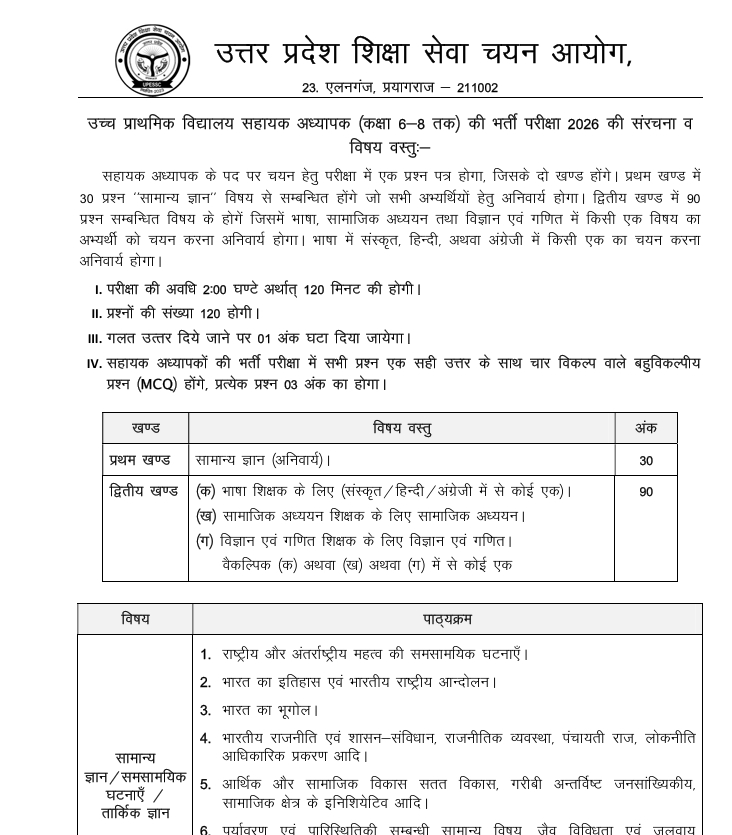
UPESSC has since revised the pattern for upcoming TGT recruitment cycles. Under the new structure, candidates answer 120 questions total — 90 from their concerned subject and 30 compulsory General Studies questions — for a combined 360 marks, and negative marking has been introduced for the first time. This is a meaningful shift: guessing blindly is no longer risk-free, so building strong elimination skills for uncertain questions now matters more than it used to.

Whichever pattern applies to your specific recruitment cycle, one thing stays constant: the Concerned Subject carries the heaviest weight in the paper, so your subject-wise preparation should absorb the majority of your study time.

Common Sections for All Candidates

Regardless of which subject you’re applying for, every TGT candidate needs to prepare for the same shared sections:

General Awareness covers national and Uttar Pradesh-specific current affairs, history (with particular attention to UP’s own history), geography, polity, and general science at a foundational level.

General English tests grammar, vocabulary, comprehension passages, sentence correction, and basic usage — straightforward but easy to underestimate if you assume your subject knowledge alone will carry you.

Quantitative Aptitude includes arithmetic, percentages, ratio and proportion, simple and compound interest, time and work, averages, and elementary data interpretation — nothing at an advanced level, but consistent practice matters since these questions are quick to lose marks on under time pressure.

Now let’s get into the subject-specific breakdowns.

Hindi Syllabus

The Hindi syllabus is built around both language mechanics and literary knowledge. Core areas include Hindi Vyakaran (grammar) covering sandhi, samas, alankar, ras, chhand, and word formation rules; literature spanning major poets and prose writers across Adikal, Bhaktikal, Ritikal, and Adhunik Kal (the four broad historical periods of Hindi literature); comprehension and unseen passage analysis; and letter writing, essay writing, and translation exercises. Pedagogy of Hindi teaching — methods for teaching language skills at the secondary level — also features prominently, since TGT is fundamentally a teaching qualification exam, not a pure literature test.

English Syllabus

English candidates should expect a mix of language and literature components. This includes grammar (tenses, voice, narration, parts of speech, error correction), comprehension passages testing inference and vocabulary in context, English literature covering major poets, playwrights, and prose writers typically taught at the secondary and senior secondary level, and pedagogy of English language teaching, covering approaches to developing the four language skills — listening, speaking, reading, and writing — in a classroom setting.

Mathematics Syllabus

Mathematics is one of the more content-heavy subjects, spanning both pure theoretical topics and applied problem-solving. The core areas include Algebra (polynomials, equations, progressions), Geometry (plane and solid geometry, coordinate geometry), Trigonometry (identities, heights and distances), Mensuration (area and volume of standard shapes), Statistics (frequency distribution, measures of central tendency, measures of dispersion), and elementary Calculus concepts at the level typically taught in senior secondary classes. Candidates should also expect application-based questions like time-speed-distance, work and time problems, compound interest, and banking/taxation-related numerical questions, alongside pedagogy of mathematics teaching, which focuses on methods for building conceptual clarity in students rather than rote memorization.

Science Syllabus

For the composite Science subject, the syllabus draws from Physics, Chemistry, and Biology at a level aligned with the NCERT secondary curriculum. Physics topics typically include mechanics, heat and thermodynamics, light and optics, electricity and magnetism, and modern physics basics. Chemistry covers atomic structure, periodic classification, chemical bonding, acids and bases, and organic chemistry fundamentals. Biology spans cell biology, genetics, human physiology, plant physiology, and ecology. Since Science is examined as a single composite subject rather than three separate ones, balanced preparation across all three branches matters — candidates who lean heavily on just one branch often find themselves short-changed on the other two sections of the paper.

Social Science Syllabus

Social Science is structured into four distinct sections — Geography, History, Economics, and Civics (Political Science) — each carrying its own detailed, granular topic list rather than broad chapter headings, meaning questions can be drawn from any specific point within a section.

Geography covers the origin of the solar system, Earth’s shape and motions, solar and lunar eclipses, latitude and longitude, determination of local and standard time, and both Indian and world physical geography.

History spans Ancient, Medieval, and Modern India, with heavy emphasis on the Indian National Movement, alongside significant coverage of Modern India from 1858 to 1958.

Economics includes economic theory, public finance, and applied topics like the Indian economy and foreign trade.

Civics covers the Indian Constitution, governance structures, fundamental rights and duties, and the functioning of democratic institutions.

Because all four sections carry roughly equal weight, dividing preparation time evenly across them tends to work better than concentrating heavily on just one or two.

Sanskrit Syllabus

The Sanskrit syllabus centers on Vyakaran (grammar) — sandhi, samas, karak, and verb conjugation rules — alongside classical Sanskrit literature, covering major texts and authors typically studied at the secondary and senior secondary level. Translation exercises (Sanskrit to Hindi and vice versa), comprehension of unseen Sanskrit passages, and pedagogy of Sanskrit language teaching round out the syllabus.

Urdu Syllabus

Urdu candidates should prepare grammar fundamentals, Urdu literature covering major poets and prose writers, comprehension of unseen passages, and translation exercises, along with pedagogy focused on effective Urdu language instruction at the secondary level.

Commerce Syllabus

The Commerce syllabus covers Accountancy (fundamentals of bookkeeping, financial statements, partnership accounts), Business Studies (principles of management, business organization, and economic environment), and foundational Economics concepts relevant to commerce education, along with pedagogy of commerce teaching for secondary-level classrooms.

Agriculture Syllabus

Agriculture is a comparatively specialized subject with syllabus coverage across Agronomy (crop production practices), Horticulture (fruit and vegetable cultivation), Soil Science (soil types, fertility management), Crop Protection (pest and disease management), Natural Farming practices, and Agricultural Management, including basic farm economics. Since Agriculture tends to attract fewer overall applicants compared to subjects like Hindi or Social Science, candidates with a strong agricultural science background often find comparatively less crowded competition here.

Home Science Syllabus

Home Science covers Nutrition and Food Science, Textiles and Clothing, Child Development, Family Resource Management, and Home Management principles, along with pedagogy focused on teaching practical life-skills subjects effectively at the secondary level.

Art Syllabus

The Art syllabus spans Art History (major movements and periods, with attention to Indian art history specifically), Art Techniques (drawing, painting, and composition fundamentals), Applied Art concepts, and pedagogy of art education, covering how to nurture creative skills in secondary-level students.

Music Syllabus

Music syllabus content is generally divided between Vocal and Instrumental streams, covering music theory (ragas, talas, notation systems), practical performance knowledge, and the history of Indian classical and light music, along with pedagogy for teaching music appreciation and practice at the secondary level.

Physical Education Syllabus

Physical Education covers Sports Science fundamentals (anatomy and physiology as applied to physical activity), principles of physical training and conditioning, rules and techniques across major sports disciplines, health education, and yoga, alongside pedagogy focused on organizing physical education programs in a school setting.

How to Approach Your Subject-Wise Preparation

A few practical points worth keeping in mind regardless of which subject you’re preparing for. First, treat the official syllabus PDF as your primary reference document rather than any single summary article, since subject-wise topic lists get updated and the official version is always the final word. Second, notice that pedagogy — the “how to teach this subject” component — appears across virtually every subject syllabus; candidates sometimes focus purely on content mastery and underprepare for pedagogy-oriented questions, which is a fixable gap with just a bit of targeted attention. Third, since the revised exam pattern now includes negative marking, build the habit of eliminating clearly wrong options before attempting uncertain questions rather than guessing outright, particularly in the Concerned Subject section where questions tend to get more specific and detail-oriented as the paper progresses.

Quick Reference: Subject-Wise Syllabus and PDF Access

SubjectKey Topic AreasWhere to Access Detailed PDF
HindiVyakaran, literature (all historical periods), comprehension, pedagogyOfficial UPESSC syllabus portal
EnglishGrammar, literature, comprehension, pedagogyOfficial UPESSC syllabus portal
MathematicsAlgebra, Geometry, Trigonometry, Mensuration, Statistics, Calculus basicsOfficial UPESSC syllabus portal
SciencePhysics, Chemistry, Biology (composite, NCERT-aligned)Official UPESSC syllabus portal
Social ScienceGeography, History, Economics, CivicsOfficial UPESSC syllabus portal
SanskritVyakaran, literature, translation, pedagogyOfficial UPESSC syllabus portal
UrduGrammar, literature, translation, pedagogyOfficial UPESSC syllabus portal
CommerceAccountancy, Business Studies, EconomicsOfficial UPESSC syllabus portal
AgricultureAgronomy, Horticulture, Soil Science, Crop ProtectionOfficial UPESSC syllabus portal
Home ScienceNutrition, Textiles, Child Development, Home ManagementOfficial UPESSC syllabus portal
ArtArt History, Techniques, Applied Art, pedagogyOfficial UPESSC syllabus portal
Music (Vocal/Instrumental)Theory, practical performance, historyOfficial UPESSC syllabus portal
Physical EducationSports Science, training principles, health education, yogaOfficial UPESSC syllabus portal

To download the exact subject-wise PDF, visit the official UPESSC website, open the Syllabus section from the homepage navigation, select UP TGT Syllabus, and choose your subject code from the dropdown list. Always confirm you’re downloading the version matching your specific recruitment cycle, since older and revised syllabus PDFs sometimes circulate simultaneously across different websites.

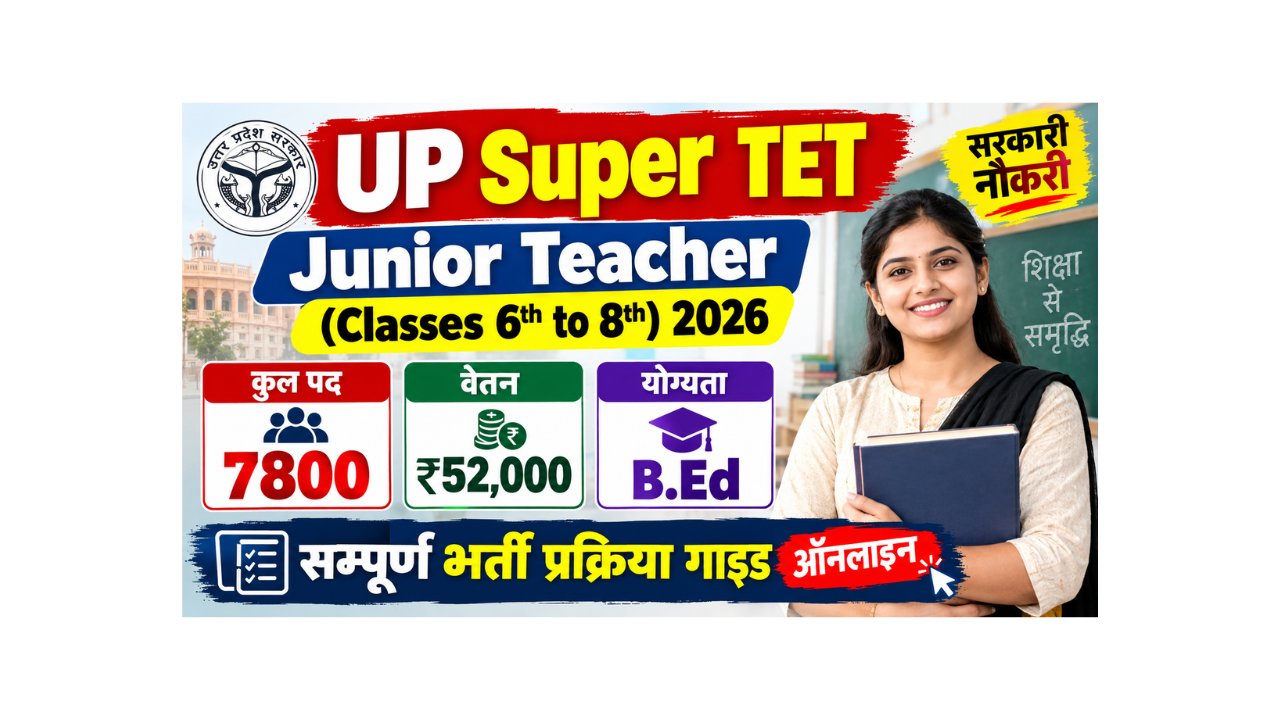
UP Super TET Junior Teacher (Classes 6th to 8th) 2026 Vacancy, Salary, Eligibility

UP Super TET Junior Teacher (Classes 6th to 8th) 2026 Vacancy, Salary, Eligibility &

Uttar Pradesh’s upcoming teacher recruitment drive has two distinct tracks running in parallel, and mixing them up is the single most common mistake candidates make right now. One track covers Primary Teachers for Classes 1 to 5. The other — the one this article focuses on — covers Junior Teachers for Classes 6th to 8th, commonly referred to as UP Super TET Junior 2026. If you’re a B.Ed graduate with UPTET Paper 2 or CTET Paper 2 in hand, this is the recruitment cycle built specifically for you.

Where Things Currently Stand: Junior vs Primary Recruitment

This distinction matters more than most articles online make clear. On 15 September 2026, the Uttar Pradesh Education Service Selection Commission (UPESSC) released an official notification (Advertisement No. 05/2026) — but that notification covers 12,405 Primary Teacher vacancies only, split between Urban Primary posts under the Basic Education Department and Attached Primary posts in aided institutions. Applications for that cycle opened on 16 September and run until 15 October 2026, with the exam scheduled for 3 and 4 December 2026.

The Junior Teacher recruitment for Classes 6th to 8th is a separate stream and, as of now, its own formal advertisement is still awaited from UPESSC. Industry trackers and recruitment portals have been circulating an expected vacancy figure of around 7,800 posts for this Junior stream, with an anticipated starting salary in the range of ₹52,000 per month once HRA, DA, and other allowances are factored in. These figures are reasonable projections based on current recruitment patterns and reported estimates, but they are not yet confirmed by an official gazetted notification specific to the Junior category. Treat them as the direction things are heading rather than a locked-in fact until UPESSC publishes the dedicated Junior Teacher advertisement.

What Makes the Junior Teacher Post Different from Primary Teacher

Both posts fall under the broader Super TET umbrella, but they’re built for genuinely different candidate profiles:

Primary Teachers (Classes 1–5) work across ten foundational subject areas and require a D.El.Ed or BTC qualification along with UPTET/CTET Paper 1. Junior Teachers (Classes 6th to 8th), on the other hand, teach within specialized subject streams — Language, Social Studies, or Science & Mathematics — in upper primary schools, and eligibility opens up to both B.Ed and D.El.Ed qualified candidates, provided they hold a valid Paper 2 qualification from UPTET or CTET.

That last point is worth underlining for B.Ed holders specifically. Since B.Ed candidates are not eligible for Primary Teacher (Classes 1–5) posts under current rules, the Junior Teacher stream becomes the primary entry point into UP’s government school system for anyone who pursued a straightforward graduation-plus-B.Ed path rather than a D.El.Ed/BTC route.

Expected Vacancy Breakdown

While the district-wise and subject-wise split for the ~7,800 expected Junior vacancies hasn’t been officially released, based on how upper primary recruitment has historically been structured in UP, expect the notification to divide seats across the three subject streams — Language, Social Studies, and Science & Mathematics — with further category-wise reservation applied as per state norms (SC, ST, OBC, EWS, and general category allocations). Once the official advertisement drops, this is the first section worth checking closely, since your specific subject stream’s vacancy count will directly shape how competitive your preparation needs to be.

Salary and Pay Structure

Based on the pay matrix currently applicable to Assistant Teacher posts under Super TET recruitment, the pay scale sits at Level 6, ranging from ₹35,400 to ₹1,12,400. In-hand salary — after HRA, DA, and standard deductions — typically works out to somewhere between ₹45,000 and ₹55,000 per month, depending on posting location (urban postings generally carry higher HRA than rural ones). The commonly cited ₹52,000 figure for Junior Teachers fits comfortably within this range and represents a realistic in-hand estimate for a mid-tier posting location.

Beyond the monthly pay, the post carries the full weight of a permanent government job: pension benefits, General Provident Fund contributions, job security, and periodic increments tied to central and state pay commission revisions. It’s also worth noting that with the 8th Pay Commission expected to influence government salary structures going forward, these figures may see upward revision by the time actual appointments are made.

Eligibility Criteria

Based on the established framework for Super TET Junior recruitment, here’s what you’ll need:

Educational qualification requires a graduation degree along with a B.Ed (or D.El.Ed/BTC, depending on the specific post category), plus a valid UPTET Paper 2 or CTET Paper 2 qualifying certificate. The general age bracket for Super TET recruitment runs from 21 to 40 years, with the standard 5-year upper age relaxation applicable to SC, ST, and OBC candidates as per Uttar Pradesh government reservation rules.

One recent development worth flagging: a second gazette notification issued around 11 September 2026 clarified that BTC-category vacancies in certain attached sections will now be filled through direct recruitment, and reaffirmed that a B.Ed qualification alone is not automatically treated as equivalent to BTC for every post category. If you’re relying on a B.Ed as your sole teaching qualification, it’s worth reading the fine print of the official notification closely once it’s out, rather than assuming blanket eligibility across every Junior Teacher vacancy.

Exam Pattern

The verified Super TET 2026 examination structure applies across both Primary and Junior streams, with subject content naturally differing based on the post applied for:

The exam consists of 120 objective-type multiple-choice questions, to be completed within 120 minutes (2 hours), carrying a maximum of 360 marks. The marking scheme awards +3 marks for every correct answer and deducts −1 mark for each incorrect answer — meaning negative marking is firmly in place, so blind guessing carries real risk. The question paper is bilingual, set in both Hindi and English, and the exam is conducted offline in pen-and-paper, OMR-based mode.

For the Junior Teacher stream specifically, expect your paper to draw from your chosen specialization — Language, Social Studies, or Science & Mathematics — layered with the standard pedagogy, child development, and general awareness components that form the backbone of the broader Super TET syllabus.

Selection is based purely on your written exam score. There’s no separate interview round and no additional weightage given to academic marks in the final merit calculation for this cycle — your rank is determined entirely by your performance in that single 360-mark paper, followed by document verification for shortlisted candidates.

How to Apply Once the Notification Is Released

When the official Junior Teacher advertisement goes live, the application process is expected to follow the same structure UPESSC has used for the Primary Teacher cycle:

First, complete One Time Registration (OTR) on the UPESSC portal if you haven’t already, since this generates the unique OTR ID required before you can apply to any UPESSC recruitment cycle. Once your OTR is active, log in, select the Super TET Junior Teacher recruitment link, and fill in your personal, educational, and category details carefully. Upload the required scanned documents — certificates, photographs, signature, and category proof — in the specified format and size. Pay the prescribed application fee through the available online payment modes, and review every entered detail carefully before final submission, since correction windows are typically short and don’t remain open indefinitely.

Preparation Strategy While You Wait

The gap before the official notification drops is genuinely your most valuable preparation time, not a reason to pause. A few focused steps:

Start by nailing down your subject stream now — Language, Social Studies, or Science & Mathematics — rather than waiting for the notification to decide for you, since deep subject preparation takes months, not weeks. Work through the general Super TET syllabus components (child development and pedagogy, general awareness, and your subject stream) using previous years’ Primary and Junior Teacher papers as a reference for question style and difficulty. Given that negative marking applies, build an elimination-based answering habit early, rather than developing a guessing reflex you’ll need to unlearn later. Keep your UPTET/CTET Paper 2 certificate, degree certificates, and category documents organized and ready, since application windows close faster than most candidates expect.

The Bottom Line

The UP Super TET Junior Teacher 2026 recruitment for Classes 6th to 8th is shaping up to be a genuinely significant opportunity for B.Ed and D.El.Ed qualified candidates holding a valid Paper 2 certificate, with expected numbers around 7,800 vacancies and a realistic in-hand salary near ₹52,000 once fully rolled out. The already-released Primary Teacher notification (12,405 vacancies) confirms that UPESSC’s broader recruitment machinery is actively moving, which makes a dedicated Junior Teacher advertisement a matter of when, not if. Use this waiting period to lock in your subject preparation, organize your documents, and check the official UPESSC portal regularly so you’re among the first to apply the moment the notification lands.

Official Links and Resources

ResourceDescriptionLink
UPESSC Official WebsitePrimary source for all notifications, syllabus, and resultshttps://www.upessc.up.gov.in/
Super TET 2026 Notification (Advt. No. 05/2026)Official notification PDF for the released Primary Teacher cycle (12,405 vacancies)Available under “Latest Notifications” on upessc.up.gov.in
UP Basic Education Board (UPBEB)Departmental portal for basic education recruitment updateshttps://upbeb.org/
UP Education Department PortalAdditional recruitment and policy updateshttps://updeled.gov.in/
One Time Registration (OTR) PortalMandatory registration before applying to any UPESSC recruitmentAccessible via upessc.up.gov.in homepage

UP Super TET Syllabus 6-8 in Hindi PDF 2026 ( Junior )

UP Super TET Syllabus 6-8 in Hindi PDF 2026

UP Super TET (Uttar Pradesh Super Teacher Eligibility Test) is an important teacher recruitment examination conducted by the Government of Uttar Pradesh. This exam is held for the post of Sahayak Adhyapak (Assistant Teacher) and aims to select teachers for government schools.

Important Point: Super TET is not merely an eligibility test — it is an actual recruitment examination that determines your final appointment. If you wish to apply for the Upper Primary level (Class 6-8), it is mandatory to have already passed UPTET or CTET Paper-2.

Super TET 2026 Exam Pattern (Class 6-8)

ItemDetails
Total Questions120
Total Marks360
Question TypeMultiple Choice Questions (MCQ)
Exam Duration120 minutes (2 hours)
Exam ModeOffline (pen and paper)
LanguageHindi and English
Marks for Correct Answer3 marks
Marks Deducted for Wrong Answer-1 mark
Conducting BodyUP Education Service Selection Commission (UPESSC)

Exam Structure

The Super TET exam is divided into two sections:

Section 1: General Knowledge (30 Questions)

  • Mandatory for all candidates
  • Covers current affairs, national-international news, awards, and Indian culture

Section 2: Chosen Teaching Subject (90 Questions)

  • For Class 6-8, you can choose your subject:
    • Hindi/Sanskrit/English
    • Science
    • Mathematics
    • Social Studies
    • Etc.

Total = 30 + 90 = 120 Questions

Subject-wise Distribution and Marks for Class 6-8

Detailed Subject-wise Table

S.No.SubjectNumber of QuestionsTotal MarksWeightage %
1.Language (Hindi, Sanskrit, English)309025.0%
2.General Knowledge & Current Affairs257520.8%
3.Mathematics164813.3%
4.Science08246.7%
5.Environment & Social Studies08246.7%
6.Teaching Skills08246.7%
7.Child Psychology08246.7%
8.Life Skills, Management & Attitude08246.7%
9.Logical Reasoning05154.2%
10.Information Technology (IT)04123.3%
Total120360100%

Detailed Subject-wise Syllabus (Class 6-8)

1. Language (Hindi, Sanskrit, English) – 30 Questions (90 Marks)

This is the highest-weightage subject.

Hindi Language

Grammar Topics:

  • Noun, pronoun, adjective, verb
  • Gender, number, case, tense
  • Analysis of predicate relations
  • Sentence formation and types of sentences (simple, compound, complex)
  • Punctuation marks and their usage
  • Figures of speech (Alankar) — Anupras (alliteration), Yamak, Shlesh, Upma (simile), Rupak (metaphor), Utpreksha, Atishayokti (hyperbole)
  • Sandhi (conjunction) — vowel sandhi, consonant sandhi, visarga sandhi
  • Samas (compound words) — Tatpurush, Dvandva, Bahuvrihi, Avyayibhav samas

Vocabulary:

  • Synonyms (Paryayvachi)
  • Antonyms (Viparitarthak)
  • Idioms and proverbs
  • Polysemous words (words with multiple meanings)

Comprehension Topics:

  • Comprehension of unseen prose passages
  • Comprehension of unseen poetry passages
  • Form, merits and demerits of poetry
  • Genres of prose (story, essay, drama)

Language Teaching:

  • Stages of language development
  • Theories of language learning
  • Strategies for language teaching in the classroom
  • Language skills — listening, speaking, reading, writing
  • Teaching language to students from diverse backgrounds
  • Understanding language-related disorders

Sanskrit Language

  • Fundamentals of Sanskrit grammar
  • Sandhi, samas, general vocabulary
  • General introduction to Sanskrit literature
  • Teaching methods

English Language

  • English Grammar (Parts of Speech, Tenses, Sentence Structure)
  • Vocabulary and Word Formation
  • Reading Comprehension
  • Writing Skills
  • English Language Teaching Methodology

2. General Knowledge & Current Affairs – 25 Questions (75 Marks)

This is the second most important subject.

National and International News:

  • Recent national events
  • Important events around the world
  • Political developments
  • International relations

Important Personalities:

  • Important national and international leaders
  • Scientists, writers, artists
  • Famous personalities from the world of sports

Awards and Honours:

  • Bharat Ratna
  • Padma awards (Padma Vibhushan, Padma Bhushan, Padma Shri)
  • Sahitya Akademi Award
  • Nobel Prize
  • International awards

Sports:

  • Olympic Games
  • Cricket and other major sports
  • Indian athletes and their achievements

Indian Culture:

  • Indian art and architecture
  • Indian music and dance
  • Festivals and traditions
  • Religious sites

Government Schemes:

  • Education-related schemes
  • Health-related schemes
  • Economic schemes
  • Women’s welfare schemes

3. Mathematics – 16 Questions (48 Marks)

Arithmetic

  • Number systems (natural, whole, integers, rational, irrational numbers)
  • Divisibility (multiples, factors, prime numbers, prime factorization)
  • Highest Common Factor (HCF) and Least Common Multiple (LCM)
  • Decimals and fractions
  • Percentage and ratio
  • Profit and loss
  • Simple and compound interest
  • Specific types of problems

Algebra

  • Variables, constants, expressions
  • Algebraic equations (linear, quadratic)
  • Solving equations
  • Substitution method, elimination method
  • Polynomials
  • Numerical and expression-based problems

Geometry

  • Basic principles of geometry
  • Point, line, ray, line segment
  • Angles — definition, types, measurement
  • Triangles — properties, types, congruence, similarity
  • Circle — radius, diameter, circumference, area
  • Quadrilaterals — types and properties
  • Pyramid, prism, cylinder, cone, sphere

Mensuration

  • Area calculations:
    • Area of triangle
    • Area of quadrilateral
    • Area of circle
    • Area of plane figures
  • Perimeter calculations
  • Volume and surface area

Statistics

  • Data collection and presentation
  • Mean, median, mode
  • Basic principles of probability
  • Graphs and charts

Mathematics Teaching

  • Methods of teaching mathematics
  • Problem-solving skills
  • Abstract and concrete representation
  • Mathematical reasoning and proof

4. Science – 08 Questions (24 Marks)

Physics

  • Motion, force and laws
  • Newton’s laws of motion
  • Work, power, energy
  • Simple machines
  • Sound — waves, frequency, wavelength
  • Light — reflection, refraction, lenses, mirrors
  • Electricity — current, voltage, resistance
  • Magnetism
  • Heat — temperature, heat transfer

Chemistry

  • Matter and its properties
  • Elements, compounds, mixtures
  • Chemical reactions
  • Acids, bases, salts
  • Metals and non-metals
  • Carbon and its compounds
  • Oxygen, hydrogen, nitrogen
  • Combustion and oxidation

Biology

  • The basic unit of life — the cell
  • Heredity and evolution
  • Plant physiology
  • Animal physiology
  • Plant and animal kingdoms
  • Nutrition — autotrophic, heterotrophic
  • Photosynthesis
  • Respiration

Human Body Systems

  • Digestive system
  • Respiratory system
  • Circulatory system
  • Nervous system
  • Endocrine system
  • Reproductive system
  • Excretory system

Health and Disease

  • Communicable (infectious) diseases
  • Non-communicable diseases
  • Immunity
  • Nutrition and health
  • First aid

Science Teaching

  • Methods of teaching science
  • Experimental and demonstration methods
  • Use of microscope
  • Safety in the science lab

5. Environment & Social Studies – 08 Questions (24 Marks)

Geography

Geography of India:

  • Location, size and boundaries of India
  • Climate and monsoon system
  • Rainfall distribution
  • Indian plateaus, mountain ranges
  • Rivers — Ganga, Brahmaputra, Narmada, Yamuna
  • Types of soil
  • Vegetation and wildlife
  • Climatic zones of India

World Geography:

  • Continents and oceans
  • Geographical features of major countries
  • World climate systems

History

Ancient India:

  • Indus Valley Civilization
  • Vedic period
  • Maurya Empire
  • Ashoka
  • Gupta period
  • Religions — Hinduism, Buddhism, Jainism

Medieval India:

  • Turkish invasions
  • Delhi Sultanate
  • Mughal Empire
  • Akbar, Shah Jahan
  • Kingdoms in the south

Modern India:

  • Arrival of Europeans in India
  • British East India Company
  • Revolt of 1857
  • Indian National Movement
  • Mahatma Gandhi, Jawaharlal Nehru
  • Indian independence struggle
  • 15 August 1947

Civics

Indian Constitution:

  • Making of the Constitution
  • Preamble
  • Fundamental Rights (Articles 12-35)
  • Fundamental Duties
  • Directive Principles of State Policy

Indian Governance:

  • President
  • Prime Minister
  • Council of Ministers
  • Parliament (Lok Sabha and Rajya Sabha)

Judiciary:

  • Supreme Court
  • High Court
  • District Court

State Government:

  • Governor
  • Chief Minister
  • Legislative Assembly
  • Legislative Council

Local Governance:

  • Panchayati Raj
  • Municipality
  • Mayor

Election Process:

  • Indian electoral system
  • Voting rights
  • Election Commission

Economics

  • Production, consumption, distribution
  • Market economy
  • National income
  • Per capita income
  • Economic development
  • Agriculture, industry, services
  • Import-export
  • Currency and banking

Environmental Studies

  • Ecosystem
  • Biodiversity
  • Climate change
  • Pollution (air, water, soil)
  • Conservation of resources
  • Renewable and non-renewable resources
  • Environmental protection programs

6. Teaching Skills – 08 Questions (24 Marks)

  • Modern teaching methods
  • Collaborative learning
  • Problem-based learning
  • Project-based learning
  • Classroom management
  • Discipline and positive reinforcement
  • Student assessment
  • Formative and summative assessment
  • Use of technology (ICT in education)
  • Inclusive classroom
  • Working with students from diverse backgrounds

7. Child Psychology – 08 Questions (24 Marks)

Theories of Development

  • Meaning, need and scope of child development
  • Stages of development:
    • Infancy (0-3 years)
    • Early childhood (3-6 years)
    • Middle childhood (6-12 years)
    • Adolescence (12-18 years)

Dimensions of Development

  • Physical development
  • Mental (cognitive) development
  • Emotional development
  • Social development
  • Moral development
  • Language development

Theories of Learning

  • Thorndike’s trial-and-error theory
  • Pavlov’s classical conditioning
  • Skinner’s operant conditioning
  • Piaget’s theory of cognitive development
    • Sensorimotor stage
    • Preoperational stage
    • Concrete operational stage
    • Formal operational stage
  • Vygotsky’s socio-cultural theory
  • Bloom’s taxonomy

The Learning Process

  • What is learning
  • Types of learning
  • Meaningful learning
  • Cooperative learning
  • Problem-solving
  • Transfer of learning

Individual Differences

  • Intelligence
  • Creativity
  • Personality
  • Aptitude
  • Ability
  • Different types of intelligence

Children with Special Needs

  • Gifted children
  • Children with learning difficulties
  • Physically disabled children
  • Mentally disabled children
  • Concept of inclusive education

Adjustment and Problems

  • Common childhood problems
  • Aggression
  • Fear
  • Shyness
  • Lack of self-confidence
  • Counselling and guidance

8. Life Skills, Management & Attitude – 08 Questions (24 Marks)

Life Skills

  • Communication skills
  • Decision-making ability
  • Problem-solving
  • Self-awareness
  • Emotional intelligence
  • Social skills
  • Empathy
  • Cooperation and teamwork

Management Skills

  • Time management
  • Resource management
  • Classroom management
  • Stress management
  • Change management
  • Leadership skills

Teacher’s Attitude

  • Attitude towards the teaching profession
  • Sensitivity towards children
  • Commitment to equality and inclusion
  • Commitment to lifelong learning
  • Practicality
  • Accountability
  • Respect for Indian culture and values

9. Logical Reasoning – 05 Questions (15 Marks)

  • Similarities and differences
  • Classification
  • Series (number series, letter series)
  • Relationships
  • Ordering/arrangement
  • Coding and decoding
  • Direction test
  • Logical equations
  • Analytical reasoning

10. Information Technology (IT) – 04 Questions (12 Marks)

Computer Basics

  • What is a computer
  • Hardware and software
  • Generations of computers
  • Input and output devices

Operating Systems

  • Windows
  • Linux
  • Mac OS
  • Android

Software Applications

  • Word processing (MS Word)
  • Spreadsheet (MS Excel)
  • Presentation (MS PowerPoint)
  • Database

Internet and Online Safety

  • Introduction to the internet
  • Email
  • Web browsing
  • Cyber security
  • Data security
  • Password management

ICT in Education

  • E-learning
  • Digital resources
  • Online classes
  • Use of technology in education
  • Use of multimedia
  • Teaching software

Important Preparation Tips for Class 6-8

1. Organizing Subject-wise Study Material

High-priority subjects (60% of total time):

  • Language (30 questions)
  • General Knowledge (25 questions)
  • Mathematics (16 questions)

Medium priority (25% of total time):

  • Science (08 questions)
  • Teaching Skills (08 questions)
  • Child Psychology (08 questions)

Lower priority (15% of total time):

  • Life Skills (08 questions)
  • Logical Reasoning (05 questions)
  • Information Technology (04 questions)

2. Time Management

  • Total time: 120 minutes
  • Time per question: approximately 60 seconds
  • Section 1 (General Knowledge): 30 minutes
  • Section 2 (Teaching Subject): 90 minutes

3. Study Strategy

Phase One — Foundation Building (3-4 months)

  • Understand the core concepts of each subject
  • Read NCERT textbooks (Class 6-8 and Class 11-12)
  • Prepare notes

Phase Two — In-depth Study (2-3 months)

  • Deep study of specific subjects
  • Practice questions
  • Solve previous exam papers

Phase Three — Revision and Mock Tests (1-2 months)

  • Take full-length mock tests
  • Practice time management
  • Focus on weak areas

4. Preparing General Knowledge

Daily Study:

  • Read newspapers (15-20 minutes)
  • Use current affairs apps
  • Note down important events

Weekly Review:

  • Summarize the week’s important events
  • Remember awards and honours
  • Note sports news

5. Preparing Language

Grammar:

  • Understand the rules, don’t just memorize them
  • Practice one or two exercises daily
  • Learn from mistakes

Vocabulary:

  • Learn 5-10 new words daily
  • Use them in sentences
  • Build a set of synonyms and antonyms

Comprehension:

  • Regularly read unseen passages
  • Practice by writing answers to questions

Important Points Before the Exam

Check Your Eligibility

  • Have you passed UPTET Paper-2 or CTET Paper-2?
  • Do you have a graduate degree?
  • Have you completed D.El.Ed or B.Ed?

Follow Official Notifications

  • Check www.updeled.gov.in regularly
  • Obtain the official UPESSC notification
  • Don’t miss the application deadline

On Exam Day

  • Keep your documents ready
  • Arrive at the exam center on time
  • Try to attempt all 120 questions
  • Don’t make errors due to haste

Selection Process

Final Merit

The result is calculated based on:

  • Written exam: 60% weightage
  • Academic qualifications: 40% weightage
    • High school marks
    • Intermediate marks
    • Graduation marks
    • D.El.Ed/B.Ed marks

Reservation Policy

  • General category: 45% minimum marks
  • OBC: 45% minimum marks
  • SC/ST: 40% minimum marks
  • EWS: 45% minimum marks

Reservation Distribution

  • SC: 21%
  • ST: 2%
  • OBC: 27%
  • EWS: 10%
  • PwD: 4% (horizontal reservation)

Difference Between Class 1-5 and Class 6-8

AspectClass 1-5Class 6-8
LevelPrimaryUpper Primary
LanguageBasicAdvanced
MathematicsBasic operationsAlgebra, Geometry
ScienceEnvironmental StudiesDetailed Science
Social StudiesBasic geographyHistory, Geography, Civics
Teaching MethodPlay-basedActivity-centered

Mock Test Papers 05

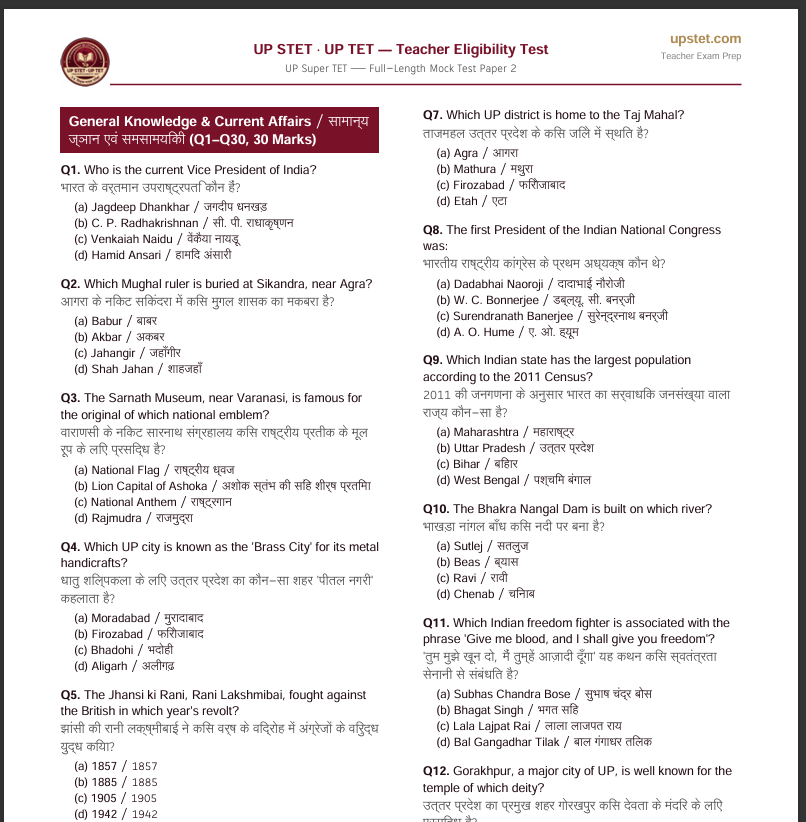
Super TET New Exam Pattern Mock Test Papers 01Click Here
Super TET New Exam Pattern Mock Test Papers 02Click Here
Super TET New Exam Pattern Mock Test Papers 03Click Here
Super TET New Exam Pattern Mock Test Papers 04Click Here
Super TET New Exam Pattern Mock Test Papers 05Click Here

Official Resources and Download Links

Official Super TET 1-5 Primary Click Here
Official Super TET 6-8 Upper – PrimaryClick Here
Official SiteClick Here
Home PageClick Here

Primary Super TET Practice Set PDF 2026 ( New Pattern )

Primary Super TET Practice Set PDF 2026

If you’re preparing for the Super TET exam for Primary Assistant Teacher posts in Uttar Pradesh, you’ve probably already collected a stack of PDFs, YouTube playlists, and WhatsApp-forwarded “important questions” files. But here’s the honest truth most toppers will tell you: reading notes and solving practice sets are two completely different skills, and it’s the second one that actually decides your score on exam day. This guide breaks down what a good Primary Super TET practice set should look like, how to use one properly, and where to find reliable resources without wasting your limited prep time.

What Is the Super TET Exam, Exactly?

Super TET, formally the Uttar Pradesh Assistant Teacher Recruitment Exam, is the gateway exam for candidates who want to teach classes 1 to 5 in UP’s government primary schools. It’s conducted offline in objective format, and only candidates who’ve already cleared UPTET or CTET are eligible to sit for it. For the Assistant Teacher post, the paper typically runs to 150 questions, while candidates applying for Principal-level posts face a slightly longer 200-question paper. Given how competitive this exam gets every cycle, simply knowing the syllabus isn’t enough you need repeated, structured practice under exam-like conditions to actually perform well when it counts.

Why Practice Sets Matter More Than You Think

A lot of candidates fall into the trap of over-consuming theory and under-practicing application. You can read child development and pedagogy notes ten times over, but if you haven’t actually sat down and answered 150 questions in the allotted time, you won’t know how your preparation holds up under real exam pressure.

A well-designed practice set does three things that passive reading simply can’t:

It reveals your actual weak areas. You might feel confident about Environmental Studies until a practice set shows you’re consistently missing questions on specific NCERT-based concepts.

It builds your speed and time management. Super TET rewards candidates who can move through questions efficiently without getting stuck. Practice sets, especially timed ones, train this instinct.

It familiarizes you with the real question style. UP’s exam-setting pattern has its own flavor a certain phrasing style, a certain difficulty curve and previous years’ papers combined with well-modeled practice sets are the closest thing you’ll get to a preview of the actual exam.

What a Good Primary Super TET Practice Set Should Cover

The Super TET syllabus for Primary Assistant Teachers is broadly divided into five sections, and a genuinely useful practice set should give you proportionate coverage across all of them rather than skewing heavily toward one or two “easy” areas:

Child Development and Pedagogy This section tests your understanding of how children learn, developmental psychology, inclusive education, and teaching methodology. It’s conceptually heavy and benefits enormously from scenario-based practice questions, not just definitions.

Language I and Language II (Hindi and English/Urdu/Sanskrit) Grammar, comprehension, and language pedagogy. Practice sets here should include passage-based comprehension questions, not just isolated grammar rules, since that’s closer to what the actual exam tests.

Mathematics — Arithmetic, geometry, and math pedagogy for primary-level teaching. This is one of the highest-scoring sections if you practice consistently, since the concepts, once mastered, don’t really change.

Environmental Studies (EVS) — A mix of science, social studies, and general environmental awareness aimed at primary-level teaching content.

General Knowledge and Current Affairs — Often underestimated, but a meaningful chunk of marks comes from here, especially UP-specific current affairs.

If a practice set you’re using skips or under-weighs any of these five areas, it’s not giving you a realistic picture of exam-day difficulty.

How to Actually Use a Practice Set (Most People Do This Wrong)

Simply solving a practice set and checking your score isn’t enough. Here’s a more effective approach:

Solve it strictly timed, exactly as you would in the real exam no pausing, no looking things up mid-attempt. This is the only way to genuinely test your speed and stamina.

Review every wrong answer, not just the ones you got right. Understanding why an answer is correct matters far more than confirming what you already knew.

Track your section-wise performance across multiple practice sets, not just one. A single test can be misleading patterns across five or six attempts tell you where your real gaps are.

Revisit previous years’ actual question papers alongside fresh practice sets. Previous year papers show you the real difficulty and phrasing style the commission uses; practice sets from coaching institutes are useful for volume, but the actual papers are your most authentic benchmark.

Space your practice sets out over your prep schedule rather than solving twenty of them in the final week. Spaced practice retains better than cramming, especially for a fact-heavy exam like this.

A Simple Weekly Practice Rhythm

If you’re not sure how to structure your practice sets into your existing study routine, a reasonably balanced approach looks like this: two to three full-length timed practice sets per week during your core preparation phase, ramping up to one every alternate day in the final month before the exam. Mix full-length sets with occasional section-wise sets when you know a specific area say, Mathematics or EVS needs isolated attention.

Don’t neglect revision between practice sets either. A practice set without a proper review session afterward is only half as useful as it should be.

Choosing Reliable Practice Set Resources

With so many PDFs and books floating around, it’s worth being selective. Look for practice sets that are explicitly aligned with the current, most recent syllabus and pattern, ideally ones that reference actual previous year Super TET papers (2018, 2019, and more recent cycles) as their foundation rather than generic recycled question banks. Books and platforms that clearly state their analytical basis showing trends from real past papers tend to be more reliable than unattributed PDF forwards circulating on social media.

Passing Super TET isn’t just about how much you’ve studied it’s about how well you can apply what you’ve studied under real exam conditions. A disciplined practice set routine, reviewed honestly and repeated consistently, is what closes the gap between “I’ve covered the syllabus” and “I can actually clear the cutoff.” Treat your practice sets as diagnostic tools, not just score trackers, and let them guide where your remaining preparation time actually goes.

Primary Super TET Practice Set PDF 2026

UP Primary Teacher Bharti 2026 Notification Out 12,405 Posts, Full Details on Dates, Eligibility & Selection

UP Primary Teacher Bharti 2026 Notification Out 12,405 Posts, Full Details on Dates, Eligibility & Selection

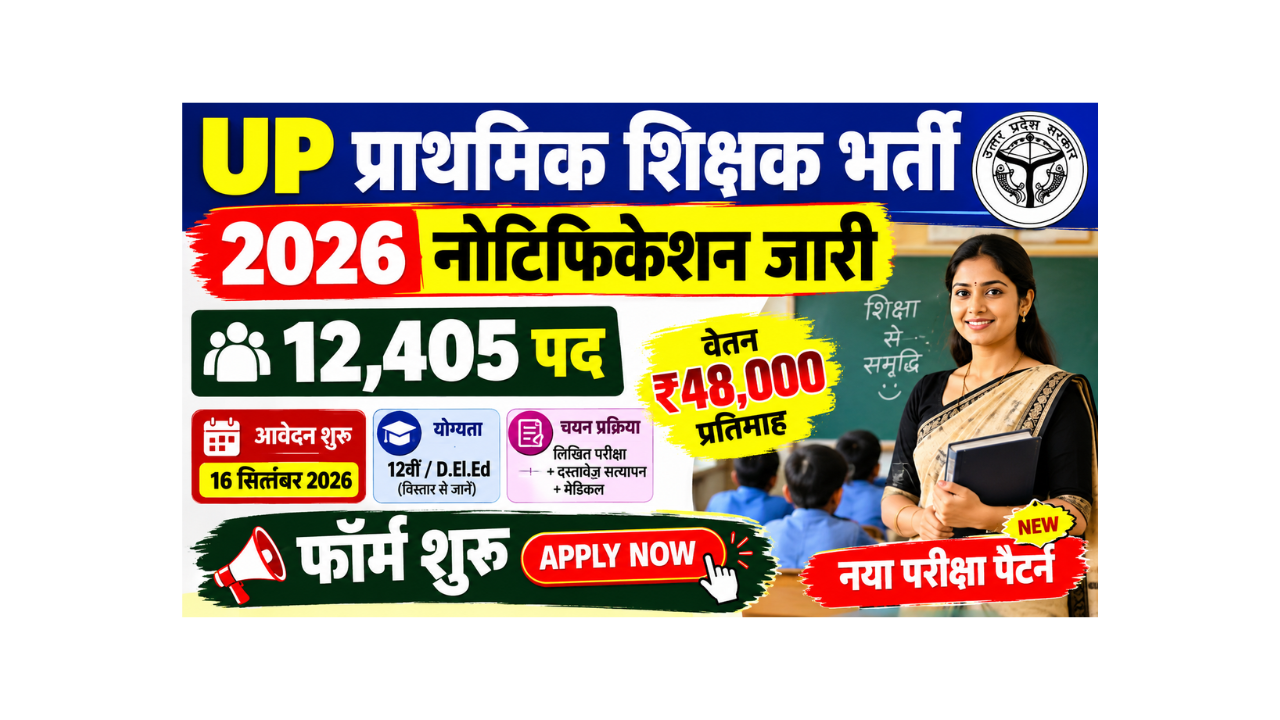
Uttar Pradesh has officially opened one of its biggest primary-level teacher recruitment drives in recent years. The Uttar Pradesh Education Service Selection Commission (UPESSC) has released the notification for Assistant Teacher (Primary Teacher / PRT) posts under Advertisement No. 05/2026, and this cycle is bringing a substantial 12,405 vacancies to the table. If you’re BTC, D.El.Ed, or B.El.Ed qualified and have been waiting for a solid opportunity to step into a government primary school classroom, this is the recruitment to pay close attention to.

Total Vacancies: 12,405 Posts

This is a meaningful number by any recent standard for UP’s primary education recruitment. The vacancies are split across two categories of primary teacher posts, each carrying slightly different eligibility conditions, so it’s worth checking which one applies to your qualifications before you start filling the form.

Important Dates You Need to Track

  • Online Application Start Date: 16 September 2026
  • Online Application Last Date: 15 October 2026
  • Last Date for Fee Payment: 15 October 2026
  • Correction Window Closes: 19 October 2026
  • Written Exam Date: 3–4 December 2026
  • Admit Card Release: Before the exam (exact date to be announced)
  • Result Date: To be updated once announced by UPESSC

Given the tight window between the application closing (mid-October) and the exam (early December), candidates have roughly six weeks after applications close to prepare seriously. That’s not a lot of runway, so starting your preparation now — rather than waiting for the admit card — is a genuinely smart move here.

Age Limit (As on 1 July 2026)

  • Minimum Age: 21 years
  • Maximum Age: 40 years
  • Age relaxation is applicable for reserved categories as per standard Uttar Pradesh government recruitment norms

Application Fee

  • General, EWS, OBC candidates: ₹1,000
  • SC/ST candidates: ₹500
  • PH (Persons with Disability) candidates: ₹300

Payment can be made online through debit card, credit card, internet banking, IMPS, or mobile wallet/cash card options.

Eligibility Criteria: Two Post Categories, Slightly Different Requirements

This recruitment covers two distinct primary teacher post types, and the eligibility conditions differ in one important detail:

Assistant Teacher (Primary – Urban) Candidates need a graduation degree along with BTC, D.El.Ed, B.El.Ed, or Special D.El.Ed qualification, and must have cleared STET or CTET Paper-I.

Assistant Teacher (Attached Primary) Candidates need the same graduation degree and BTC/D.El.Ed/B.El.Ed/Special D.El.Ed qualification, but must have cleared UPTET or CTET Paper-I instead.

Notice the difference in the qualifying test accepted for each — Urban posts specifically look for STET or CTET Paper-I, while Attached Primary posts ask for UPTET or CTET Paper-I. If you’ve cleared both UPTET and CTET, you’re likely eligible for either category, but if you’ve only cleared one of these, double-check which post type matches your specific qualifying exam before applying.

It’s also worth noting that current teacher eligibility norms restrict Primary Teacher (PRT) posts specifically to BTC/D.El.Ed/B.El.Ed-qualified candidates — this is different from TGT and PGT recruitment, where B.Ed holders are also eligible. If your teacher training qualification is a B.Ed rather than a BTC or D.El.Ed, this particular recruitment cycle is not the right fit for you.

Selection Process

The recruitment follows a three-stage selection process:

  1. Written Examination
  2. Interview (Viva-Voce)
  3. Document Verification

The inclusion of an interview stage is worth noting here, since it means your final selection depends on more than just your written test score. Candidates who clear the written exam cutoff should start preparing for the interview stage well in advance rather than treating it as a formality — communication clarity and confidence in discussing your subject and teaching approach genuinely matter in these rounds.

How to Apply

The application process will open on 16 September 2026 and run through 15 October 2026. Here’s the general approach:

  1. Visit the official UPESSC website
  2. Locate the notification for Assistant Teacher (Primary Teacher PRT) Recruitment 2026 (Advt. No. 05/2026)
  3. Read the complete official notification thoroughly before starting your form — pay close attention to the exact eligibility clause, last date, and age limit sections
  4. Register and fill in your application details carefully
  5. Upload the required documents and photographs as per specified format
  6. Pay the applicable application fee based on your category
  7. Submit the form and download a copy for your records

A quick but important reminder: read the full official notification PDF before filling your form, not just a summary like this one. Details around document requirements, photo specifications, and category-specific clauses are easy to get wrong if you’re working only from secondhand information, and corrections after the window closes on 19 October 2026 won’t be possible.

Why This Recruitment Matters

At over 12,000 posts, this is a significant hiring push for UP’s primary education system, and it comes at a time when the state has been visibly working to strengthen its teaching workforce across primary, TGT, and PGT levels simultaneously. For BTC and D.El.Ed qualified candidates who’ve been waiting for a large-scale opportunity, this notification represents one of the more substantial primary teacher recruitment windows UP has opened in recent years.

Given the six-week gap between the application deadline and the exam date, candidates serious about this opportunity should treat the current application window as preparation time too — get your documents in order, revise your qualifying exam concepts, and start subject and pedagogy revision now rather than waiting until admit cards are issued.

Useful Links

UP Primary Teacher Bharti 2026 Apply LinkClick Here
UP Primary Teacher Vacancy Notification 2026Click Here
UP Super Tet 2026 New Exam PatternClick Here
Home PageClick Here

UP Super TET Mock Test FREE 2026 PDF

UP Super TET Mock Test FREE 2026

If you’re preparing for UP Super TET, you already know that reading theory alone won’t get you across the finish line. What actually moves the needle — consistently, across every serious candidate’s experience — is practicing under exam-like conditions with well-structured mock papers. Mock tests do something textbooks simply can’t: they show you exactly where you stand, how fast you can work under time pressure, and which topics quietly keep tripping you up no matter how many times you’ve “read” them.

This article gives you access to a free UP Super TET mock test paper to start with, along with a set of additional structured practice papers for candidates who want to go deeper into their preparation.

Why Mock Tests Matter More Than Candidates Realize

A lot of aspirants spend weeks going through notes and textbooks, feel reasonably confident, and then get a rude shock the first time they sit for a timed mock paper. That gap between “I know this” and “I can recall and apply this correctly in 60 seconds under exam pressure” is exactly what mock tests are designed to close.

Here’s what a well-structured mock test actually does for your preparation:

  • Reveals your real accuracy, not your perceived accuracy. It’s common to feel confident about a topic while your actual test performance says otherwise.
  • Builds time management instincts. UP Super TET is a timed exam, and knowing how long you can afford to spend per question — before you’re even in the exam hall — is a skill in itself.
  • Simulates exam-day pressure. The first time you experience timed pressure shouldn’t be on the actual exam day. Mock tests let you get that adrenaline spike out of your system beforehand.
  • Identifies weak areas with precision. A mock test result doesn’t just tell you “Child Development needs work” — it tells you exactly which sub-topics within Child Development are costing you marks.
  • Improves question-reading speed. Many candidates lose marks not because they don’t know the answer, but because they misread the question under time pressure. Repeated mock practice fixes this almost automatically.

What This Mock Test Series Covers

The mock test papers in this series are structured to reflect the actual UP Super TET exam pattern, covering the core sections candidates are tested on:

  • Child Development and Pedagogy — learning theories, developmental stages, inclusive education, and classroom application
  • Language I and Language II — grammar, comprehension, and language pedagogy
  • Mathematics — arithmetic, algebra, geometry, and teaching methodology for the subject
  • Environmental Studies / Science — foundational concepts aligned with the primary and upper-primary teaching syllabus
  • Social Studies — history, geography, civics, and pedagogy where applicable

Each paper is built to mirror realistic exam-level difficulty rather than oversimplified practice questions, since practicing with artificially easy papers tends to build false confidence that falls apart on the real exam.

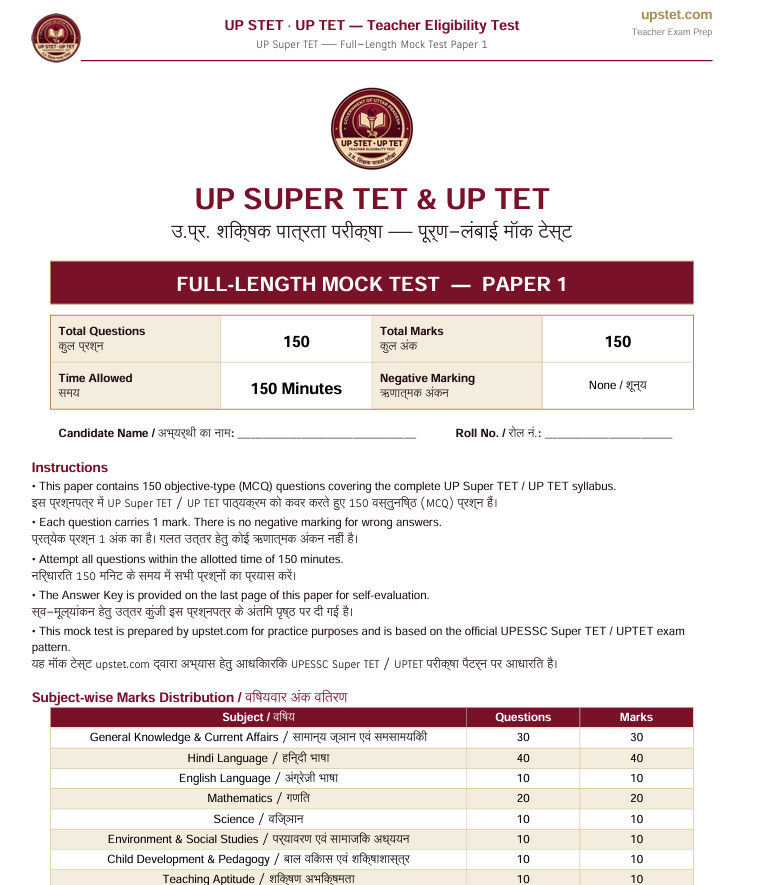
Paper 1: Free Mock Test

This is a complete, no-cost mock paper you can download and attempt right away — ideal if you want to get a genuine baseline reading of where your preparation currently stands before deciding how to structure the rest of your revision.

Download UP Super TET Mock Test Paper 1 (Free): The link is available in the Links section at the end of this article.

Treat this first attempt seriously — sit in a quiet space, time yourself strictly, and resist the urge to check your notes mid-test. A mock test only gives you an honest signal if you take it under honest conditions.

Papers 2–5: Extended Practice Series

Once you’ve attempted Paper 1 and have a sense of your starting point, Papers 2 through 5 continue the practice series with fresh question sets covering the same core sections at a similarly rigorous difficulty level. These are made available as part of a paid practice bundle — each link below takes you to a secure checkout page to access that specific paper.

This structure exists for a simple reason: one free paper is enough to sample the format and test your baseline, but real improvement comes from repeated, varied practice across multiple full-length papers — which is what the extended series is built for.

How to Use This Mock Test Series Effectively

Simply attempting papers back-to-back without reviewing them properly is one of the most common ways candidates waste the value of mock practice. Here’s a more effective approach:

  1. Attempt Paper 1 under strict timed conditions — no notes, no pausing, full focus, exactly as you would on exam day.
  2. Review every question afterward, not just the ones you got wrong. Even correct answers can reveal whether you got there through solid reasoning or a lucky guess.
  3. Log your weak areas in a simple list. After each paper, note down the specific topics — not just subjects — where you lost marks.
  4. Space out your attempts. Don’t do all five papers in two days. Give yourself time between papers to actually revise the weak areas you identified, or you’ll just keep repeating the same mistakes.
  5. Track your score trend across papers, not just your score on any single paper. A rising trend across Papers 1 through 5 is a far better predictor of exam-day readiness than any one good score.
  6. Simulate real exam conditions as closely as possible for at least your final one or two attempts — same time of day as your actual exam slot, same seating setup, minimal distractions.

A Quick Word on Consistency

No mock test series, free or paid, replaces consistent study — it sharpens and directs it. The candidates who benefit most from structured mock practice are the ones who treat each paper as a diagnostic tool, not a pass/fail judgment. A weak score on Paper 2 isn’t a bad sign; it’s useful information that tells you exactly where to focus before Paper 3. Use these papers that way, and your preparation will improve measurably with each attempt.

Good luck with your UP Super TET preparation — steady, honest practice really is the difference-maker here.

UP SUPER TET MOCK FREE TEST 2026

Mock FREE TEST PAPERSLinks
UP Super TET Mock Test Paper 1Click Here
UP Super TET Mock Test Paper 2 Click Here
UP Super TET Mock Test Paper 3 Click Here
UP Super TET Mock Test Paper 4 Click Here
UP Super TET Mock Test Paper 5 Click Here
Home PageClick Here

CTET Syllabus 2026 Paper 1 and Paper 2

ctet syllabus 2026

The Central Teacher Eligibility Test is one of the most important gateways into a teaching career in India’s central government schools, and getting your preparation right starts with genuinely understanding the syllabus rather than skimming a summary and hoping for the best. CBSE has released the CTET Syllabus 2026 for both Paper 1 and Paper 2, and the exam is scheduled for 6th September 2026, conducted in offline OMR-based mode.

This guide walks through the complete syllabus for both papers, the exam pattern, subject-wise topic breakdowns, and how to access the official syllabus PDF, so you can build your study plan around what’s actually being tested rather than guesswork.

Paper 1 and Paper 2: Which One Do You Need?

Before diving into topics, it’s worth being absolutely clear on which paper applies to you, since a lot of preparation time gets wasted on the wrong paper’s content.

Paper 1 is meant for candidates who want to teach Classes 1 to 5, at the primary school stage. If your goal is a primary teaching role, this is your paper.

Paper 2 is meant for candidates aiming to teach Classes 6 to 8, at the upper primary stage. If you’re targeting a middle-school teaching position, Paper 2 is what you need.

If you want the flexibility to teach anywhere from Class 1 through Class 8, you’re required to appear for both papers. Many candidates choose to do exactly this, since it widens the range of teaching vacancies they become eligible for later, even if it means a heavier preparation load upfront.

CTET Exam Pattern: The Basics You Should Know First

Both papers follow a similar structural logic, though the subject composition differs. Each paper consists of 150 multiple-choice questions carrying 150 marks, and importantly, there is no negative marking in either paper. This means every question is worth attempting, since an incorrect answer costs you nothing beyond the marks you’d have gained from a correct one.

To qualify, general category candidates need approximately 60% marks (90 out of 150), while SC, ST, OBC, and PwD candidates need approximately 55% marks (82 out of 150). The exam is conducted in a two-and-a-half-hour window for each paper, and candidates appearing for both papers on the same day get a combined window to attempt them.

CTET Paper 1 Syllabus: Subject-Wise Breakdown (Classes 1 to 5)

Paper 1 is structured across five distinct sections, each carrying 30 questions and 30 marks, adding up to the full 150-question paper.

1. Child Development and Pedagogy (30 Questions)

This section evaluates your of how children grow, think, and learn, and it’s often the section that separates well-prepared candidates from the rest, since it’s less about memorization and more about conceptual clarity. Key areas include the concept of child development and its connection to learning, principles of child development, influence of heredity and environment, socialization processes, Piaget, Kohlberg, and Vygotsky’s theories of cognitive development, concepts of child-centered and progressive education, critical perspectives on the construct of intelligence and multiple intelligences, language and thought, gender as a social construct and gender roles in the classroom, individual differences among learners, assessment of learning versus assessment for learning, and of inclusive education along with catering to children with special needs and learning difficulties.

2. Language I (30 Questions)

This tests your proficiency and pedagogical of the language you choose as your medium of instruction. It covers reading comprehension of unseen passages, elements of language and grammar, pedagogy of language development including learning and acquisition, principles of language teaching, the role of listening and speaking skills, functions of language and how a classroom facilitates second-language acquisition, challenges and remedial teaching approaches for language difficulties, and evaluation approaches for language proficiency, including the difference between speech and writing skills.

3. Language II (30 Questions)

This section works similarly to Language I but assesses a second language of your choice, distinct from the one selected for Language I. The topic areas broadly mirror Language I: comprehension passages, grammar, pedagogical issues, language skills development, and evaluation of language competency, but applied to the second language.

4. Mathematics (30 Questions)

The Mathematics section for Paper 1 covers content areas including geometry, shapes and spatial , numbers, addition, subtraction, multiplication, division, measurement, weight, time and money, data handling, and patterns, along with the pedagogical side: nature of mathematics, logical thinking, place of mathematics in the curriculum, language of mathematics, community mathematics, evaluation through formal and informal methods, problems of teaching mathematics, and error analysis of common student mistakes.

5. Environmental Studies (30 Questions)

Environmental Studies at the primary level covers family and friends, relationships, work and play, animals, plants, food, shelter, water, travel, and things we make and do. On the pedagogical side, it includes the concept and scope of EVS, its significance and integration with Science and Social Studies, environmental studies and environmental education, learning principles, scope and relation to Science and Social Science, approaches of presenting concepts, activities, experimentation and discovery-based practical work, discussion of environmental issues in the syllabus, CCE (Continuous and Comprehensive Evaluation), teaching material and aids, and problems associated with teaching EVS.

CTET Paper 2 Syllabus: Subject-Wise Breakdown (Classes 6 to 8)

Paper 2 also totals 150 questions across four sections, but with a key structural difference in how the subject-specific portion works.

1. Child Development and Pedagogy (30 Questions)

This section is compulsory for all Paper 2 candidates regardless of subject specialization, and it closely mirrors the Paper 1 syllabus but with content oriented toward the upper primary age group. It covers the same foundational theories of child development, learning theories, inclusive education, and assessment concepts, adjusted to reflect the cognitive and social development stage of 11 to 14-year-olds.

2. Language I (30 Questions)

Similar in structure to Paper 1’s Language I section, this evaluates language proficiency and pedagogy at a level appropriate for upper primary learners, covering comprehension, grammar, language acquisition theory, and teaching methodology.

3. Language II (30 Questions)

A second language paper distinct from Language I, following the same pattern of comprehension, grammar, and pedagogy, but again pitched toward upper primary teaching requirements.

4. Mathematics and Science, OR Social Studies/Social Science (60 Questions)

This is where Paper 2 differs meaningfully from Paper 1. Candidates must choose one of two specialization tracks for the remaining 60 questions:

Mathematics and Science — chosen by candidates who want to teach these subjects at the upper primary level. This combines content from both disciplines: for Mathematics, topics include number systems, algebra, geometry, mensuration, data handling, and pedagogical issues in teaching mathematics at the upper primary stage; for Science, topics include food, materials, the world of living organisms, moving things, people and ideas, how things work, natural phenomena, natural resources, and pedagogical issues specific to Science teaching.

Social Studies/Social Science — chosen by candidates aiming to teach this subject instead. It covers History (topics such as the earliest societies, empires, and the modern period through to contemporary India), Geography (topics including the Earth, globe, environment, resources, agriculture, and human habitation), Social and Political Life (democracy, government, local self-governance, and social justice concepts), and pedagogical issues related to teaching social science effectively at the upper primary level.

A candidate can only choose one of these two tracks, not both, so it’s worth deciding early which track aligns with your subject background and target teaching role, since your entire preparation strategy for that 60-question block depends on this choice.

Why the Syllabus Structure Matters for Your Preparation

this breakdown isn’t just an academic exercise. It directly shapes how you allocate your study time. Child Development and Pedagogy appears in both papers and carries meaningful weight (30 out of 150 marks, exactly 20% of the paper), yet many candidates underprepare for it because it feels less “concrete” than subject content. In reality, it’s a section built on a relatively fixed set of theorists and concepts, making it one of the more efficiently scorable sections if you study it properly rather than skimming it late in your preparation.

Similarly, the language sections test not just your command of the language but your of how children acquire language and how to teach it, which is a distinct skill from simply being fluent yourself. Candidates who are strong in a language but haven’t studied the pedagogical angle often lose marks they assumed were guaranteed.

How to Download the Official CTET Syllabus PDF

While this guide covers the syllabus in detail, it’s always good practice to cross-check against the official document before finalizing your preparation plan. Here’s how to access it directly from CBSE:

Visit the official CTET website, locate the notification or syllabus section on the homepage, find the link for the CTET 2026 Information Bulletin or Syllabus PDF, click to open or download the document, and save it for reference alongside your study material. The official PDF also includes the detailed exam pattern, marking scheme, and any subject-specific clarifications that may not always make it into secondary summaries.

Preparation Tips Based on the Syllabus Structure

Since there’s no negative marking, attempting every single question in both papers is the correct strategy regardless of how confident you feel about any particular answer. Build your study schedule around the section weightage rather than personal preference, giving Child Development and Pedagogy the attention it deserves given its consistent presence across both papers. Practice previous years’ question papers specifically to understand how theoretical pedagogy concepts get converted into exam questions, since this is often where the gap between “knowing the theory” and “answering exam questions correctly” becomes obvious. For Paper 2 candidates, decide on your Mathematics-Science versus Social Studies track early, since splitting preparation time between both tracks is inefficient and unnecessary.

Frequently Asked Questions

Is there negative marking in CTET 2026? No, there is no negative marking in either Paper 1 or Paper 2. Candidates should attempt all questions.

Can I appear for both Paper 1 and Paper 2? Yes, candidates aiming to be eligible for teaching Classes 1 through 8 can and should appear for both papers.

What is the qualifying percentage for CTET? General category candidates need approximately 60% marks, while SC, ST, OBC, and PwD candidates need approximately 55% marks to qualify.

How long is the CTET certificate valid? The CTET qualifying certificate is valid for a lifetime from the date of result declaration.

Can I choose between Mathematics-Science and Social Studies in Paper 2? Yes, Paper 2 candidates must choose one of these two tracks for the final 60-question block, based on their intended teaching subject.

Helpful Links and Resources

ResourceDescription
CTET Official WebsiteOfficial CBSE portal for CTET notifications, application, syllabus, and results
CTET Syllabus PDF (Official Bulletin)Download the detailed Information Bulletin containing the full syllabus, exam pattern, and marking scheme directly from CBSE
CBSE Official WebsiteCentral Board of Secondary Education’s main portal for broader announcements
NCERT Official WebsiteUseful for accessing NCERT textbooks that align closely with CTET’s content syllabus

UP TGT PGT Syllabus 2026 Complete Revised Pattern, Subject-Wise Topics & What’s Actually Changed

UPTGTPGTSyllabus2026CompleteRevisedPatternSubject-WiseTopicsWhatsActuallyChanged

If you’ve been preparing for UP TGT or PGT using last year’s pattern in your head, stop for a second because the syllabus and exam structure have genuinely changed, not just cosmetically. The Uttar Pradesh Education Service Selection Commission (UPESSC), formerly UPSESSB, has revised the exam pattern for upcoming TGT and PGT recruitment cycles, and the changes affect everything from question count to how you should approach guessing on exam day.

This guide walks through exactly what’s changed, what’s stayed the same, and how to structure your preparation around the new syllabus with a clear distinction between what’s officially confirmed and what’s still evolving, so you’re preparing from facts rather than recycled old information.

Important: Two Patterns Are Currently in Circulation Here’s the Difference

This is the single most confusing thing for candidates right now, so let’s clear it up first.

The outgoing pattern used for the 2022 recruitment cycle (Advertisement No. 01/2022), whose written exam was conducted in June 2026 for 3,539 TGT posts followed the older structure: 125 questions, 500 marks for TGT, 425 marks for PGT, no negative marking, drawn from General Awareness, English, Quantitative Aptitude, and the Concerned Subject.

The revised pattern announced by UPESSC for upcoming TGT and PGT recruitment cycles introduces a meaningfully different structure: 120 questions total (90 subject-specific + 30 General Studies), 360 marks, and negative marking for the first time. For PGT specifically, a 40-mark interview has also been added after the written stage.

If you’re preparing right now, the revised pattern is the one that matters for any recruitment cycle going forward. But because both patterns are actively referenced across different sources online some describing the just-concluded 2022 cycle, others describing the new upcoming cycle it’s worth double-checking which cycle a source is actually talking about before you trust its numbers. This article focuses on the revised 2026 pattern, flagging the older structure only for context.

The Revised UP TGT PGT Exam Pattern: What Actually Changed

Here’s a side-by-side of the shift, so you can see exactly what’s new:

FeaturePrevious PatternRevised Pattern (2026)
Total Questions125120
Subject-specific QuestionsFull paper90
General Studies QuestionsNot separate30 (compulsory)
Total MarksTGT: 500 / PGT: 425360
Negative MarkingNoneIntroduced
Interview (PGT only)IncludedStill included 40 marks
Exam Duration2 hours2 hours (unchanged)

Three changes stand out here, and each one demands a different response from your preparation strategy:

1. The introduction of a compulsory General Studies section. Previously, your subject knowledge alone could carry almost the entire exam. Now, 30 out of 120 questions a full quarter of the paper come from General Studies, regardless of whether you’re a Physics teacher or a Sanskrit teacher. You can no longer afford to treat general awareness as an afterthought.

2. Negative marking is now real. This is arguably the biggest strategic shift. Under the old no-penalty system, attempting every question was mathematically the smart move even on pure guesses. That’s no longer true. With negative marking now applied to incorrect responses, blind guessing carries genuine risk, and elimination-based answering (ruling out clearly wrong options before choosing) becomes a far more valuable skill than it used to be.

3. Total marks dropped from 500/425 to 360. Each question now likely carries proportionally more weight relative to the whole exam, which means fewer opportunities to recover from a bad section every topic area matters more per question than it did before.

General Studies Syllabus: What’s Actually Covered

Since General Studies is now compulsory for both TGT and PGT candidates regardless of subject, it deserves focused attention rather than last-minute cramming. Based on the officially referenced structure, the section draws from:

  • Indian History & Culture Ancient, Medieval, and Modern India, with particular focus on the Indian National Movement
  • Geography Indian and world geography fundamentals
  • Polity & Governance Constitution, governance structures, and civic frameworks
  • Economy Basic economic concepts and current economic developments
  • Current Affairs National and Uttar Pradesh-specific developments
  • General Science Foundational scientific concepts relevant to general awareness

Because this section is identical across both TGT and PGT and across every subject discipline, it’s genuinely worth building a dedicated study block for it rather than treating it as filler you’ll “pick up along the way.” A Hindi TGT aspirant and a Physics PGT aspirant will face the exact same General Studies questions.

Subject-Wise Syllabus: TGT

The revised UP TGT syllabus covers subject-specific topics across the full range of disciplines UPESSC recruits for:

  • Hindi Grammar, literature, prose, poetry, and pedagogy of language teaching
  • English Grammar, literature, comprehension, and English language pedagogy
  • Sanskrit Grammar (Vyakaran), literature, and classical texts
  • Urdu Grammar, literature, and language pedagogy
  • Mathematics Algebra, geometry, trigonometry, arithmetic, and pedagogy of mathematics teaching
  • Science Physics, Chemistry, and Biology fundamentals at the secondary teaching level
  • Social Science Divided into four core sections: History, Geography, Economics, and Civics (Political Science), each covering foundational concepts through to more advanced applied topics
  • Commerce Accountancy, business studies, and economics fundamentals
  • Agriculture Agronomy, horticulture, soil science, crop protection, natural farming, and agricultural management
  • Home Science Nutrition, textiles, child development, and home management
  • Art Art history, techniques, and pedagogy
  • Music Theory, practical knowledge, and music pedagogy
  • Physical Education Sports science, physical training methods, and health education

Taking Social Science as a representative example of how detailed these syllabi get: the official breakdown covers topics ranging from the origin of the solar system and Earth’s motions in Geography, through ancient and medieval Indian history, right up to governance structures and economic principles in Civics and Economics the official syllabus lists topic-wise coverage rather than broad chapter headings, meaning questions can be drawn from any specific point within a section, not just the “important” chapters candidates often assume examiners will stick to.

Subject-Wise Syllabus: PGT

The PGT syllabus mirrors the same subject spread as TGT but at a postgraduate depth level, since PGT teachers handle senior secondary classes (11th and 12th). Core PGT subjects typically include:

  • English, Hindi, Sanskrit, Urdu
  • Mathematics, Physics, Chemistry, Biology
  • History, Geography, Civics, Economics
  • Commerce, Home Science

The key distinction from TGT preparation: PGT questions probe deeper conceptual and analytical understanding rather than foundational-level recall, reflecting the higher academic level PGT teachers are expected to instruct at.

How to Download the Official Syllabus PDF

Don’t rely on secondhand summaries (including this one) as your final source always cross-check against the official document. Here’s how to get it directly:

  1. Visit the official UPESSC website: upessc.up.gov.in
  2. Locate the “Syllabus” section on the homepage navigation
  3. Select either UP TGT Revised Syllabus or UP PGT Revised Syllabus
  4. Choose your specific subject code from the list
  5. Download and save the PDF for detailed topic-wise reference

Subject codes matter here make sure you’re downloading the syllabus for your exact subject and post combination, since generic “TGT syllabus” searches sometimes surface outdated or subject-mismatched documents from unofficial sources.

Preparation Strategy Given the Revised Pattern

The pattern change isn’t just administrative trivia it should genuinely reshape how you study. Here’s a practical approach:

  • Don’t skip General Studies preparation. With 30 compulsory questions carrying real weight in a 360-mark paper, ignoring this section because you’re “a subject specialist” is no longer a viable strategy.
  • Practice answer elimination, not blind guessing. Now that negative marking is live, train yourself to rule out at least two of four options confidently before attempting a question you’re unsure about this shifts a pure guess into a calculated risk.
  • Go topic-wise, not chapter-wise. Since official syllabi (Social Science being a clear example) list granular topics rather than broad headings, build your revision around the specific topic list in the official PDF rather than assuming a few “important” chapters will cover you.
  • For PGT aspirants, start interview preparation early. The 40-mark interview is a separate skill from written recall practicing how you’d discuss your subject and teaching approach out loud is something you can’t cram in the final week.
  • Use previous years’ papers as a baseline, not a template. Old papers remain useful for understanding subject depth and framing style, but remember they reflect the older 500/425-mark, no-negative-marking pattern don’t assume the marking psychology from those papers applies directly to your revised-pattern attempt.

A Note on Where This Information Comes From

Recruitment exam syllabi get revised, re-revised, and sometimes reported inconsistently across different tracking websites before the dust settles. The pattern details in this article the 120-question, 360-mark, negative-marking structure reflect the most recently reported UPESSC updates at the time of writing. Given how much this differs from the pattern used in the immediately preceding TGT cycle, it’s worth treating the official syllabus PDF from upessc.up.gov.in as the single source of truth once you begin serious preparation, rather than any secondary summary, including this one.

Final Thoughts

The UP TGT PGT Syllabus 2026 represents a genuine structural shift, not a minor update a mandatory General Studies section, real negative marking, and a leaner overall mark scheme all change the calculus of how you should prepare, question by question. Candidates who adjust their strategy around these specific changes rather than continuing to prepare exactly as they would have for the older pattern are the ones who’ll walk into the exam hall with an actual edge.

Download the official subject-wise syllabus, build General Studies into your daily study routine instead of leaving it for later, and practice your elimination technique now that guessing carries real consequences. The syllabus tells you what to study your strategy is what determines how well you use it.

Frequently Asked Questions

Q: Is there negative marking in the UP TGT PGT exam now?

Yes under the revised 2026 pattern, negative marking has been introduced for both TGT and PGT exams for the first time. This is a change from the earlier pattern, which had no negative marking.

Q: How many questions are in the revised UP TGT PGT exam?

The revised pattern consists of 120 questions total 90 from the candidate’s concerned subject and 30 compulsory General Studies questions carrying a combined 360 marks.

Q: Is General Studies compulsory for all subjects?

Yes. The 30-question General Studies section is identical and mandatory for every TGT and PGT candidate, regardless of subject specialization.

Q: Does UP PGT still include an interview?

Yes, PGT recruitment includes a 40-mark interview after the written examination. TGT selection does not include an interview stage.

Q: Where can I download the official syllabus PDF?

The official subject-wise syllabus is available on upessc.up.gov.in under the Syllabus section always verify against this official source rather than third-party summaries.

50% OFF
📚

Super TET Mock Papers

Complete Exam Solutions with Solutions

50% OFF
📚

Super TET Mock Papers

Complete Exam Solutions with Solutions