If you’re preparing for the Central Teacher Eligibility Test (CTET) 2026, one of the very first numbers you need to know isn’t a syllabus topic it’s the qualifying mark. Unlike a competitive exam with a shifting rank-based cut-off, CTET has a fixed, category-wise passing threshold set by the CBSE as per NCTE guidelines. Hit that number, and you’re CTET qualified for life no re-appearing required.
This article breaks down the CTET Qualifying Marks 2026 in complete detail category-wise marks, how they apply to Paper 1 and Paper 2, what “qualifying” actually means, and how it’s different from a merit-based selection score.
| Detail | Information |
|---|---|
| Exam Name | Central Teacher Eligibility Test (CTET) |
| Conducting Body | Central Board of Secondary Education (CBSE) |
| Governing Guidelines | National Council for Teacher Education (NCTE) |
| Exam Type | Qualifying exam (not rank-based) |
| Total Marks | 150 |
| Total Questions | 150 (MCQs, 1 mark each) |
| Negative Marking | None |
| Papers | Paper 1 (Classes 1–5) & Paper 2 (Classes 6–8) |
| Certificate Validity | Lifetime |
| Result Mode | Score + Qualifying Status (Pass/Fail) |
CTET Qualifying Marks 2026: Category-Wise Table
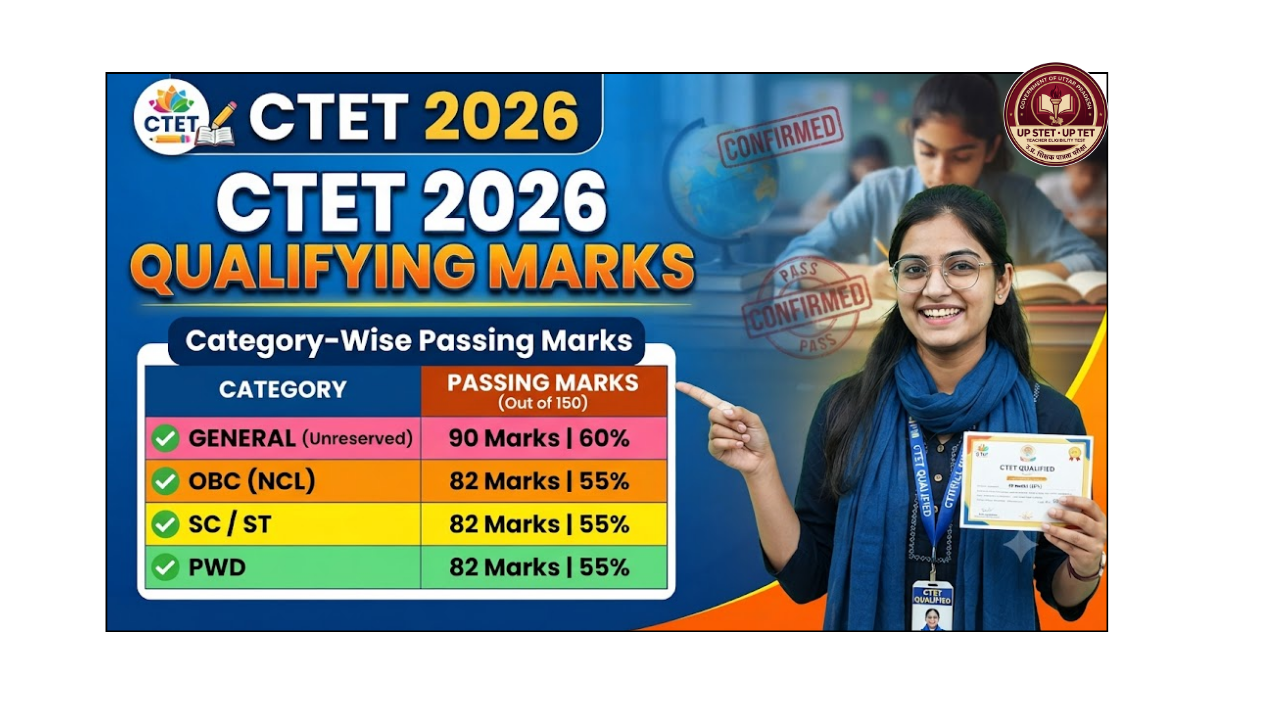
| Category | Minimum Qualifying Marks (out of 150) | Percentage Required |
|---|---|---|
| General / Unreserved (UR) | 90 | 60% |
| OBC (Non-Creamy Layer) | 82 | 55% |
| SC (Scheduled Caste) | 82 | 55% |
| ST (Scheduled Tribe) | 82 | 55% |
| PwD (Persons with Disability) | 82 | 55% |
Key takeaway: General category candidates need a straight 60%, while OBC/SC/ST/PwD candidates get a 5% relaxation, bringing their requirement down to 55%.
Do Qualifying Marks Differ Between Paper 1 and Paper 2?
No. The qualifying marks are identical for both papers:
| Paper | Applicable To | Qualifying Marks (General) | Qualifying Marks (OBC/SC/ST/PwD) |
|---|---|---|---|
| Paper 1 | Classes I–V (Primary Stage) | 90/150 (60%) | 82/150 (55%) |
| Paper 2 | Classes VI–VIII (Elementary Stage) | 90/150 (60%) | 82/150 (55%) |
If you want to be eligible to teach both primary and upper-primary levels, you must appear for and qualify both papers separately clearing one does not automatically qualify you for the other.
How CTET Marks Are Calculated
- The exam has 150 objective-type (MCQ) questions, each worth 1 mark.
- There is no negative marking so attempting every question is always in your interest.
- Your final score is a simple sum of correct answers across all sections of the paper (Child Development & Pedagogy, Language I, Language II, Mathematics/Environmental Studies or Social Studies, and the relevant content sections).
- Marks are calculated and reported as whole numbers.
What Does “Qualifying” Actually Mean in CTET?
This is where many first-time candidates get confused, so here’s the clear distinction:
| Concept | What It Means |
|---|---|
| Qualifying Marks | The fixed minimum score (90 for General, 82 for reserved categories) needed to be declared “CTET Pass” |
| Merit/Selection Score | Not applicable to CTET itself CTET is not competitive, so there’s no ranking among candidates |
| CTET Certificate | Issued to all candidates who meet the qualifying marks, valid for a lifetime |
| Recruitment Eligibility | Passing CTET makes you eligible to apply for teaching posts in central schools (KVS, NVS, etc.) and many state-run schools it does not guarantee a job or interview call |
In short: CTET tells you whether you’re qualified to teach it does not rank you against other candidates. Actual recruitment for teaching posts happens through separate exams or interviews, where your CTET certificate is one of the eligibility requirements, and in many recruitment processes, CTET/TET marks may also be given some weightage.
CTET Qualifying Marks: Historical Consistency
The 60% (General) / 55% (Reserved) qualifying bar has remained the standard NCTE-mandated benchmark across CTET cycles for years, including the most recent February 2026 session. This consistency makes it easy for aspirants to set a clear target while preparing there’s no unpredictable, exam-day-dependent cut-off to worry about, unlike competitive recruitment exams.
CTET Result & Qualifying Status: How to Check
- Visit the official website ctet.nic.in
- Click on the CTET Result link (usually available at the bottom of the homepage once declared)
- Enter your roll number (and other required details like date of birth)
- Click Submit
- Your result will display your subject-wise/section-wise scores, total marks obtained, and qualifying status (Pass/Fail)
- Download and print your result for your records
- Once qualified, your CTET certificate can also be accessed via DigiLocker
Key Facts About the CTET Certificate
- The CTET certificate carries lifetime validity from the date of result declaration it no longer expires after a fixed number of years.
- There is no limit on the number of times a candidate can reattempt CTET, even after qualifying many candidates reappear simply to improve their score for better recruitment prospects.
- A qualified CTET certificate makes you eligible to apply for teaching posts in Kendriya Vidyalaya Sangathan (KVS), Navodaya Vidyalaya Samiti (NVS), and various central and state government schools, subject to each recruiter’s specific eligibility norms.
CTET Qualifying Marks vs. State TET Qualifying Marks
| Exam | General Category | Reserved Category (OBC/SC/ST/PwD) |
|---|---|---|
| CTET | 90/150 (60%) | 82/150 (55%) |
| UPTET (Uttar Pradesh) | 90/150 (60%) | 82/150 (55%) |
| Most other State TETs | Typically 60% | Typically 55% (varies slightly by state) |
Most State TETs mirror the CTET qualifying pattern closely, since they all follow the broader NCTE framework, though minor state-specific variations can exist always check the respective state board’s official notification for confirmation.
Preparation Tips to Comfortably Clear the Qualifying Marks
- Don’t just aim for the minimum: Many recruitment processes give weightage to your actual TET score, so aiming well above 90/82 improves your future recruitment chances, not just your qualifying status.
- Focus on Child Development & Pedagogy: This section is often the most scoring if concepts are understood rather than memorized.
- Practice previous years’ papers: This helps you gauge the real difficulty level and question pattern used by CBSE.
- Attempt every question: Since there’s no negative marking, an educated guess is always better than leaving a question blank.
- Balance both languages sections: Language I and Language II together carry significant weightage don’t neglect grammar and comprehension practice.
Frequently Asked Questions
Q1. What are the CTET qualifying marks for the General category?
General category candidates must score at least 90 out of 150 marks (60%) to qualify CTET.
Q2. What are the CTET qualis different for Paper 1 and Paper 2?
No, the qualifying marks are the same for both Paper 1 and Paper 2 60% for General and 55% for reserved categories.
Q4. Is there negative marking in CTET?
No, there is no negative marking in CTET. Marks are awarded only for correct answers.
Q5. Does qualifying CTET guarantee a teaching job?
No. Qualifying CTET only makes you eligible to apply for teaching positions it does not guarantee recruitment or an interview call. Selection depends on the specific recruitment process of the school or board you apply to.
Q6. How long is the CTET certificate valid?
The CTET certificate is valid for a lifetime from the date the result is declared.
Q7. Can I reappear for CTET after qualifying it once?
Yes, there is no restriction on the number of attempts, and many candidates reappear to improve their score even after qualifying.
Q8. Where can I download my CTET certificate?
Once qualified, your certificate can be downloaded from the official CTET website (ctet.nic.in) as well as through DigiLocker.