Mock tests are the backbone of successful exam preparation. For candidates aspiring to become Assistant Teachers in Uttar Pradesh’s government schools through the Super TET 2026 examination, understanding how to effectively use mock tests can be the difference between success and failure.
Mock tests are practice exams designed to prepare students for the final one. Taking mock tests regularly helps students improve time management skills and boost confidence. This guide will walk you through everything you need to know about Super TET mock tests in 2026.
A Super TET mock test is a practice examination designed to mirror the actual exam pattern, difficulty level, and marking scheme. It is a practice paper based on the latest exam pattern and syllabus, designed to help you assess your preparation level.
Why Mock Tests Matter
Mock tests serve multiple critical purposes in your preparation journey. They help with familiarization of the exam pattern before the actual exam, assessment of your preparation level, identification of performance gaps, practice for time management skills, building of confidence before the exam, recognition of common mistakes, and objective performance tracking to monitor improvement over time.
Super TET 2026 Mock Test Pattern
Exam Structure Recap
Remember the actual exam structure:
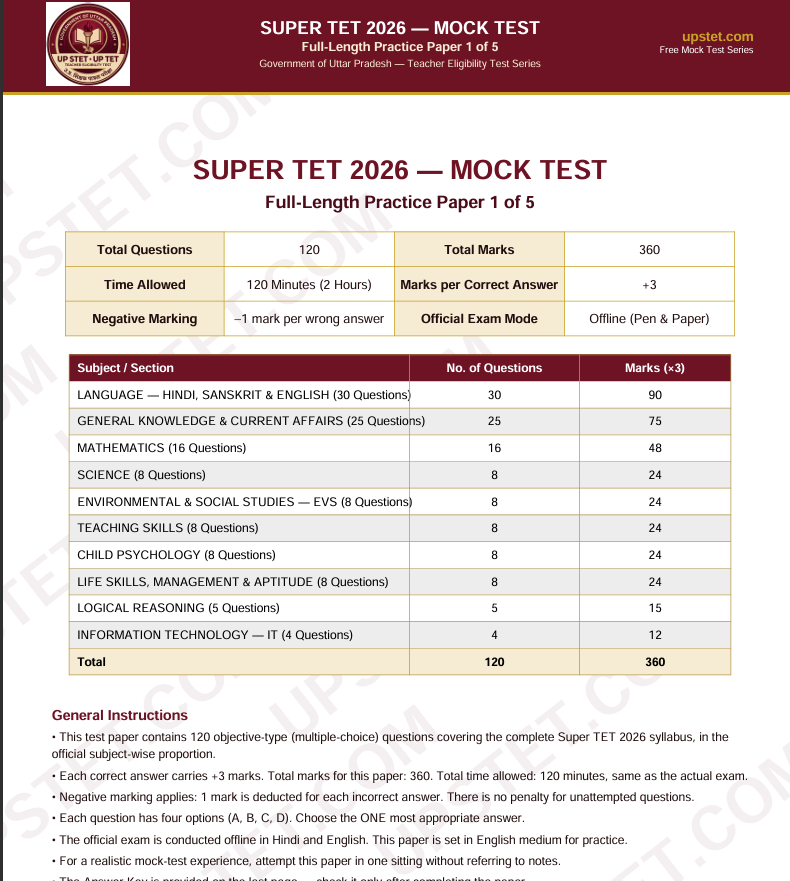
| Parameter | Details |
|---|---|
| Total Questions | 120 |
| Total Marks | 360 |
| Marks per Question | 3 marks |
| Negative Marking | -1 mark for wrong answer |
| Duration | 120 minutes (2 hours) |
| Question Type | Multiple Choice (MCQs) |
| Sections | 2 (General Knowledge: 30 + Teaching Subject: 90) |
Mock Test Pattern Components
Section 1: General Knowledge & Current Affairs
- 30 questions
- Time allocation: ~30 minutes
- Covers national/international events, awards, government schemes, Indian culture
Section 2: Selected Teaching Subject
- 90 questions
- Time allocation: ~90 minutes
- Covers your chosen subject specialization
Key Features of a Good Mock Test
A good mock test should be based on latest syllabus and updated with 2026 exam pattern changes, match exact exam difficulty level with questions mirroring actual exam difficulty, simulate time pressure of real exam in timed environment, provide detailed solutions with step-by-step explanations, offer comprehensive performance analysis with scorecard and weak area identification, allow multiple attempts for practice, and be available in bilingual options (Hindi and English).
Uttar Pradesh Super TET Mock Test New Pattern 2026
| Super TET New Exam Pattern Mock Test Papers 01 (New Pattern 2026) | Click Here |
| Super TET New Exam Pattern Mock Test Papers 02 (New Pattern 2026) | Click Here |
| Super TET New Exam Pattern Mock Test Papers 03 (New Pattern 2026) | Click Here |
| Super TET New Exam Pattern Mock Test Papers 04 (New Pattern 2026) | Click Here |
| Super TET New Exam Pattern Mock Test Papers 05 (New Pattern 2026) | Click Here |
Critical Benefits of Mock Tests for Super TET 2026
Time Management Mastery
Mock tests will help improve your time management and thus increase your momentum in the actual exam. How mock tests help includes practicing answering 120 questions in exactly 120 minutes, developing strategies for skipping and returning to difficult questions, learning optimal time allocation between sections, building pace without compromising accuracy, and reducing anxiety about completing the exam on time.
A good strategy is to spend maximum 45-50 seconds per question initially, reserve 5-10 minutes for revision at the end, mark and skip difficult questions then revisit if time permits, and never waste time being stuck on a single question.
Accuracy and Speed Development
Mock tests help in improving the time management skills of candidates and boosts the speed and accuracy of the aspirants in the exam. The relationship between speed and accuracy is crucial throughout your preparation phases.
Early Attempts: Focus on accuracy, not speed Mid-Preparation: Gradually increase speed while maintaining accuracy Final Week: Simulate exam conditions with full speed and accuracy
Identifying Strengths and Weaknesses
After completing a mock test, candidates receive a detailed analysis of their performance. This includes a breakdown of correct and incorrect answers, enabling them to focus on areas that need improvement.
Analysis should include correct vs. incorrect answers, subject-wise performance, topic-wise performance, time spent per section, comparison with other candidates (All-India Rank), and suggested improvement areas.
Confidence Building
By practicing a series of mock tests, candidates become well-acquainted with the types of questions asked, the marking scheme, and the overall format of the exam. This familiarity helps candidates feel more confident and prepared on the actual exam day.
Regular mock test practice leads to mental readiness for exam day, reduced exam anxiety, improved problem-solving confidence, better decision-making under pressure, and increased self-assurance.
Pattern Recognition
Mock tests help you identify frequently asked topics which subjects repeat most often, common question formats and trick patterns, misleading options and common mistakes, confirmation of subject importance through questions asked, and new question styles introduced in 2026.
Detailed Solutions and Learning
Quality mock tests provide step-by-step solutions for every question, explanation of why the correct answer is right, clarification of why other options are wrong, pedagogical insights for teaching-related questions, and additional learning resources for difficult topics.
Types of Super TET Mock Tests Available
Full-Length Mock Tests
What They Include: All 120 questions, complete 120-minute duration, both sections (General Knowledge + Teaching Subject), real exam-like interface
When to Use: Weekly during active preparation phase, at least 2-3 times per week in final month, to simulate final exam conditions, for comprehensive performance assessment
Expected Duration: 120 minutes + 15-20 minutes for analysis
Sectional Tests
What They Include: 30 questions from General Knowledge section only, OR 90 questions from selected teaching subject
When to Use: When focusing on specific weak areas, to improve speed in particular sections, for topic-wise conceptual clarity, during specific subject preparation phases
Expected Duration: 30-60 minutes depending on section
Chapter-Wise/Topic-Wise Tests
What They Include: Questions from specific topics within a subject, usually 10-30 questions per test, focused on concept building
When to Use: During initial learning phase, after completing a particular topic, to strengthen conceptual foundation, for targeted weak area improvement
Expected Duration: 15-30 minutes per test
Current Affairs Booster Tests
What They Include: Special focus on General Knowledge section, recent events, awards, government schemes, national and international news, Indian culture and sports
When to Use: 2-3 times per week, during lunch breaks or free time, to stay updated with daily news, to strengthen the highest-weightage section
Expected Duration: 10-15 minutes
Previous Year Question Papers (PYQs)
What They Include: Actual questions from previous Super TET/UPTET exams, real exam difficulty and pattern, trend analysis opportunities
When to Use: During revision phase, to understand actual question quality, for trend analysis, in final 2 weeks before exam
Expected Duration: 120 minutes full paper
Revision Tests
What They Include: High-frequency topics only, most important concepts, common mistake patterns, last-minute review format
When to Use: In final week before exam, for quick revision, to boost confidence, for final performance check
Expected Duration: 60-90 minutes
Performance Analysis: Understanding Your Mock Test Report
Key Metrics to Track
A comprehensive mock test report should provide overall score including raw score, percentage, percentile, and all-india rank calculation.
Section-Wise Breakdown should show correct answers, incorrect answers, unattempted questions, accuracy percentage, time spent, and average time per question.
Subject-Wise Analysis for each subject should include number of questions attempted, correct answers, incorrect answers, accuracy percentage, performance vs. expected, and improvement suggestions.
Weak Area Identification identifies topics where accuracy is below 40%, topics requiring more practice, conceptual gaps needing clarification, and high-weightage weak areas (priority areas).
Comparison Metrics show how you performed vs. other candidates, gap analysis with high scorers, performance compared to your category, and how your performance is trending over time.
After each mock test, you should review all answers (correct and incorrect), understand why correct answers are right, understand why other options are wrong, note down common mistake patterns, and learn alternative solving methods.
Smart Mock Test Strategy: When and How to Take Them
Pre-Exam Preparation Timeline
Phase 1: Foundation Building (Months 1-2 of Preparation)
- Focus: Topic-wise and chapter-wise tests
- Frequency: 2-3 tests per week
- Duration: 15-45 minutes each
- Purpose: Concept reinforcement and foundation building
- Action: Take tests after completing 2-3 topics, identify conceptual gaps early, build confidence before full-length tests, gradually increase pace
Phase 2: Active Preparation (Months 2-3)
- Focus: Sectional tests and full-length tests
- Frequency: 2-3 full-length tests per week + daily sectional tests
- Duration: 120 minutes for full tests
- Purpose: Pattern familiarization and strategy development
- Action: Take 1-2 full-length tests on weekends, do sectional/topic tests on weekdays, analyze performance deeply, work on identified weak areas, develop time management strategies
Phase 3: Refinement Phase (Final Month)
- Focus: Full-length tests and PYQ papers
- Frequency: 3-4 full-length tests per week
- Duration: Full 120 minutes under exam conditions
- Purpose: Final performance check and confidence building
- Action: Take at least 2 full-length tests per week, practice in actual exam time, simulate exact exam conditions, review only high-value corrections, focus on speed optimization
Phase 4: Revision Phase (Final 2 Weeks)
- Focus: Previous year papers and revision tests
- Frequency: 2-3 tests per week
- Duration: Full-length or sectional
- Purpose: Final review and confidence maintenance
- Action: Solve previous year question papers, take revision-focused tests, quick error review (30 minutes per test), maintain momentum without exhaustion, trust your preparation
Weekly Mock Test Schedule Template
Sunday: 1 full-length mock test (120 min) + Detailed analysis (30 min)
Tuesday: 1 sectional test – Languages (45 min) + Quick review (15 min)
Thursday: 1 sectional test – Teaching Subject (60 min) + Quick review (15 min)
Saturday: Current affairs + GK booster (15 min) + Topic-wise test for weak area (30 min)
Daily (15 minutes): Practice 5-10 GK questions and review 1-2 previous incorrect answers
Common Mistakes to Avoid While Taking Mock Tests
Mistake 1: Taking Mock Tests Without Proper Time Simulation
- Wrong: Taking a test over multiple sittings, pausing to look up answers
- Right: Complete 120 questions in exactly 120 minutes continuously
Mistake 2: Not Reviewing Thoroughly After Mock Tests
- Wrong: Just checking the score and moving on
- Right: Spending 30-45 minutes analyzing every question (correct and wrong)
Mistake 3: Focusing Only on Score, Not Learning
- Wrong: Chasing high percentile numbers
- Right: Understanding conceptual gaps and weaknesses
Mistake 4: Taking Too Many Mock Tests Without Learning
- Wrong: Attempting 5-6 tests per week without analysis
- Right: Taking fewer tests with deep analysis and learning
Mistake 5: Ignoring Weak Areas
- Wrong: Repeating strong areas for higher scores
- Right: Focusing practice on identified weak areas
Mistake 6: Not Tracking Progress
- Wrong: Taking random tests without tracking improvement
- Right: Maintaining a score sheet to monitor trends
Mistake 7: Changing Strategy Based on One Mock Test
- Wrong: Drastically changing approach after one bad test
- Right: Looking at trends over 3-4 tests before changing strategy
Mistake 8: Neglecting Sectional Time Management
- Wrong: Spending 45 minutes on General Knowledge section
- Right: Allocating ~25 minutes for GK and ~95 minutes for Teaching Subject
Top Mock Test Platforms for Super TET 2026
Adda247 – Super TET Mock Tests
URL: www.adda247.com/super-tet/mock-test
Features: Practice full-length and subject-wise online tests covering Child Development & Pedagogy, Hindi, English, Mathematics, Science, and Social Studies. Tests designed per latest 2026 syllabus. Detailed performance analysis. Multiple language options. Regular updates with new questions.
Test Types Available: Full-length tests, subject-wise tests, topic-wise tests, free tests for trial
Best For: Comprehensive practice with varied test types
Testbook – UP Assistant Teacher Mock Tests
URL: testbook.com/super-tet/test-series
Features: Designed by experts with years of experience, based on latest pattern, with subject-wise and topic-wise tests for practice. Detailed analysis and solutions. Subject-wise weak area identification. All-India Rank calculation. Free tests available.
Test Types Available: Full-length tests, sectional tests, chapter-wise tests, previous year papers (115+ PYQs), current affairs booster tests
Best For: Comprehensive test series with extensive previous papers
Toppersexam – Super TET Mock Test Series
URL: toppersexam.com/TEACHING-EXAMS/SUPER-TET/
Features: Latest 2026 exam pattern. Sectional and subject-wise tests available. Detailed step-by-step solutions. Combo packages with question banks. Free demo test. Re-attempt option for practice.
Test Types Available: Full-length tests (10-20 tests in packages), sectional tests, question bank (1000-2000 questions), current affairs MCQ PDFs, GK MCQ materials
Pricing: Affordable combo packages
Best For: Budget-friendly comprehensive preparation with detailed solutions
PrepResults.in – Super TET Mock Test Series
URL: prepresults.in/super-tet-mock-test.html
Features: 480+ mock tests available. 17 Full-Length Tests. 142 Chapter Tests. 44 Sectional Tests. 115+ Previous Year Papers. Section-wise analysis and All-India Rank. Free tests (4 completely free, no registration required). Bilingual (Hindi and English).
Unique Features: Detailed scorecard with section-wise analysis. Real exam-like interface. Personalised study roadmap. No registration required for free tests.
Best For: Extensive mock test practice with free trials
Test Vidya – Super TET Mock Test Series
URL: testvidya.com/exam/super-tet-mock-test-series
Features: Comprehensive question bank covering all subjects. Timer feature for time-bound practice. Detailed performance analysis. User-friendly platform accessible on multiple devices. Mobile and desktop compatibility.
Analysis Provided: Breakdown of correct and incorrect answers. Focus areas for improvement. Performance tracking. Weak area identification.
Best For: User-friendly platform with strong mobile accessibility
EduRev – Super TET Mock Tests
URL: edurev.in/test/49406/Super-TET-Mock-Test-1
Features: Mock tests designed with the analysis of important topics, recent trends of the exam, and previous year questions of the last 3-years. All-India Rank after each test. Weak area identification. Free mock tests available. Part of comprehensive test series.
Special Features: Analysis of 3+ years of previous questions. Question explanation in simplest way possible. Mobile app available. Free tests for trial.
Best For: Learning-focused preparation with detailed explanations
Unictest – Super TET 2026 Mock Tests
URL: unictest.com/exam/super-tet-2026
Features: Free mock tests rolling out regularly. Latest pattern questions. Complete practice approach. Mobile app available (India’s best exam prep app). Bilingual support.
Best For: Frequent practice with regularly updated questions
Platform Comparison Table
| Platform | Free Tests | Full Tests | Sectional | PYQ | Analysis Quality | Price |
|---|---|---|---|---|---|---|
| Adda247 | Yes | Yes | Yes | Limited | Excellent | ₹300-1000 |
| Testbook | Yes | Yes | Yes | 115+ | Excellent | ₹500-2000 |
| Toppersexam | Yes (1 demo) | Yes | Yes | Included | Very Good | ₹200-800 |
| PrepResults.in | 4 Free | Yes | Yes | 115+ | Excellent | ₹400-1200 |
| Test Vidya | Limited | Yes | Yes | Limited | Good | ₹300-1000 |
| EduRev | Yes | Yes | Limited | Included | Good | ₹200-600 |
| Unictest | Yes (regular) | Yes | Limited | Limited | Good | Free-500 |
Advanced Mock Test Strategy: Maximizing Your Score
Strategy 1: The 80-20 Approach
Focus 80% of your mock test practice on high-weightage subjects (Languages 25%, GK 20.8%, Math 13.3%), frequently repeated topics, and your identified weak areas. Use remaining 20% for low-weightage subjects (just maintenance), building confidence in strong areas, and exploring new question patterns.
Strategy 2: The Weakness to Strength Conversion
Step 1: Identify Weakness using first 3-4 mock tests Step 2: Targeted Learning with 2-3 weeks of intensive learning Step 3: Targeted Testing with 3-4 mock tests focusing on these areas Step 4: Re-Assessment to check if weakness has become strength Step 5: Maintenance including these topics in regular revision tests
Strategy 3: Speed Building Without Accuracy Sacrifice
Week 1-2: Focus on accuracy
- Spend more time on difficult questions
- Don’t worry about completing all 120 questions
- Goal: 70%+ accuracy on attempted questions
Week 3-4: Balance speed and accuracy
- Try to complete all 120 questions
- Accept slightly lower accuracy (65-70%)
- Build comfortable pace
Week 5-6: Full speed mode
- Complete all 120 questions in 120 minutes
- Target 70%+ accuracy
- Develop rhythm and flow
Final Week: Refinement
- Maintain speed with highest possible accuracy
- Reduce careless mistakes
- Build confidence
Strategy 4: The Mistake Analysis Protocol
After every mock test, create a Mistake Notebook. For each wrong answer, record the question number & topic, what you did (your approach/reasoning), why it was wrong (conceptual gap or careless mistake), correct approach (the right method), and prevention strategy (how to avoid this mistake again).
Review this notebook daily during final month, before taking next mock test, and a day before actual exam.
Strategy 5: The Peer Comparison Strategy
Check how you performed compared to others, identify if your weak areas are common weak areas, benchmark against top performers, and learn from others’ successful strategies through discussion forums.
Expected Mock Test Score vs. Actual Exam Performance
If your average mock test score across 5+ tests is:
240+ (66%+) → Good chance of qualifying (High) 200-240 (55-66%) → Moderate chance of qualifying (Medium) 160-200 (44-55%) → Need improvement (Lower) Below 160 (<44%) → Significant improvement needed (Low)
Important Notes: Mock tests may be slightly harder while actual exam might be easier. Your exam performance could be better due to less time pressure. Don’t rely only on mock score. Use them as guidance, not prediction. Trend is more important than single score. Look at score progression over 5-10 tests. Consistency matters more than individual high scores.