UP Super TET (Uttar Pradesh Super Teacher Eligibility Test) is an important teacher recruitment examination conducted by the Government of Uttar Pradesh. This exam is held for the post of Sahayak Adhyapak (Assistant Teacher) and aims to select teachers for government schools.
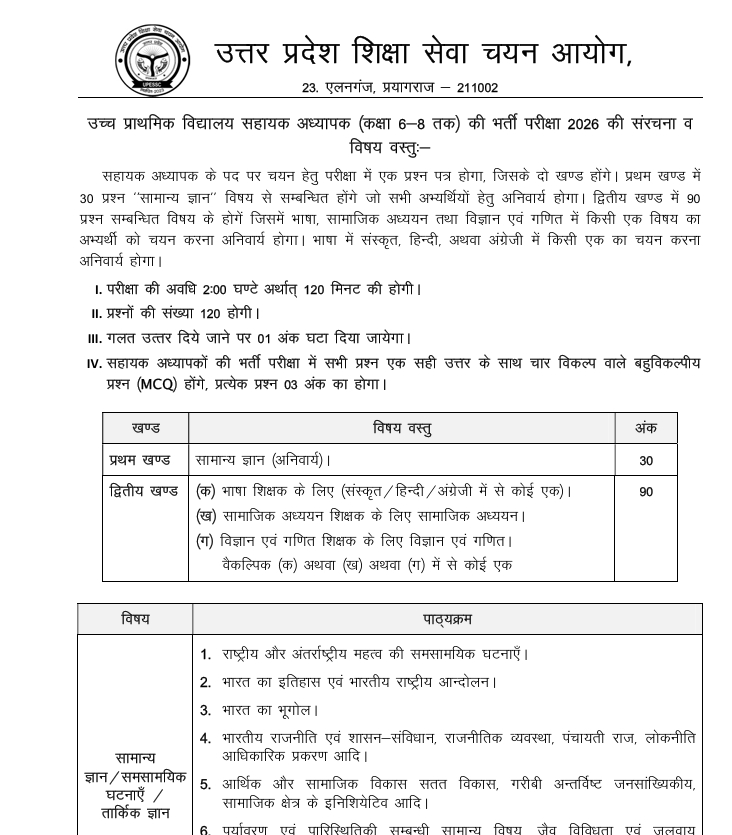
Important Point: Super TET is not merely an eligibility test — it is an actual recruitment examination that determines your final appointment. If you wish to apply for the Upper Primary level (Class 6-8), it is mandatory to have already passed UPTET or CTET Paper-2.
Super TET 2026 Exam Pattern (Class 6-8)
Overall Structure
| Item | Details |
|---|---|
| Total Questions | 120 |
| Total Marks | 360 |
| Question Type | Multiple Choice Questions (MCQ) |
| Exam Duration | 120 minutes (2 hours) |
| Exam Mode | Offline (pen and paper) |
| Language | Hindi and English |
| Marks for Correct Answer | 3 marks |
| Marks Deducted for Wrong Answer | -1 mark |
| Conducting Body | UP Education Service Selection Commission (UPESSC) |
Exam Structure
The Super TET exam is divided into two sections:
Section 1: General Knowledge (30 Questions)
- Mandatory for all candidates
- Covers current affairs, national-international news, awards, and Indian culture
Section 2: Chosen Teaching Subject (90 Questions)
- For Class 6-8, you can choose your subject:
- Hindi/Sanskrit/English
- Science
- Mathematics
- Social Studies
- Etc.
Total = 30 + 90 = 120 Questions
Subject-wise Distribution and Marks for Class 6-8
Detailed Subject-wise Table
| S.No. | Subject | Number of Questions | Total Marks | Weightage % |
|---|---|---|---|---|
| 1. | Language (Hindi, Sanskrit, English) | 30 | 90 | 25.0% |
| 2. | General Knowledge & Current Affairs | 25 | 75 | 20.8% |
| 3. | Mathematics | 16 | 48 | 13.3% |
| 4. | Science | 08 | 24 | 6.7% |
| 5. | Environment & Social Studies | 08 | 24 | 6.7% |
| 6. | Teaching Skills | 08 | 24 | 6.7% |
| 7. | Child Psychology | 08 | 24 | 6.7% |
| 8. | Life Skills, Management & Attitude | 08 | 24 | 6.7% |
| 9. | Logical Reasoning | 05 | 15 | 4.2% |
| 10. | Information Technology (IT) | 04 | 12 | 3.3% |
| Total | 120 | 360 | 100% |
Detailed Subject-wise Syllabus (Class 6-8)
1. Language (Hindi, Sanskrit, English) – 30 Questions (90 Marks)
This is the highest-weightage subject.
Hindi Language
Grammar Topics:
- Noun, pronoun, adjective, verb
- Gender, number, case, tense
- Analysis of predicate relations
- Sentence formation and types of sentences (simple, compound, complex)
- Punctuation marks and their usage
- Figures of speech (Alankar) — Anupras (alliteration), Yamak, Shlesh, Upma (simile), Rupak (metaphor), Utpreksha, Atishayokti (hyperbole)
- Sandhi (conjunction) — vowel sandhi, consonant sandhi, visarga sandhi
- Samas (compound words) — Tatpurush, Dvandva, Bahuvrihi, Avyayibhav samas
Vocabulary:
- Synonyms (Paryayvachi)
- Antonyms (Viparitarthak)
- Idioms and proverbs
- Polysemous words (words with multiple meanings)
Comprehension Topics:
- Comprehension of unseen prose passages
- Comprehension of unseen poetry passages
- Form, merits and demerits of poetry
- Genres of prose (story, essay, drama)
Language Teaching:
- Stages of language development
- Theories of language learning
- Strategies for language teaching in the classroom
- Language skills — listening, speaking, reading, writing
- Teaching language to students from diverse backgrounds
- Understanding language-related disorders
Sanskrit Language
- Fundamentals of Sanskrit grammar
- Sandhi, samas, general vocabulary
- General introduction to Sanskrit literature
- Teaching methods
English Language
- English Grammar (Parts of Speech, Tenses, Sentence Structure)
- Vocabulary and Word Formation
- Reading Comprehension
- Writing Skills
- English Language Teaching Methodology
2. General Knowledge & Current Affairs – 25 Questions (75 Marks)
This is the second most important subject.
National and International News:
- Recent national events
- Important events around the world
- Political developments
- International relations
Important Personalities:
- Important national and international leaders
- Scientists, writers, artists
- Famous personalities from the world of sports
Awards and Honours:
- Bharat Ratna
- Padma awards (Padma Vibhushan, Padma Bhushan, Padma Shri)
- Sahitya Akademi Award
- Nobel Prize
- International awards
Sports:
- Olympic Games
- Cricket and other major sports
- Indian athletes and their achievements
Indian Culture:
- Indian art and architecture
- Indian music and dance
- Festivals and traditions
- Religious sites
Government Schemes:
- Education-related schemes
- Health-related schemes
- Economic schemes
- Women’s welfare schemes
3. Mathematics – 16 Questions (48 Marks)
Arithmetic
- Number systems (natural, whole, integers, rational, irrational numbers)
- Divisibility (multiples, factors, prime numbers, prime factorization)
- Highest Common Factor (HCF) and Least Common Multiple (LCM)
- Decimals and fractions
- Percentage and ratio
- Profit and loss
- Simple and compound interest
- Specific types of problems
Algebra
- Variables, constants, expressions
- Algebraic equations (linear, quadratic)
- Solving equations
- Substitution method, elimination method
- Polynomials
- Numerical and expression-based problems
Geometry
- Basic principles of geometry
- Point, line, ray, line segment
- Angles — definition, types, measurement
- Triangles — properties, types, congruence, similarity
- Circle — radius, diameter, circumference, area
- Quadrilaterals — types and properties
- Pyramid, prism, cylinder, cone, sphere
Mensuration
- Area calculations:
- Area of triangle
- Area of quadrilateral
- Area of circle
- Area of plane figures
- Perimeter calculations
- Volume and surface area
Statistics
- Data collection and presentation
- Mean, median, mode
- Basic principles of probability
- Graphs and charts
Mathematics Teaching
- Methods of teaching mathematics
- Problem-solving skills
- Abstract and concrete representation
- Mathematical reasoning and proof
4. Science – 08 Questions (24 Marks)
Physics
- Motion, force and laws
- Newton’s laws of motion
- Work, power, energy
- Simple machines
- Sound — waves, frequency, wavelength
- Light — reflection, refraction, lenses, mirrors
- Electricity — current, voltage, resistance
- Magnetism
- Heat — temperature, heat transfer
Chemistry
- Matter and its properties
- Elements, compounds, mixtures
- Chemical reactions
- Acids, bases, salts
- Metals and non-metals
- Carbon and its compounds
- Oxygen, hydrogen, nitrogen
- Combustion and oxidation
Biology
- The basic unit of life — the cell
- Heredity and evolution
- Plant physiology
- Animal physiology
- Plant and animal kingdoms
- Nutrition — autotrophic, heterotrophic
- Photosynthesis
- Respiration
Human Body Systems
- Digestive system
- Respiratory system
- Circulatory system
- Nervous system
- Endocrine system
- Reproductive system
- Excretory system
Health and Disease
- Communicable (infectious) diseases
- Non-communicable diseases
- Immunity
- Nutrition and health
- First aid
Science Teaching
- Methods of teaching science
- Experimental and demonstration methods
- Use of microscope
- Safety in the science lab
5. Environment & Social Studies – 08 Questions (24 Marks)
Geography
Geography of India:
- Location, size and boundaries of India
- Climate and monsoon system
- Rainfall distribution
- Indian plateaus, mountain ranges
- Rivers — Ganga, Brahmaputra, Narmada, Yamuna
- Types of soil
- Vegetation and wildlife
- Climatic zones of India
World Geography:
- Continents and oceans
- Geographical features of major countries
- World climate systems
History
Ancient India:
- Indus Valley Civilization
- Vedic period
- Maurya Empire
- Ashoka
- Gupta period
- Religions — Hinduism, Buddhism, Jainism
Medieval India:
- Turkish invasions
- Delhi Sultanate
- Mughal Empire
- Akbar, Shah Jahan
- Kingdoms in the south
Modern India:
- Arrival of Europeans in India
- British East India Company
- Revolt of 1857
- Indian National Movement
- Mahatma Gandhi, Jawaharlal Nehru
- Indian independence struggle
- 15 August 1947
Civics
Indian Constitution:
- Making of the Constitution
- Preamble
- Fundamental Rights (Articles 12-35)
- Fundamental Duties
- Directive Principles of State Policy
Indian Governance:
- President
- Prime Minister
- Council of Ministers
- Parliament (Lok Sabha and Rajya Sabha)
Judiciary:
- Supreme Court
- High Court
- District Court
State Government:
- Governor
- Chief Minister
- Legislative Assembly
- Legislative Council
Local Governance:
- Panchayati Raj
- Municipality
- Mayor
Election Process:
- Indian electoral system
- Voting rights
- Election Commission
Economics
- Production, consumption, distribution
- Market economy
- National income
- Per capita income
- Economic development
- Agriculture, industry, services
- Import-export
- Currency and banking
Environmental Studies
- Ecosystem
- Biodiversity
- Climate change
- Pollution (air, water, soil)
- Conservation of resources
- Renewable and non-renewable resources
- Environmental protection programs
6. Teaching Skills – 08 Questions (24 Marks)
- Modern teaching methods
- Collaborative learning
- Problem-based learning
- Project-based learning
- Classroom management
- Discipline and positive reinforcement
- Student assessment
- Formative and summative assessment
- Use of technology (ICT in education)
- Inclusive classroom
- Working with students from diverse backgrounds
7. Child Psychology – 08 Questions (24 Marks)
Theories of Development
- Meaning, need and scope of child development
- Stages of development:
- Infancy (0-3 years)
- Early childhood (3-6 years)
- Middle childhood (6-12 years)
- Adolescence (12-18 years)
Dimensions of Development
- Physical development
- Mental (cognitive) development
- Emotional development
- Social development
- Moral development
- Language development
Theories of Learning
- Thorndike’s trial-and-error theory
- Pavlov’s classical conditioning
- Skinner’s operant conditioning
- Piaget’s theory of cognitive development
- Sensorimotor stage
- Preoperational stage
- Concrete operational stage
- Formal operational stage
- Vygotsky’s socio-cultural theory
- Bloom’s taxonomy
The Learning Process
- What is learning
- Types of learning
- Meaningful learning
- Cooperative learning
- Problem-solving
- Transfer of learning
Individual Differences
- Intelligence
- Creativity
- Personality
- Aptitude
- Ability
- Different types of intelligence
Children with Special Needs
- Gifted children
- Children with learning difficulties
- Physically disabled children
- Mentally disabled children
- Concept of inclusive education
Adjustment and Problems
- Common childhood problems
- Aggression
- Fear
- Shyness
- Lack of self-confidence
- Counselling and guidance
8. Life Skills, Management & Attitude – 08 Questions (24 Marks)
Life Skills
- Communication skills
- Decision-making ability
- Problem-solving
- Self-awareness
- Emotional intelligence
- Social skills
- Empathy
- Cooperation and teamwork
Management Skills
- Time management
- Resource management
- Classroom management
- Stress management
- Change management
- Leadership skills
Teacher’s Attitude
- Attitude towards the teaching profession
- Sensitivity towards children
- Commitment to equality and inclusion
- Commitment to lifelong learning
- Practicality
- Accountability
- Respect for Indian culture and values
9. Logical Reasoning – 05 Questions (15 Marks)
- Similarities and differences
- Classification
- Series (number series, letter series)
- Relationships
- Ordering/arrangement
- Coding and decoding
- Direction test
- Logical equations
- Analytical reasoning
10. Information Technology (IT) – 04 Questions (12 Marks)
Computer Basics
- What is a computer
- Hardware and software
- Generations of computers
- Input and output devices
Operating Systems
- Windows
- Linux
- Mac OS
- Android
Software Applications
- Word processing (MS Word)
- Spreadsheet (MS Excel)
- Presentation (MS PowerPoint)
- Database
Internet and Online Safety
- Introduction to the internet
- Web browsing
- Cyber security
- Data security
- Password management
ICT in Education
- E-learning
- Digital resources
- Online classes
- Use of technology in education
- Use of multimedia
- Teaching software
Important Preparation Tips for Class 6-8
1. Organizing Subject-wise Study Material
High-priority subjects (60% of total time):
- Language (30 questions)
- General Knowledge (25 questions)
- Mathematics (16 questions)
Medium priority (25% of total time):
- Science (08 questions)
- Teaching Skills (08 questions)
- Child Psychology (08 questions)
Lower priority (15% of total time):
- Life Skills (08 questions)
- Logical Reasoning (05 questions)
- Information Technology (04 questions)
2. Time Management
- Total time: 120 minutes
- Time per question: approximately 60 seconds
- Section 1 (General Knowledge): 30 minutes
- Section 2 (Teaching Subject): 90 minutes
3. Study Strategy
Phase One — Foundation Building (3-4 months)
- Understand the core concepts of each subject
- Read NCERT textbooks (Class 6-8 and Class 11-12)
- Prepare notes
Phase Two — In-depth Study (2-3 months)
- Deep study of specific subjects
- Practice questions
- Solve previous exam papers
Phase Three — Revision and Mock Tests (1-2 months)
- Take full-length mock tests
- Practice time management
- Focus on weak areas
4. Preparing General Knowledge
Daily Study:
- Read newspapers (15-20 minutes)
- Use current affairs apps
- Note down important events
Weekly Review:
- Summarize the week’s important events
- Remember awards and honours
- Note sports news
5. Preparing Language
Grammar:
- Understand the rules, don’t just memorize them
- Practice one or two exercises daily
- Learn from mistakes
Vocabulary:
- Learn 5-10 new words daily
- Use them in sentences
- Build a set of synonyms and antonyms
Comprehension:
- Regularly read unseen passages
- Practice by writing answers to questions
Important Points Before the Exam
Check Your Eligibility
- Have you passed UPTET Paper-2 or CTET Paper-2?
- Do you have a graduate degree?
- Have you completed D.El.Ed or B.Ed?
Follow Official Notifications
- Check www.updeled.gov.in regularly
- Obtain the official UPESSC notification
- Don’t miss the application deadline
On Exam Day
- Keep your documents ready
- Arrive at the exam center on time
- Try to attempt all 120 questions
- Don’t make errors due to haste
Selection Process
Final Merit
The result is calculated based on:
- Written exam: 60% weightage
- Academic qualifications: 40% weightage
- High school marks
- Intermediate marks
- Graduation marks
- D.El.Ed/B.Ed marks
Reservation Policy
- General category: 45% minimum marks
- OBC: 45% minimum marks
- SC/ST: 40% minimum marks
- EWS: 45% minimum marks
Reservation Distribution
- SC: 21%
- ST: 2%
- OBC: 27%
- EWS: 10%
- PwD: 4% (horizontal reservation)
Difference Between Class 1-5 and Class 6-8
| Aspect | Class 1-5 | Class 6-8 |
|---|---|---|
| Level | Primary | Upper Primary |
| Language | Basic | Advanced |
| Mathematics | Basic operations | Algebra, Geometry |
| Science | Environmental Studies | Detailed Science |
| Social Studies | Basic geography | History, Geography, Civics |
| Teaching Method | Play-based | Activity-centered |
Mock Test Papers 05
| Super TET New Exam Pattern Mock Test Papers 01 | Click Here |
| Super TET New Exam Pattern Mock Test Papers 02 | Click Here |
| Super TET New Exam Pattern Mock Test Papers 03 | Click Here |
| Super TET New Exam Pattern Mock Test Papers 04 | Click Here |
| Super TET New Exam Pattern Mock Test Papers 05 | Click Here |
Official Resources and Download Links
| Official Super TET 1-5 Primary | Click Here |
| Official Super TET 6-8 Upper – Primary | Click Here |
| Official Site | Click Here |
| Home Page | Click Here |