If you’re preparing for the Super TET exam for Primary Assistant Teacher posts in Uttar Pradesh, you’ve probably already collected a stack of PDFs, YouTube playlists, and WhatsApp-forwarded “important questions” files. But here’s the honest truth most toppers will tell you: reading notes and solving practice sets are two completely different skills, and it’s the second one that actually decides your score on exam day. This guide breaks down what a good Primary Super TET practice set should look like, how to use one properly, and where to find reliable resources without wasting your limited prep time.
What Is the Super TET Exam, Exactly?
Super TET, formally the Uttar Pradesh Assistant Teacher Recruitment Exam, is the gateway exam for candidates who want to teach classes 1 to 5 in UP’s government primary schools. It’s conducted offline in objective format, and only candidates who’ve already cleared UPTET or CTET are eligible to sit for it. For the Assistant Teacher post, the paper typically runs to 150 questions, while candidates applying for Principal-level posts face a slightly longer 200-question paper. Given how competitive this exam gets every cycle, simply knowing the syllabus isn’t enough you need repeated, structured practice under exam-like conditions to actually perform well when it counts.
Why Practice Sets Matter More Than You Think
A lot of candidates fall into the trap of over-consuming theory and under-practicing application. You can read child development and pedagogy notes ten times over, but if you haven’t actually sat down and answered 150 questions in the allotted time, you won’t know how your preparation holds up under real exam pressure.
A well-designed practice set does three things that passive reading simply can’t:
It reveals your actual weak areas. You might feel confident about Environmental Studies until a practice set shows you’re consistently missing questions on specific NCERT-based concepts.
It builds your speed and time management. Super TET rewards candidates who can move through questions efficiently without getting stuck. Practice sets, especially timed ones, train this instinct.
It familiarizes you with the real question style. UP’s exam-setting pattern has its own flavor a certain phrasing style, a certain difficulty curve and previous years’ papers combined with well-modeled practice sets are the closest thing you’ll get to a preview of the actual exam.
What a Good Primary Super TET Practice Set Should Cover
The Super TET syllabus for Primary Assistant Teachers is broadly divided into five sections, and a genuinely useful practice set should give you proportionate coverage across all of them rather than skewing heavily toward one or two “easy” areas:
Child Development and Pedagogy This section tests your understanding of how children learn, developmental psychology, inclusive education, and teaching methodology. It’s conceptually heavy and benefits enormously from scenario-based practice questions, not just definitions.
Language I and Language II (Hindi and English/Urdu/Sanskrit) Grammar, comprehension, and language pedagogy. Practice sets here should include passage-based comprehension questions, not just isolated grammar rules, since that’s closer to what the actual exam tests.
Mathematics — Arithmetic, geometry, and math pedagogy for primary-level teaching. This is one of the highest-scoring sections if you practice consistently, since the concepts, once mastered, don’t really change.
Environmental Studies (EVS) — A mix of science, social studies, and general environmental awareness aimed at primary-level teaching content.
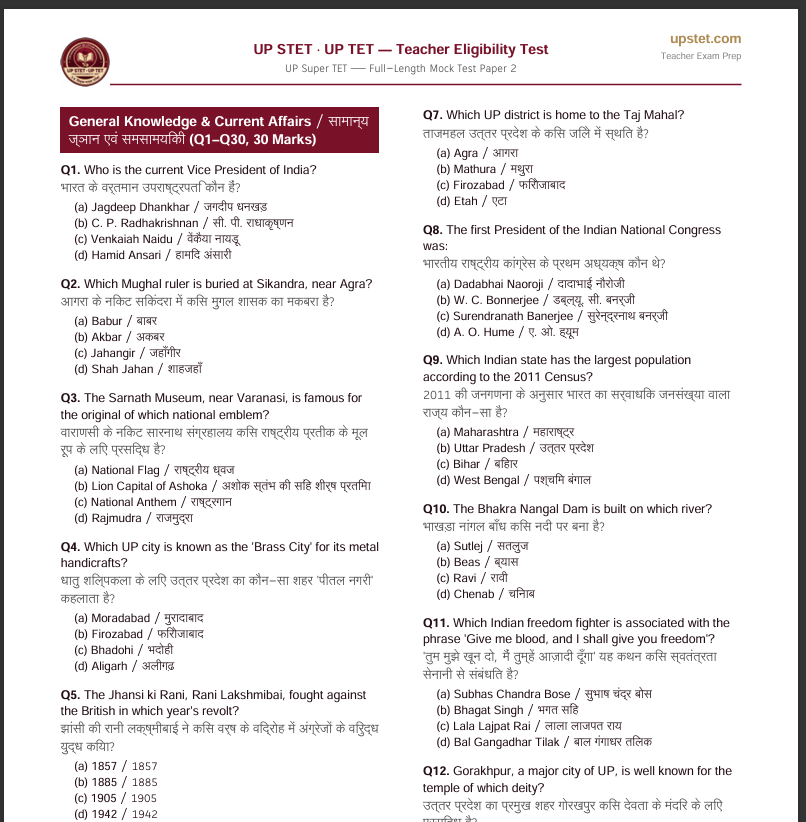
General Knowledge and Current Affairs — Often underestimated, but a meaningful chunk of marks comes from here, especially UP-specific current affairs.
If a practice set you’re using skips or under-weighs any of these five areas, it’s not giving you a realistic picture of exam-day difficulty.
How to Actually Use a Practice Set (Most People Do This Wrong)
Simply solving a practice set and checking your score isn’t enough. Here’s a more effective approach:
Solve it strictly timed, exactly as you would in the real exam no pausing, no looking things up mid-attempt. This is the only way to genuinely test your speed and stamina.
Review every wrong answer, not just the ones you got right. Understanding why an answer is correct matters far more than confirming what you already knew.
Track your section-wise performance across multiple practice sets, not just one. A single test can be misleading patterns across five or six attempts tell you where your real gaps are.
Revisit previous years’ actual question papers alongside fresh practice sets. Previous year papers show you the real difficulty and phrasing style the commission uses; practice sets from coaching institutes are useful for volume, but the actual papers are your most authentic benchmark.
Space your practice sets out over your prep schedule rather than solving twenty of them in the final week. Spaced practice retains better than cramming, especially for a fact-heavy exam like this.
A Simple Weekly Practice Rhythm
If you’re not sure how to structure your practice sets into your existing study routine, a reasonably balanced approach looks like this: two to three full-length timed practice sets per week during your core preparation phase, ramping up to one every alternate day in the final month before the exam. Mix full-length sets with occasional section-wise sets when you know a specific area say, Mathematics or EVS needs isolated attention.
Don’t neglect revision between practice sets either. A practice set without a proper review session afterward is only half as useful as it should be.
Choosing Reliable Practice Set Resources
With so many PDFs and books floating around, it’s worth being selective. Look for practice sets that are explicitly aligned with the current, most recent syllabus and pattern, ideally ones that reference actual previous year Super TET papers (2018, 2019, and more recent cycles) as their foundation rather than generic recycled question banks. Books and platforms that clearly state their analytical basis showing trends from real past papers tend to be more reliable than unattributed PDF forwards circulating on social media.
Passing Super TET isn’t just about how much you’ve studied it’s about how well you can apply what you’ve studied under real exam conditions. A disciplined practice set routine, reviewed honestly and repeated consistently, is what closes the gap between “I’ve covered the syllabus” and “I can actually clear the cutoff.” Treat your practice sets as diagnostic tools, not just score trackers, and let them guide where your remaining preparation time actually goes.
Primary Super TET Practice Set PDF 2026
| Super TET New Exam Pattern Mock Test Papers 01 | Click Here |
| Super TET New Exam Pattern Mock Test Papers 02 | Click Here |
| Super TET New Exam Pattern Mock Test Papers 03 | Click Here |
| Super TET New Exam Pattern Mock Test Papers 04 | Click Here |
| Super TET New Exam Pattern Mock Test Papers 05 | Click Here |