Ask any candidate who’s actually cleared Super TET what made the real difference in their preparation, and you’ll rarely hear “I read every textbook cover to cover.” What you’ll hear, almost every time, is some version of: “I solved as many previous year papers as I could get my hands on.” There’s a reason for that — and it’s not just exam superstition.
Super TET (the exam that recruits Assistant Teachers for Uttar Pradesh’s primary and upper primary government schools) has a fairly consistent question style year over year, even when the specific topics shift. Previous year papers are, quite simply, the closest thing you’ll get to a preview of what the actual exam feels like under time pressure. This article walks through why they matter, how to use them properly, and what the exam pattern looks like so your practice sessions actually mean something.
What Is Super TET, Quickly
Super TET is conducted by the Uttar Pradesh Basic Education Board (UPBEB) to recruit Assistant Teachers for classes 1 to 5 (and in some cycles, extending toward upper primary levels) in UP’s government schools. It’s a mandatory second-stage exam for candidates who’ve already cleared UPTET or CTET — think of UPTET as your eligibility certificate, and Super TET as the actual competitive recruitment exam that gets you the job.
Because it’s a genuinely competitive, high-stakes exam with lakhs of applicants chasing a limited number of seats, the margin between clearing and missing out often comes down to fractions of a mark. That’s exactly the kind of exam where solved-paper practice pays off disproportionately.
Why Previous Year Papers Matter More Than Generic Practice Sets
It’s tempting to treat “previous year papers” and “mock tests” as interchangeable. They’re not, and the difference matters:
- They reveal the commission’s actual question style, not a coaching institute’s guess at it. Every exam-setting body has quirks — how they phrase Child Development questions, how numerical Math problems are structured, which Environmental Studies topics get repeated. You only learn these patterns from the real thing.
- They show you genuine difficulty calibration. Mock tests can run easier or harder than the actual paper. Previous year papers are the actual paper — no guessing involved.
- They expose recurring topics. If a particular Pedagogy concept or a specific type of EVS question has shown up across multiple past cycles, that’s a strong signal it’s worth mastering, not a coincidence to ignore.
- They train your timing instincts. With 150 objective questions to attempt in a tightly bound window, knowing roughly how long a “typical” question of each type takes you is something only repeated practice on real papers can teach.
- They build genuine exam-day composure. The first time you see the real paper shouldn’t be on exam day. If you’ve already sat through several previous papers under timed conditions, the actual exam feels familiar rather than intimidating.
Super TET Exam Pattern: What You’re Practicing For
Before diving into old papers, it helps to be clear on the current structure so your practice sessions are calibrated correctly:
- Mode: Offline, pen-and-paper (OMR-based)
- Question Type: Multiple Choice Questions (MCQs), objective format
- Total Questions: 150
- Paper Structure: Paper I carries 150 marks; where applicable, Paper II carries 50 marks
- Duration: Approximately 2 hours to 2 hours 30 minutes, depending on the specific cycle’s notification
- Subjects Covered: Hindi, English, Sanskrit (Language sections), Mathematics, Science, Environmental & Social Studies, Teaching Methodology, Child Psychology, General Knowledge/Current Affairs, Reasoning/Logical Ability, and Information Technology
Since exact marks distribution and section-wise weightage can shift slightly between recruitment cycles, always cross-verify against the latest official notification before finalizing your practice plan — treat the pattern above as a reliable general framework rather than a locked-in guarantee for every cycle.
How to Actually Use Previous Year Papers (Not Just Skim Them)
Downloading a stack of PDFs and glancing through the questions is the least effective way to use this resource. Here’s a more disciplined approach that actually moves your preparation forward:
- Simulate real exam conditions. Set a timer for the actual duration, sit through the full paper without interruptions, and resist the urge to check answers mid-attempt. The value of a previous year paper drops sharply the moment you turn it into an open-book exercise.
- Score yourself honestly, then analyze — don’t just check right or wrong. For every question you got wrong, ask why: was it a knowledge gap, a silly calculation error, a misread question, or a time-pressure mistake? Each of these needs a different fix.
- Track recurring topics across multiple years. Keep a running note of topics that show up repeatedly — certain Pedagogy themes, specific EVS chapters, particular grammar rules in Hindi or English. These deserve extra revision time precisely because they’re not one-off appearances.
- Solve in Hindi if that’s your exam medium. Many candidates practice in English out of habit even though they’ll attempt the actual exam in Hindi. Practicing in your actual exam language matters more than it seems — it affects both comprehension speed and how comfortable you feel reading dense questions under pressure.
- Revisit the same paper a second time after a gap. A few weeks after your first attempt, redo the same paper without looking at your previous answers. If your accuracy has genuinely improved, that’s a good sign your revision is sticking; if not, that topic needs another pass.
- Don’t stop at just the current cycle’s format. Even papers from earlier recruitment drives (like the 68500 and 69000 Assistant Teacher cycles) remain useful for building subject familiarity and question-style intuition, even where the exact pattern has since evolved.
A Realistic Study Plan Using Past Papers
If you’re wondering how to actually slot this into your weekly routine, here’s a simple structure many successful candidates follow:
- Early preparation phase: Solve one previous year paper per week, focused purely on identifying knowledge gaps subject by subject — don’t worry about timing yet.
- Mid preparation phase: Increase to two to three papers per week, now under strict timed conditions, and start tracking your accuracy trend across attempts.
- Final few weeks before the exam: Solve a paper every one to two days, prioritizing full-length, timed, exam-condition attempts to build stamina and reduce exam-day anxiety.
Throughout all three phases, keep a single running document of “topics I keep getting wrong” — this becomes your most valuable revision tool in the final stretch, far more targeted than re-reading entire textbooks from scratch.
A Word of Caution on Where You Download Papers From
Not every “previous year paper” floating around online is what it claims to be. A few sensible precautions:
- Cross-check that the paper’s marking scheme and question count actually match the year it claims to be from — mismatched or mislabeled PDFs circulate more often than you’d expect.
- Prefer sources that provide papers with verified answer keys rather than unsolved question dumps with no way to check your accuracy.
- If a “previous year paper” looks suspiciously similar to a generic mock test with UP-specific details bolted on, treat it with skepticism — genuine past papers tend to have UP Board-specific phrasing and topic emphasis that’s hard to fake convincingly.
Final Thoughts
Previous year papers aren’t a supplementary resource for Super TET preparation — for most successful candidates, they’re the backbone of it. Textbooks teach you the subject; past papers teach you the exam. The two are related but not the same thing, and candidates who only do the former often walk into the exam hall knowing the syllabus well but still getting caught off guard by the actual question style, timing pressure, or phrasing quirks that only real papers reveal.
Build a disciplined routine around solving, timing, and honestly analyzing past papers rather than passively reading through them, and you’ll walk in on exam day with something more valuable than last-minute revision — genuine familiarity.
Frequently Asked Questions
Q: How many previous year papers should I solve before the exam?
There’s no fixed magic number, but candidates who clear competitive exams like Super TET typically solve papers consistently over months rather than cramming a handful in the final week — quality of analysis matters more than raw quantity.
Q: Are older papers (like the 68500/69000 cycles) still useful?
Yes, for building subject familiarity and understanding question style, even though the exact exam pattern has evolved somewhat since those cycles.
Q: Should I solve papers in Hindi or English?
Solve in whichever language you’ll actually attempt the real exam in — practicing in a different language than your exam medium reduces the real-world value of the exercise.
Q: Where can I find the official, verified papers?
The most reliable source is always the official UPBEB website, supplemented by well-established educational platforms that provide answer keys alongside the papers.
Useful Links & Resources
For downloading previous year papers, checking exam updates, and verifying details directly from primary sources, the following are worth bookmarking.
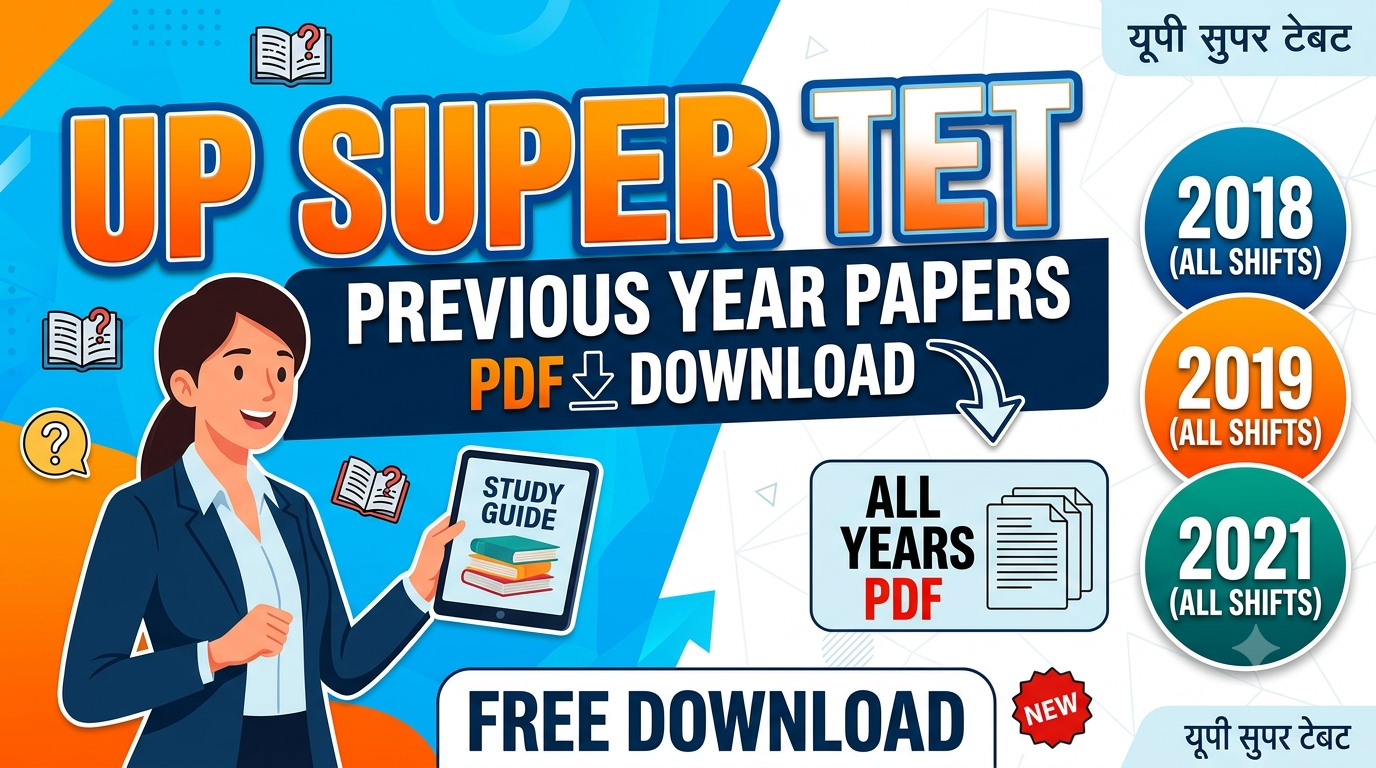
| Papers | Link |
| UP STET Question Paper 2018 | Click Here |
| UP STET Question Paper 2019 | Click Here |
| UP STET Question Paper 2021 | Click Here |
| UP TET Answer Key 2026 | Click Here |
| Home Page | Click here |